
Penny Dreadfuls, 1857 · page 59 of 394
Agnes, or, Beauty and Pleasure — page 59: what you’re looking at
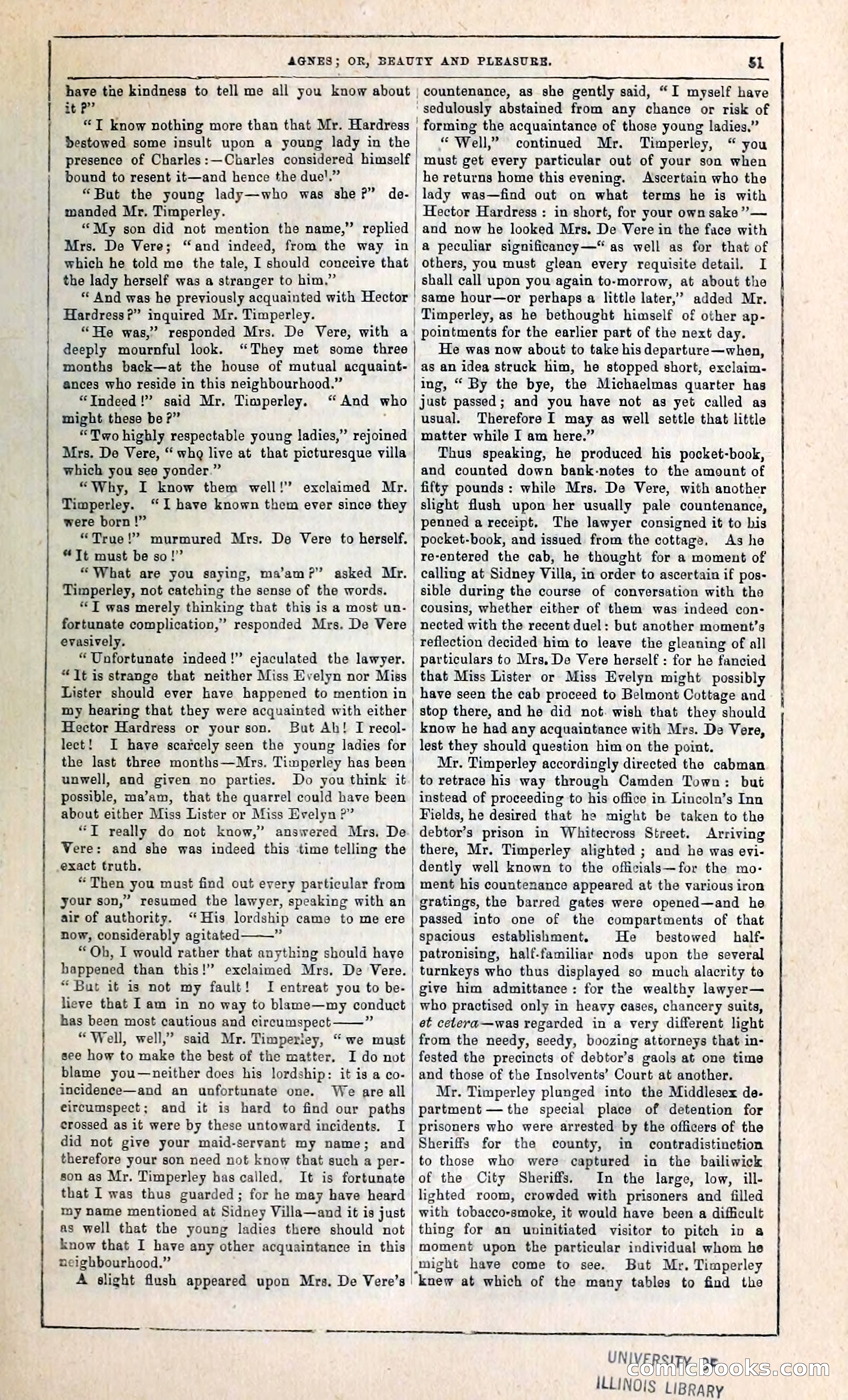
A restored page from Penny Dreadfuls, 1857. Page through the whole issue in the reader above.
📄 Transcribed text from this page (OCR, searchable)
Machine-transcribed from the original scan — historical spelling and the odd misread are preserved.
AGNES; OR, BEAUTY AND PLEASURE, haye the kindness to tell me all you know about | -sedulously abstained from any chance or risk of it P’ “T know nothing more than that Mr. Hardress destowed some insult upon a young lady in the presence of Charles:—Charles considered himself bound to resent it—and hence the due!.” “But the young lady—who was she?” de- manded Mr. Timperley. “My son did not mention the name,” Mrs. De Vere; which he told me the tale, I should conceive that the lady herself was a stranger to him,” ** And was he previously acquainted with Hector Hardress?” inquired Mr. Timperley. replied ‘and indeed, from the way in| $1 countenance, as she gently said, “I myself have forming the acquaintance of those young ladies,” “ Well,” continued Mr. Timperley, “ you must get every particular out of your son when he returns home this evening. Ascertain who the lady was—find out on what terms he is with Hector Hardress : in short, for your own sake ”— and now he looked Mrs. De Vere in the face with a peculiar significancy—“ as well as for that of others, you must glean every requisite detail. I shall call upon you again to-morrow, at about the same hour—or perhaps a little later,” added Mr. | Timperley, as he bethought himself of other ap- “He was,” responded Mrs. De Vere, with a’ pointments for the earlier part of the next day. deeply mournful look. “They met some three He was now about to take his departure—when, months back—at the house of mutual acquaint- | as an idea struck him, he stopped short, exclaim- | ing, “ By the bye, the Michaelmas quarter has ances who reside in this neighbourhood.” “Indeed!” said Mr, Timperley. might these be ?” *“Two highly respectable young ladies,’ Mrs. De Vere, “ whg live at that picturesque villa which you see yonder.” “Why, I know them well!’ exclaimed Mr. Timperley. “I have known them ever since they were born!” “True!” murmured Mrs. De Vere to herself. “Tt must be so!” “What are you saying, ma’am?P” asked Mr. Timperley, not catching the sense of the words. “IT was merely thinking that this is a most un- fortunate complication,’ responded Mrs. De Vere evasively. “Unfortunate indeed!” ejaculated the lawyer. “lt is strange that neither Miss Evelyn nor Miss Lister should ever have happened to mention in my hearing that they were acquainted with either Hector Hardress or your son. But Ah! I recol- lect! I have scarcely seen the young ladies for the last three months—Mrs. Timperley has been unwell, and given no parties. Do you think it possible, ma’am, that the quarrel could have been about either Miss Lister or Miss Evelyn ?” “T really do not know,’ answered Mrs. De Vere: and she was indeed this time telling the exact truth. “Then you must find out every particular from your son,” air of authority. now, considerably agitated * Oh, I would rather that anything should have happened than this!” exclaimed Mrs. De Vere. “But it is not my fault! I entreat you to be- lieve that Tam in no way to blame—my conduct has been most cautious and circumspect ——” “Well, well,” said Mr. Timperiey, “we must see how to make the best of the matter. I do not blame you—neither does his lordship: it is a co- incidence—and an unfortunate one. We are all circumspect; and it is hard to find our paths crossed as it were by these untoward incidents. I did not give your maid-servant my name; and therefore your son need not know that such a per- son as Mr. Timperley has called. It is fortunate that I was thus guarded; for he may have heard my name mentioned at Sidney Villa—and it is just as well that the young ladies there should not ‘His lordship came to me ere know that I have any other acquaintance in this | neighbourhood.” A slight flush appeared upon Mrs. De Vere’s resumed the lawyer, speaking with an | | fifty pounds : “And who just passed; and you have not as yet called as usual. Therefore I may as well settle that little * rejoined matter while I am here.” Thus speaking, he produced his pocket-book, and counted down bank-notes to the amount of while Mrs. De Vere, with another slight flush upon her usually pale countenance, penned a receipt. The lawyer consigned it to his pocket-book, and issued from the cottage. As he re-entered the cab, he thought for a moment of _ calling at Sidney Villa, in order to ascertain if pos- sible during the course of conversation with the cousins, whether either of them was indeed con- _to retrace his way through Camden Town: instead of proceeding to his office in Lincoln’s Inn nected with the recent duel: but another moment’s reflection decided him to leave the gleaning of all particulars to Mrs, De Vere herself : for he fancied that Miss Lister or Miss Evelyn might possibly have seen the cab proceed to Belmont Cottage and stop there, and he did not. wish that they should know he had any acquaintance with Mrs. De Vere, lest they should question him on the point. Mr. Timperley accordingly directed the cabman but Fields, he desired that he might be taken to the debtor’s prison in Whitecross Street. Arriving there, Mr. Timperley alighted ; and he was evi- dently well known to the officials—for the mo- ment his countenance appeared at the various iron gratings, the barred gates were opened—and he passed into one of the compartments of that spacious establishment. He bestowed half- patronising, half-familiar nods upon the several turnkeys who thus displayed so much alacrity to give him admittance: for the wealthy lawyer— who practised only in heavy cases, chancery suits, et celera—was regarded in a very different light from the needy, seedy, boozing attorneys that in- fested the precincts of debtor’s gaols at one time and those of the Insolvents’ Court at another. Mr. Timperley plunged into the Middlesex de- partment — the special place of detention for prisoners who were arrested by the officers of the Sheriffs for the county, im contradistinction to those who were captured in the bailiwick of the City Sheriffs. In the large, low, ill- lighted room, crowded with prisoners and filled with tobacco-smoke, it would have been a difficult thing for an uninitiated visitor to pitch in a moment upon the particular individual whom he _might have come to see. But Mr. Timperley ‘knew at which of the many tables to find the a COnLIGDOOkS ILLINOIS LIBRARY