
Penny Dreadfuls, 1857 · page 63 of 394
Agnes, or, Beauty and Pleasure — page 63: what you’re looking at
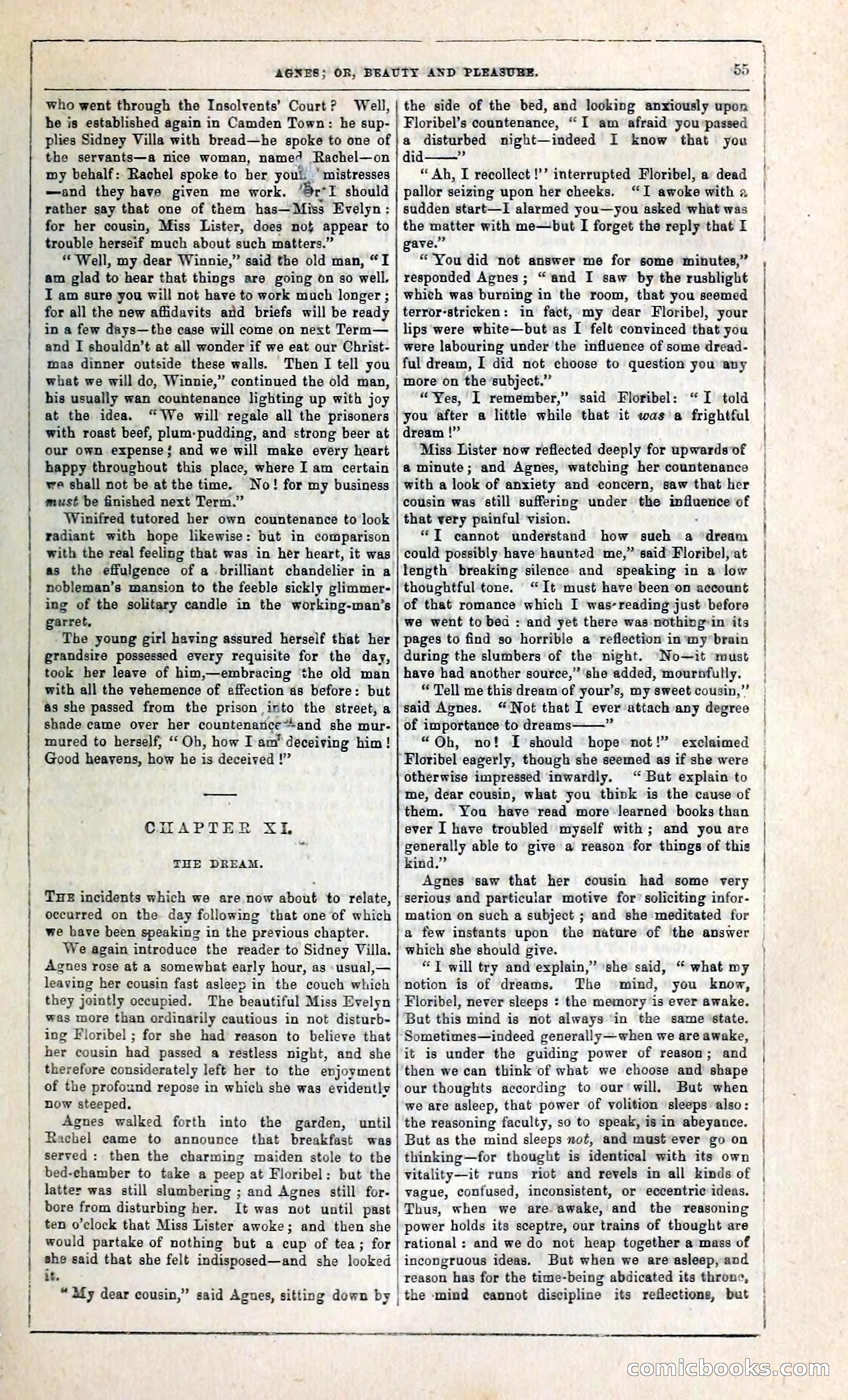
A restored page from Penny Dreadfuls, 1857. Page through the whole issue in the reader above.
📄 Transcribed text from this page (OCR, searchable)
Machine-transcribed from the original scan — historical spelling and the odd misread are preserved.
rm es a eC who went through the Insolvents’ Court? Well, he is established again in Camden Town: he sup- plies Sidney Villa with bread—he spoke to one of the servants—a nice woman, named Rachel—on my behalf: Rachel spoke to her youl “mistresses —and they have given me work. “rl should rather say that one of them has—Miss Evelyn: for her cousin, Miss Lister, does nof appear to trouble herseif much about such matters.” “Well, my dear Winnie,” said the old man, “I am glad to hear that things are going on so well. I am sure you will not have to work much longer ; for all the new affidavits ard briefs will be ready in a few days—the case will come on next Term— and I shouldn’t at all wonder if we eat our Christ- mas dinner outside these walls. Then I tell you what we will do, Winnie,” continued the old man, his usually wan countenance lighting up with joy at the idea. “We will regale all the prisoners with roast beef, plum-pudding, and strong beer at our own expense; and we will make every heart happy throughout this place, where I am certain we shall not be atthe time. No! for my business must be finished next Term.” Winifred tutored her own countenance to look radiant with hope likewise: but in comparison with the real feeling that was in her heart, it was as the effulgence of a brilliant chandelier in a nobleman’s mansion to the feeble sickly glimmer- ing of the solitary candle in the working-man’s garret, ~The young girl having assured herself that her grandsire possessed every requisite for the day, took her leave of him,—embracing the old man with all the vehemence of effection as before: but 4s she passed from the prison into the street, a shade came over her countenance “and she mur- mured to herself, ‘Oh, how I am* deceiving him! Good heavens, how he 2 deceived !”” — CHAPTER XI. THE DREAM. THE incidents which we are now about to relate, occurred on the day following that one of which we have been speaking in the previous chapter. We again introduce the reader to Sidney Villa. Agnes rose at a somewhat early hour, as ‘ usual,— leaving her cousin fast asleep in the couch which they jointly oceupied. The beautiful Miss Evelyn was more than ordinarily cautious in not disturb- ing Floribel ; for she had reason to believe that her cousin had passed a restless night, and she therefore considerately left her to the enjoyment of the profound repose in which she was evidently now steeped. Agnes walked forth into the garden, until Rachel eame to announce that breakfast was served: then the charming maiden stole to the bed-chamber to take a peep at Floribel: but the latter was still slumbering ; and Agnes still for- bore from disturbing her. It was not until past ten o’clock that Miss Lister awoke; and then she would partake of nothing but a cup of tea; for she said that she felt indisposed—and she looked it. “ My dear cousin,” said Agnes, sitting down by = ————— -—— --— AGNES; OR, BEAUTY AND PLEASURE. 5D the side of the bed, and looking anxiously upon Floribel’s countenance, “I am afraid you passed a disturbed night—indeed I know that you did———” * Ah, I recollect !’’ interrupted Floribel, a dead pallor seizing upon her cheeks. “I awoke with a sudden start—I alarmed you—you asked what was the matter with me—but I forget the reply that I ve.” “You did not answer me for some minutes,” responded Agnes; “and I saw by the rushlight whith was burning in the room, that you seemed terror-stricken: in fact, my dear Floribel, your lips ‘were white—but as I felt convinced that you were labouring under the influence of some dread- ful dream, I did not choose to question you any more on the subject.” “Yes, I remember,” said Floribel: “I told you after a little while that it was'a frightful dream !” Miss Lister now reflected deeply for upwards of a minute; and Agnes, watching her countenance with a look of anxiety and concern, saw that her cousin was still suffering under the influence of that very painful vision. *T cannot understand how sueh a .edeouen could possibly have haunted me,” said Floribel, at length breaking silence and speaking in a low thoughtful tone. “It must have been on account of that romance which I was-reading just before we went to bed : and yet there was nothing» in its pages to find so horrible a reflection in my’ brain during the slumbers of the night. “No—it must have had another source,” she added, mournfully. “ Tell me this dream of your’s, my sweet cousin,”’ said Avnes. “Not that I ever attach any degree of importance to dreams # “Qh, no! [I should hope not!” exclaimed Floribel eagerly, though she seemed as if she were otherwise impressed inwardly. “But explain to me, dear cousin, what you think is the cause of them. You have read more learned books than ever I have troubled myself with; and you are generally able to give a reason for things of thie kind.” Agnes saw that her cousin had some very serious and particular motive for’ soliciting infor- mation on such a subject ; and she meditated for a few instants upon the nature of ‘the answer which she should give. *T will try and explain,” she said, “ what my notion is of dreams, The mind, you know, Floribel, never sleeps : the memory is ever awake. But this mind is not always ‘in the same ‘state. Sometimes—indeed generally—when we are awake, it is under the guiding power of reason; and then we can think of what we choose and shape our thoughts according to our will. But when we are asleep, that power of volition sleeps also: the reasoning faculty, so to speak, is in abeyance. But as the mind sleeps not, and must ever go on thinking—for thought is identical with its own vitality—it runs riot and revels in all kinds of vague, confused, inconsistent, or eccentric ideas. Thus, when we are awake, and the reasoning power holds its sceptre, our trains of thought are rational: and we do not heap together a mass of incongruous ideas. But when we are asleep, and | reason has for the time-being abdicated its throne, | the mind cannot discipline its reflections, but Conn Ghbook (Co)