
Penny Dreadfuls, 1857 · page 74 of 394
Agnes, or, Beauty and Pleasure — page 74: what you’re looking at
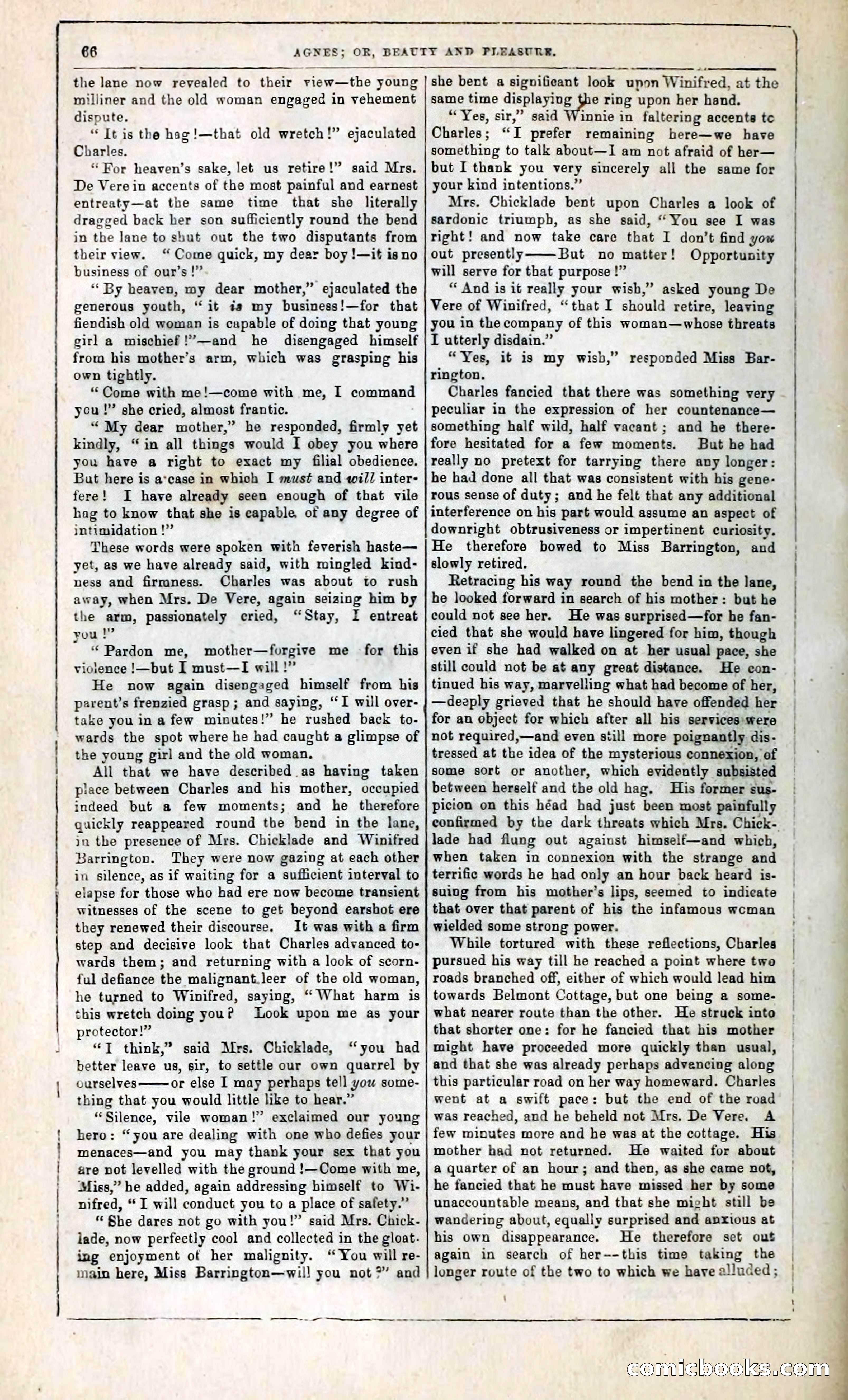
A restored page from Penny Dreadfuls, 1857. Page through the whole issue in the reader above.
📄 Transcribed text from this page (OCR, searchable)
Machine-transcribed from the original scan — historical spelling and the odd misread are preserved.
a eT ee ee ee a ee ce oe 66 AGNES; OR, BEAUTY AND PLEASURE. the lane now revealed to their view—the young milliner and the old woman engaged in vehement dispute. “It is the hs¢!—that old wretch!” ejaculated Charles. “For heaven’s sake, let us retire!” said Mrs. De Verein accents of the most painful and earnest entreaty—at the same time that she literally dragged back her son sufficiently round the bend in the Jane to shut out the two disputants from their view. “ Come quick, my deer boy !—it isno business of our’s !” “By heaven, my dear mother,” ejaculated the generous youth, “it ¢s my business!—for that fiendish old woman is capable of doing that young girl a mischief !’—and he disengaged himself from his mother’s arm, which was grasping his own tightly. ““Come with me!—come with me, I command you!” she cried, almost frantic. “My dear mother,” he responded, firmly yet kindly, “in all things would I obey you where you have a right to exact my filial obedience. But here is a*case in which I must and will inter- fere! I have already seen enough of that vile hag to know that she is capable, of any degree of intimidation !” These words were spoken with feverish haste— yet, as we have already said, with mingled kind- ness and firmness. Charles was about to rush away, when Mrs. De Vere, again seizing him by the arm, passionately cried, “Stay, I entreat you ?” " “ Pardon me, mother—forgive me for this violence !—but I must—I will!” He now again disengaged himself from his parent’s frenzied grasp; and saying, “I will over- take you ina few minutes!” he rushed back to- wards the spot where he had caught a glimpse of the young girl and the old woman. All that we have described as having taken piace between Charles and his mother, occupied indeed but a few moments; and he therefore quickly reappeared round the bend in the lane, in the presence of Mrs. Chicklade and Winifred Barrington. They were now gazing at each other in silence, as if waiting for a suflicient interval to elapse for those who had ere now become transient witnesses of the scene to get beyond earshot ere they renewed their discourse. It was with a firm step and decisive look that Charles advanced to- wards them; and returning with a look of scorn- ful defiance the malignant.leer of the old woman, he turned to Winifred, saying, “ What harm is this wretch doing you? Look upon me as your protector!” “T think,” said Mrs. Chicklade, “you had better leave us, sir, to settle our own quarrel by ourselves or else I may perhaps tell you some- thing that you would little like to hear.” ‘Silence, vile woman!” exclaimed our young hero: “you are dealing with one who defies your menaces—and you may thank your sex that you are not levelled with the ground !—Come with me, Mies,” he added, again addressing himself to Wi. nifred, “ I will conduct you to a place of safety.” “She dares not go with you!” said Mrs. Chick- lade, now perfectly cool and collected in the gloat- ing enjoyment of her malignity. “You will re- main here, Miss Barrington—wil! you not?’ and —— — she bent a significant look upon Winifred, at the same time displaying the ring upon her hand. “Yes, sir,” said Winnie in faltering accents te Charles; “I prefer remaining here—we have something to talk about—I am not afraid of her— but I thank you very sincerely all the same for your kind intentions.” Mrs. Chicklade bent upon Charles a look of sardonic triumph, as she said, “You see I was right! and now take care that I don’t find you out presently But no matter! Opportunity will serve for that purpose !” “And is it really your wish,” asked young De Vere of Winifred, “that I should retire, leaving you in the company of this woman—whose threats I utterly disdain.” “Yes, it is my wish,” responded Miss Bar- rington. Charles fancied that there was something very peculiar in the expression of her countenance— something half wild, half vacant; and he there- fore hesitated for a few moments. But he had really no pretext for tarrying there any longer: he had done all that was consistent with his gene- rous sense of duty; and he felt that any additional interference on his part would assume an aspect of downright obtrusiveness or impertinent curiosity. He therefore bowed to Miss Barrington, and slowly retired. Retracing his way round the bend in the lane, he looked forward in search of his mother: but he could not see her. He was surprised—for he fan- cied that she would have lingered for him, though even if she had walked on at her usual pace, she still could not be at any great distance. He con- tinued his way, marvelling what had become of her, —deeply grieved that he should have offended her for an object for which after all his services were not required,—and even still more poignantly dis- tressed at the idea of the mysterious connexion, of some sort or another, which evidently subsisted between herself and the old hag. His former sus- picion on this héad had just been most painfully confirmed by the dark threats which Mrs. Chick- lade had flung out against himself—and which, when taken in connexion with the strange and terrific words he had only an hour back heard is- suing from his mother’s lips, seemed to indicate that over that parent of his the infamous woman wielded some strong power. While tortured with these reflections, Charles pursued his way till he reached a point where two roads branched off, either of which would lead him towards Belmont Cottage, but one being a some- what nearer route than the other. He struck into that shorter one: for he fancied that his mother might have proceeded more quickly than usual, and that she was already perhaps advencing along this particular road on her way homeward. Charles went at a swift pace: but the end of the road was reached, and he beheld not Mrs. De Vere. A few minutes more and he was at the cottage. His mother had not returned. He waited for about a quarter of an hour; and then, as she came not, he fancied that he must have missed her by some unaccountable means, and that she might still be wandering about, equally surprised and anxious at his own disappearance. He therefore set out again in search of her--this time taking the longer route of the two to which we have alluded; comlceloolks Oc it i ee ee