
Penny Dreadfuls, 1857 · page 85 of 394
Agnes, or, Beauty and Pleasure — page 85: what you’re looking at
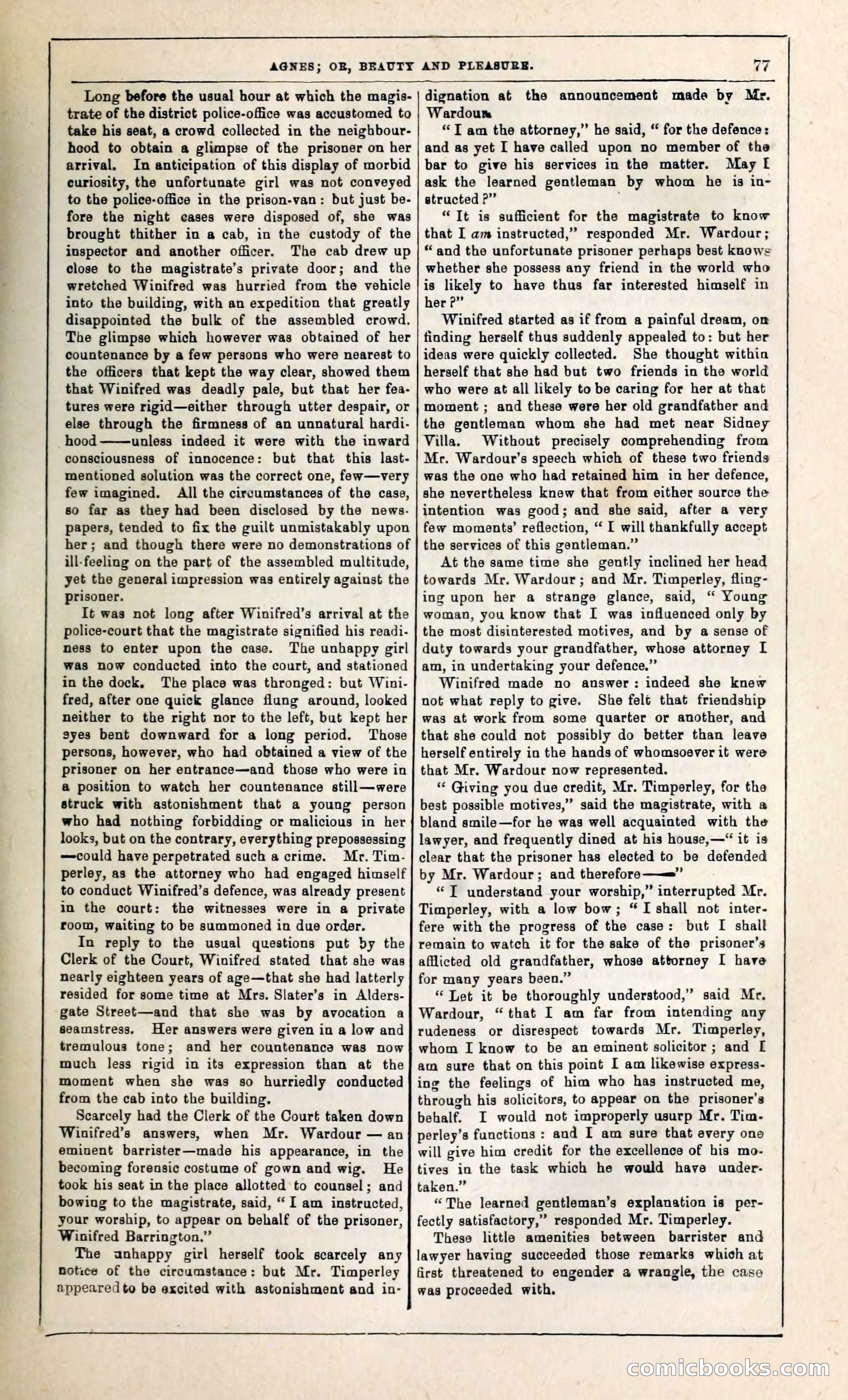
A restored page from Penny Dreadfuls, 1857. Page through the whole issue in the reader above.
📄 Transcribed text from this page (OCR, searchable)
Machine-transcribed from the original scan — historical spelling and the odd misread are preserved.
eT AGNES; OR, BEAUTY AND PLEASURE. vir Long before the usual hour at which the magis- trate of the district police-office was accustomed to take his seat, a crowd collected in the neighbour- heod to obtain a glimpse of the prisoner on her arrival. In anticipation of this display of morbid curiosity, the unfortunate girl was not conveyed to the police-office in the prison-van: but just be- fore the night cases were disposed of, she was brought thither in a cab, in the custody of the inspector and another officer. The cab drew up close to the magistrate’s private door; and the wretched Winifred was hurried from the vehicle into the building, with an expedition that greatly disappointed the bulk of the assembled crowd. The glimpse which however was obtained of her countenance by a few persons who were nearest to the officers that kept the way clear, showed them that Winifred was deadly pale, but that her fea- tures were rigid—either through utter despair, or else through the firmness of an unnatural hardi- hood unless indeed it were with the inward consciousness of innocence: but that this last- mentioned solution was the correct one, few—very few imagined. All the circumstances of the case, so far as they had been disclosed by the news- papers, tended to fix the guilt unmistakably upon her; and though there were no demonstrations of ill-feeling on the part of the assembled multitude, yet the general impression was entirely against the prisoner. It was not long after Winifred’s arrival at the police-court that the magistrate signified his readi- ness to enter upon the case. The unhappy girl was now conducted into the court, and stationed in the dock, The place was thronged: but Wini- fred, after one quick glance flung around, looked neither to the right nor to the left, but kept her gyes bent downward for a long period. Those persons, however, who had obtained a view of the prisoner on her entrance—and those who were in a position to watch her countenance still—were struck with astonishment that a young person who had nothing forbidding or malicious in her looks, but on the contrary, everything prepossessing —could have perpetrated such acrime. Mr. Tim- perley, as the attorney who had engaged himself to conduct Winifred’s defence, was already present in the court: the witnesses were in a private room, waiting to be summoned in due order. In reply to the usual questions put by the Clerk of the Court, Winifred stated that she was nearly eighteen years of age—that she had latterly resided for some time at Mrs. Slater’s in Alders- gate Street—and that she was by avocation a seamstress. Her answers were given in a low and tremulous tone; and her countenance was now much less rigid in its expression than at the moment when she was so hurriedly conducted from the cab into the building. Scarcely had the Clerk of the Court taken down Winifred’s answers, when Mr. Wardour — an eminent barrister—made his appearance, in the becoming forensic costume of gown and wig. He took his seat in the place allotted to counsel; and bowing to the magistrate, said, “ I am instructed, your worship, to appear on behalf of the prisoner, Winifred Barrington.” The anhappy girl herself took scarcely any notice of the circumstance: but Mr. Timperley appeared to be excited with astonishment and in- dignation at the announcement made by Mr. Wardounm “T am the attorney,” he said, “ for the defence: and as yet I have called upon no member of the bar to give his services in the matter. May L ask the learned gentleman by whom he is in- structed P” “Tt is sufficient for the magistrate to know that I am instructed,” responded Mr. Wardour; “and the unfortunate prisoner perhaps best knows whether she possess any friend in the world who is likely to have thus far interested himself in her P”’ Winifred started as if from a painful dream, om finding herself thus suddenly appealed to: but her ideas were quickly collected. She thought within herself that she had but two friends in the world who were at all likely to be caring for her at that moment ; and these were her old grandfather and the gentleman whom she had met near Sidney Villa. Without precisely comprehending from Mr. Wardour’s speech which of these two friends was the one who had retained him in her defence, she nevertheless knew that from either source the intention was good; and she said, after a very few moments’ reflection, “I will thankfully accept the services of this gentleman.” At the same time she gently inclined her head towards Mr. Wardour; and Mr. Timperley, fling- ing upon her a strange glance, said, “ Young woman, you know that I was influenced only by the most disinterested motives, and by a sense of duty towards your grandfather, whose attorney I am, in undertaking your defence.” Winifred made no answer: indeed she knew not what reply to give. She felt that friendship was at work from some quarter or another, and that she could not possibly do better than leave herself entirely in the hands of whomsoever it were that Mr. Wardour now represented. “ Giving you due credit, Mr. Timperley, for the best possible motives,” said the magistrate, with a bland smile—for he was well acquainted with the lawyer, and frequently dined at his house,—“ it is clear that the prisoner has elected to be defended by Mr. Wardour; and therefore——” ce understand your worship,” recmunted Mr. Timperley, with a low bow; “I shall not inter- fere with the progress of the case: but I shall remain to watch it for the sake of the prisoner’s afflicted old grandfather, whose attorney I have for many years been.” “Let it be thoroughly understood,” said Mr, Wardour, “that I am far from intending any rudeness or disrespect towards Mr. Timperley, whom I know to be an eminent solicitor; and E am sure that on this point I am likewise express- ing the feelings of him who has instructed me, through his solicitors, to appear on the prisoner’s behalf. I would not improperly usurp Mr. Tim- perley’s functions : and I am sure that every one will give him credit for the excellence of his mo- tives in the task which he would have under- taken.” “The learned gentleman’s explanation is per- fectly satisfactory,” responded Mr. Timperley. These little amenities between barrister and lawyer having succeeded those remarks which at first threatened to engender a wrangle, the case was proceeded with. Ghbook CO