
Penny Dreadfuls, 1857 · page 87 of 394
Agnes, or, Beauty and Pleasure — page 87: what you’re looking at
A restored page from Penny Dreadfuls, 1857. Page through the whole issue in the reader above.
📄 Transcribed text from this page (OCR, searchable)
Machine-transcribed from the original scan — historical spelling and the odd misread are preserved.
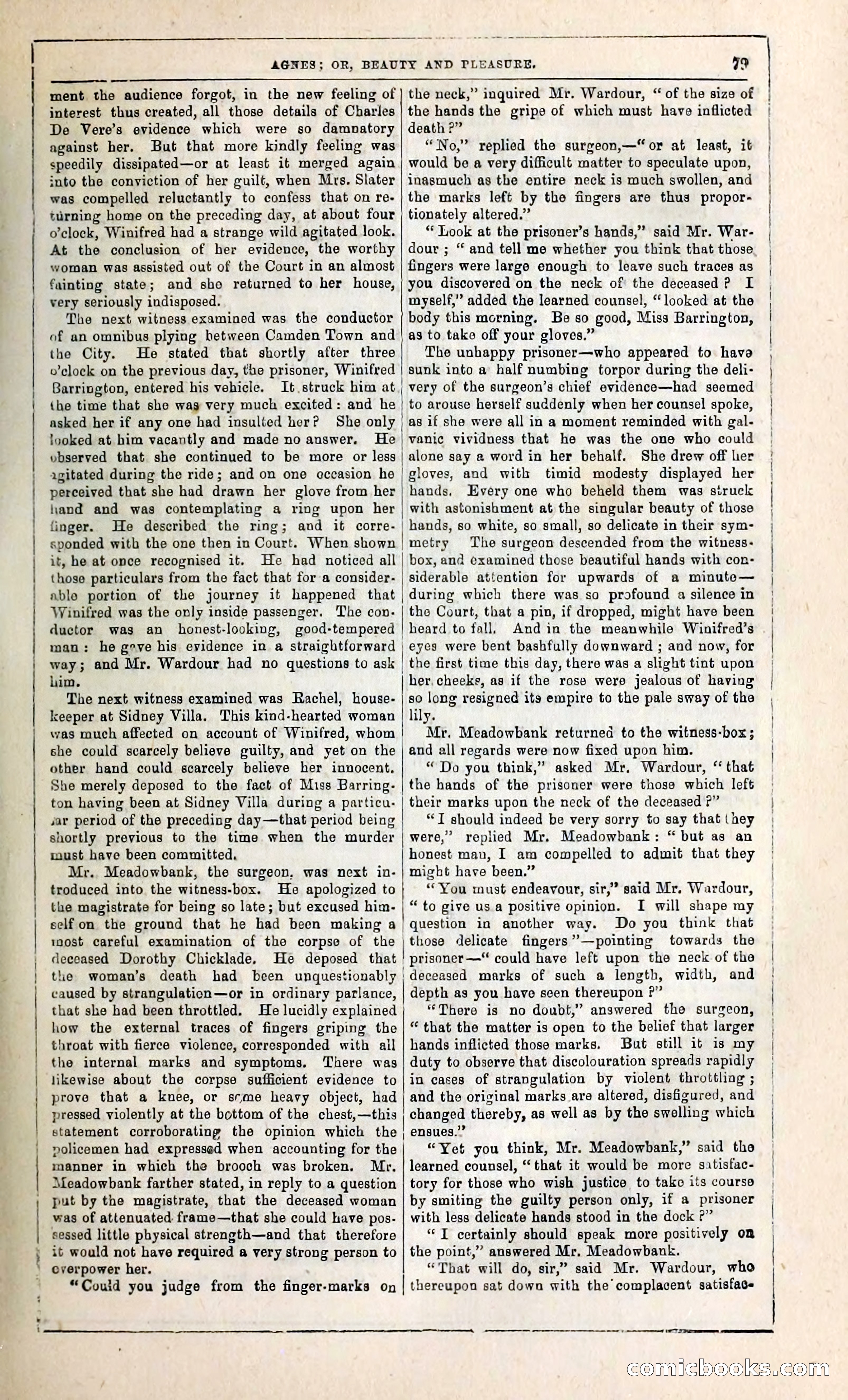
AGNES; ment the audience forgot, in the new feeling of interest thus created, all those details of Charles De Vere’s evidence which were so damnatory against her. But that more kindly feeling was speedily dissipated—or at least it merged again into the conviction of her guilt, when Mrs. Slater was compelled reluctantly to confess that on re- turning home on the preceding day, at about four o'clock, Winifred had a strange wild agitated look. At the conclusion of her evidence, the worthy woman was assisted out of the Court in an almost fainting state; and she returned to her house, very seriously indisposed. The next witness examined was the conductor of an omnibus plying between Camden Town and the City. He stated that shortly after three o'clock on the previous day, the prisoner, Winifred Barrington, entered his vehicle. It. struck him at the time that she wag very much excited: and he asked her if any one had insulted her? She only looked at him vacantly and made no answer. He observed that she continued to be more or less agitated during the ride; and on one occasion he perceived that she had drawn her glove from her OR, BEAUTY AND PLEASURE, 79 the neck,” inquired Mr. Wardour, “ of the size of the hands the gripe of which must have inflicted death P” “No,” replied the surgeon,—“ or at least, it would be a very difficult matter to speculate upon, inasmuch as the entire neck is much swollen, and the marks left by the fingers are thus propor- tionately altered.” ‘Look at the prisoner’s hands,” said Mr. War- dour ; “ and tell me whether you think that those fingers were large enough to leave such traces as you discovered on the neck of the deceased? I myself,” added the learned counsel, “looked at the body this morning. Be so good, Miss Barrington, as to take off your gloves.” The unhappy prisoner—who appeared to have sunk into a half numbing torpor during the deli- very of the surgeon’s chief evidence—had seemed to arouse herself suddenly when her counsel spoke, as if she were all in a moment reminded with gal- vanic vividness that he was the one who could alone say a word in her behalf. She drew off ler gloves, and with timid modesty displayed her hands, Every one who beheld them was struck land and was contemplating a ring upon her | with astonishment at the singular beauty of those finger. sponded with the one then in Court. When shown it, he at once recognised it. He described the ring; and it corre- | hands, so white, so small, so delicate in their sym- metry The surgeon descended from the witness- He had noticed all | box, and examined those beautiful hands with con- those particulars from the fact that for a consider- | siderable attention for upwards of a minute— able portion of the journey it happened that | Winifred was the only inside passenger. The con- ductor was an honest-looking, good-tempered man way; and Mr. Wardour had no questions to ask lim. The next witness examined was Rachel, house- keeper at Sidney Villa. This kind-hearted woman was much affected on account of Winifred, whom she could scarcely believe guilty, and yet on the other hand could scarcely believe her innocent. She merely deposed to the fact of Miss Barring- ton having been at Sidney Villa during a particu- jav period of the preceding day—that period being shortly previous to the time when the murder | were,” must have been committed. Mr. Meadowbank, the surgeon. was next in- troduced into the witness-box. He apologized to the magistrate for being so late; but excused him- self on the ground that he had been making a most careful examination of the corpse of the | those delicate fingers ”—pointing He deposed that | prisoner—“ could have left upon the neck of the deceased Dorothy Chicklade, tlie woman’s death had been unquestionably caused by strangulation—or in ordinary parlance, that she had been throttled. He lucidly explained how the external traces of fingers griping the throat with fierce violence, corresponded with ail the internal marks and symptoms. There was likewise about the corpse sufficient evidence to prove that a knee, or srme heavy object, had pressed violently at the bottom of the chest,—this statement corroborating the opinion which the policemen had expressed when accounting for the manner in which the brooch was broken. Mr, Meadowbank farther stated, in reply to a question put by the magistrate, that the deceased woman was of attenuated frame—that she could have pos- sessed little physical strength—and that therefore it would not have required a very strong person to cverpower her. “Could you judge from the finger-marks on : he gove his evidence in a straightforward | during which there was so profound a silence in the Court, that a pin, if dropped, might have been heard to fall, And in the meanwhile Winifred’s eyes were bent bashfully downward ; and now, for the first time this day, there was a slight tint upon her, cheeks, as if the rose were jealous of having so long resigned its empire to the pale sway of the lily. Mr. Meadowbank returned to the witness-box; and all regards were now fixed upon him. “Do you think,” asked Mr. Wardour, ‘that the hands of the prisoner were those which lefé their marks upon the neck of the deceased P” **T should indeed be very sorry to say that (hey replied Mr. Meadowbank: “ but as an honest mau, I am compelled to admit that they might have been.” “You must endeavour, sir,” said Mr. Wardour, “ to give us a positive opinion. I will shape my question in another way. Do you think that towards the ‘deceased marks of such a length, width, and depth as you have seen thereupon er “There is no doubt,” answered the surgeon, “ that the matter is open to the belief that larger hands inflicted those marks. But still it is my duty to observe that discolouration spreads rapidly in cases of strangulation by violent throttling ; and the original marks are altered, disfigured, and changed thereby, as well as by the swelling which ensues.” “Yet you think, Mr. Meadowbank,” said the learned counsel, ‘‘ that it would be more satisfac- tory for those who wish justice to take its course by smiting the guilty person only, if a prisoner with less delicate hands stood in the dock ?” “I certainly should speak more positively on the point,” answered Mr. Meadowbank. “That will do, sir,” said Mr. Wardour, who | thereupon sat down with the complacent satisface ee sae OCC Oe ee et ieee Comiclbooolk S CO