
Penny Dreadfuls, 1857 · page 93 of 394
Agnes, or, Beauty and Pleasure — page 93: what you’re looking at
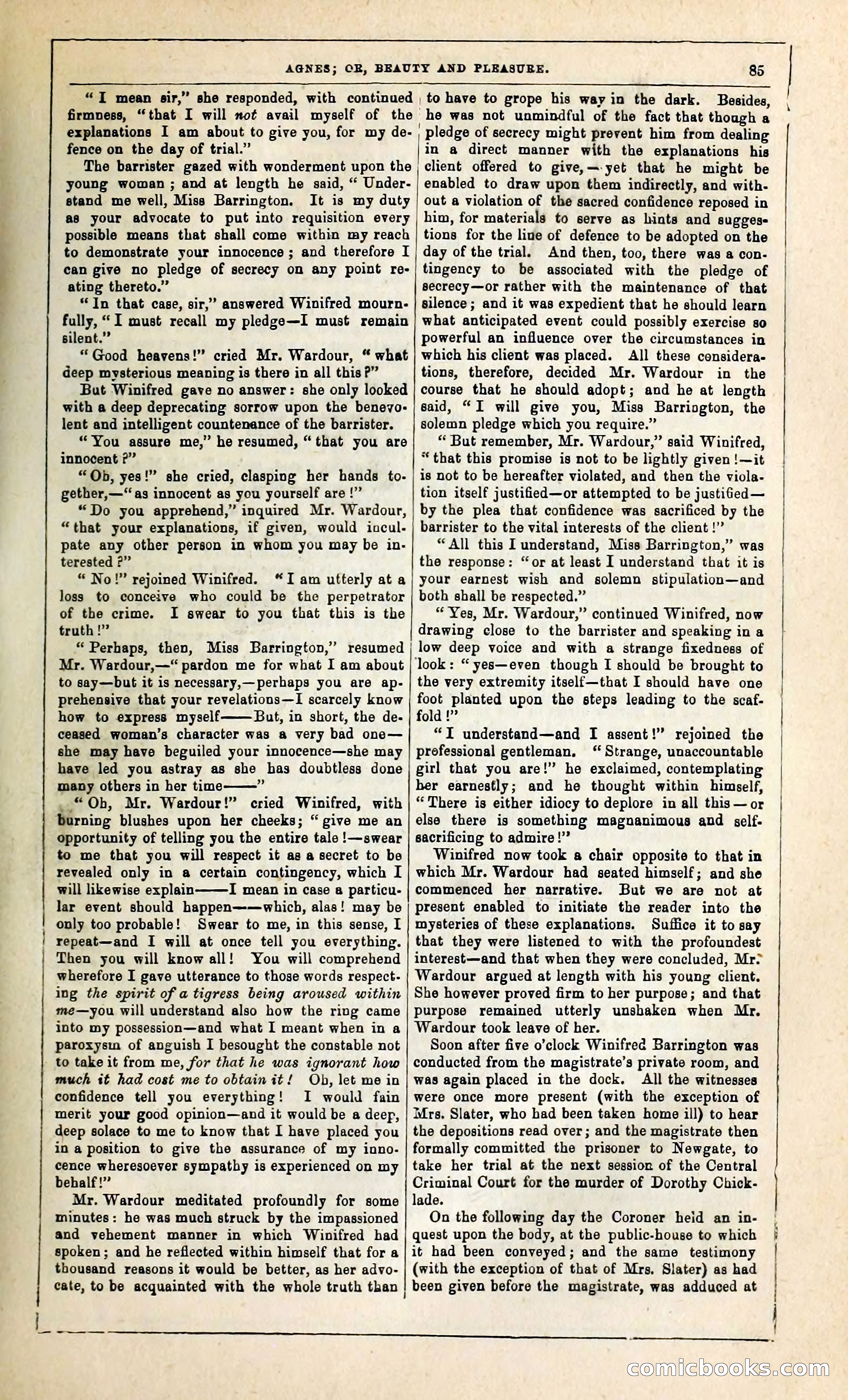
A restored page from Penny Dreadfuls, 1857. Page through the whole issue in the reader above.
📄 Transcribed text from this page (OCR, searchable)
Machine-transcribed from the original scan — historical spelling and the odd misread are preserved.
ine AGNES; CR, BEAUTY AND PLEASURE. 85 “T mean sir,” she responded, with continued firmness, “that I will not avail myself of the explanations I am about to give you, for my de- fence on the day of trial.” The barrister gazed with wonderment upon the young wowan ; and at length he said, “ Under- stand me well, Miss Barrington. It is my duty as your advocate to put into requisition every possible means that shall come within my reach to demonstrate your innocence; and therefore I can give no pledge of secrecy on any point re- ating thereto.” “In that case, sir,’ answered Winifred mourn- fully, “I must recall my pledge—I must remain silent.” “Good heavens!” cried Mr. Wardour, “ what deep mysterious meaning is there in all this?” But Winifred gave no answer: she only looked with a deep deprecating sorrow upon the benevo- lent and intelligent countenance of the barrister. “You assure me,” he resumed, “that you are innocent ?” “Ob, yes!” she cried, clasping her hands to- gether,—“as innocent as you yourself are !” “Do you apprehend,” inquired Mr. Wardour, “that your explanations, if given, would incul- pate any other person in whom you may be in- terested ?” “ No!” rejoined Winifred. “Iam utterly at a loss to conceive who could be the perpetrator of the crime. I swear to you that this is the truth !” “Perhaps, then, Miss Barrington,’ resumed Mr. Wardour,—“ pardon me for what I am about to say—but it is necessary,— perhaps you are ap- prehensive that your revelations—I scarcely know how to express myself But, in short, the de- ceased woman’s character was a very bad one— she may have beguiled your innocence—she may have led you astray as she has doubtless done many others in her time di _ “Ob, Mr. Wardour!” cried Winifred, with burning blushes upon her cheeks; “give me an opportunity of telling you the entire tale !—swear to me that you will respect it asa secret to be revealed only in a certain contingency, which I will likewise explain I mean in case a particu- lar event should happen——which, alas! may be only too probable! Swear to me, in this sense, I repeat—and I will at once tell you everything. Then you will know all! You will comprehend wherefore I gave utterance to those words respect- ing the spirit of a tigress being aroused within me—you will understand also how the ring came into my possession—and what I meant when in a paroxysm of anguish I besought the constable not - to take it from me, for that he was ignorant how much it had cost me to obtain it! Ob, let me in confidence tell you everything! I would fain merit your good opinion—and it would be a deep, deep solace to me to know that I have placed you in a position to give the assurance of my inno- cence wheresoever sympathy is experienced on my behalf!” Mr. Wardour meditated profoundly for some minutes: he was much struck by the impassioned and vehement manner in which Winifred had spoken; and he reflected within himself that for a thousand reasons it would be better, as her advo- cate, to be acquainted with the whole truth than | —— a © a a a ee | to have to grope his way in the dark. Besides, he was not unmindful of the fact that though a | pledge of secrecy might prevent him from dealing in a direct manner with the explanations his client offered to give,—-yet that he might be enabled to draw upon them indirectly, and with- out a violation of the sacred confidence reposed in him, for materials to serve as hints and sugges- tions for the line of defence to be adopted on the day of the trial. And then, too, there was a con- tingency to be associated with the pledge of secrecy—or rather with the maintenance of that silence; and it was expedient that he should learn what anticipated event could possibly exercise so powerful an influence over the circumstances in which his client was placed. All these considera- tions, therefore, decided Mr. Wardour in the course that he should adopt; and he at length said, “I will give you, Miss Barrington, the solemn pledge which you require.” ** But remember, Mr. Wardour,” said Winifred, “that this promise is not to be lightly given !—it is not to be hereafter violated, and then the viola- tion itself justified—or attempted to be justified— by the plea that confidence was sacrificed by the barrister to the vital interests of the client !” “All this I understand, Miss Barrington,” was the response: “or at least I understand that it is your earnest wish and solemn stipulation—and both shall be respected.” “Yes, Mr. Wardour,” continued Winifred, now drawing close to the barrister and speaking in a low deep voice and with a strange fixedness of ‘look: “ yes—even though I should be brought to the very extremity itself—that I should have one foot planted upon the steps leading to the scaf- fold !” “TI understand—and I assent!” rejoined the professional gentleman. ‘Strange, unaccountable girl that you are!” he exclaimed, contemplating her earnestly; and he thought within himeelf, “There is either idiocy to deplore in all this —or else there is something magnanimous and self- sacrificing to admire!” Winifred now took a chair opposite to that in which Mr. Wardour had seated himself; and she commenced her narrative. But we are not at present enabled to initiate the reader into the mysteries of these explanations. Suffice it to say that they were listened to with the profoundest interest—and that when they were concluded, Mr? Wardour argued at length with his young client. She however proved firm to her purpose; and that purpose remained utterly unshaken when Mr. Wardour took leave of her. Soon after five o’clock Winifred Barrington was conducted from the magistrate’s private room, and was again placed in the dock. All the witnesses were once more present (with the exception of Mrs. Slater, who had been taken home ill) to hear the depositions read over; and the magistrate then formally committed the prisoner to Newgate, to take her trial at the next session of the Central Criminal Court for the murder of Dorothy Chick- lade. On the following day the Coroner heid an in- quest upon the body, at the public-house to which it had been conveyed; and the same testimony (with the exception of that of Mrs, Slater) as had been given before the magistrate, was adduced at ComiclboookXs 8 rt C@