
Penny Dreadfuls, 1857 · page 106 of 394
Agnes, or, Beauty and Pleasure — page 106: what you’re looking at
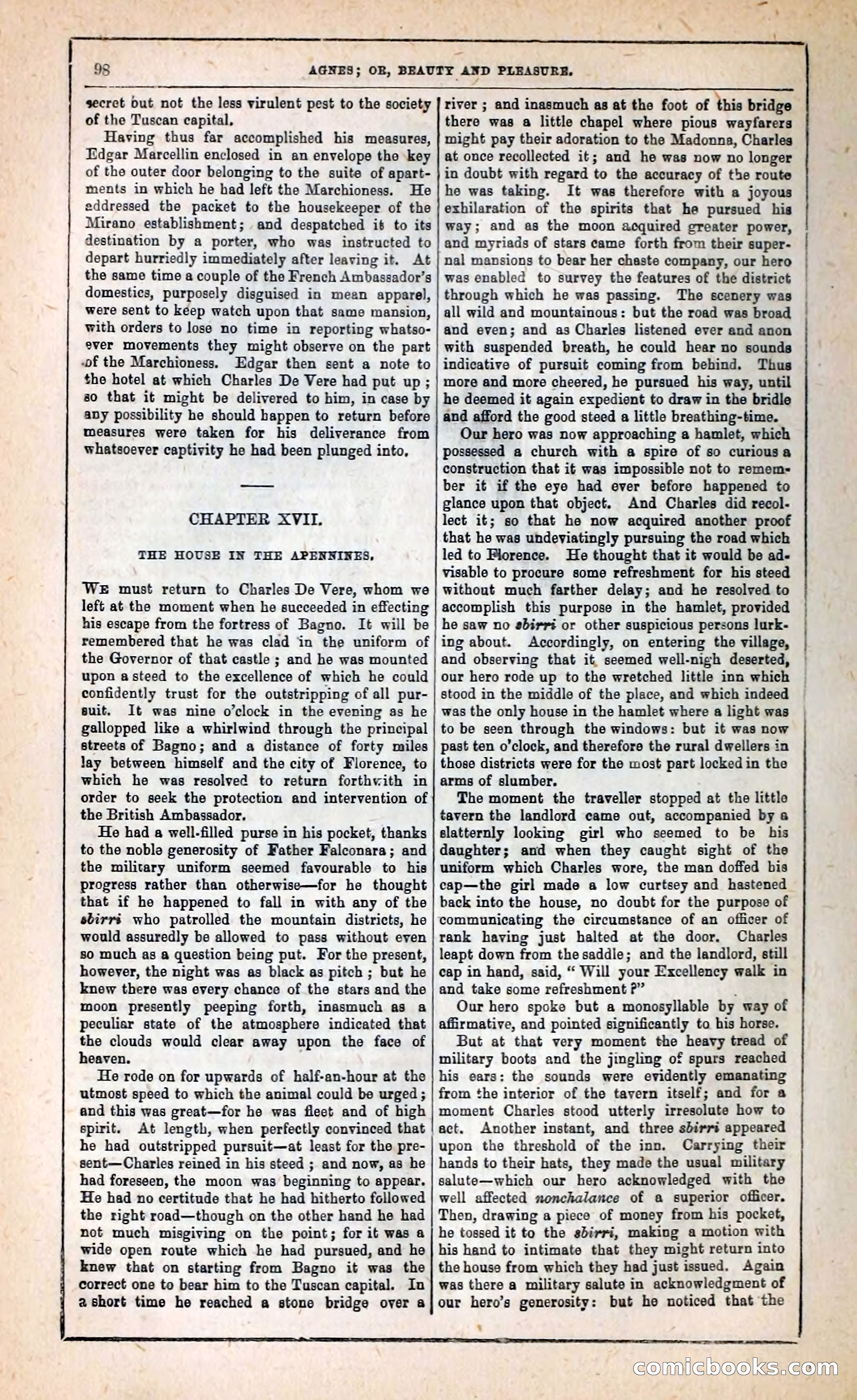
A restored page from Penny Dreadfuls, 1857. Page through the whole issue in the reader above.
📄 Transcribed text from this page (OCR, searchable)
Machine-transcribed from the original scan — historical spelling and the odd misread are preserved.
98 secret Dut not the less virulent pest to the society of the Tuscan capital, Having thus far accomplished his measures, Edgar Marcellin enclosed in an envelope the key of the outer door belonging to the suite of apart- ments in which he had left the Marchioness. He eddressed the packet to the housekeeper of the Mirano establishment; and despatched it to its destination by a porter, who was instructed to depart hurriedly immediately after leaving it. At the same time a couple of the French Ambassador’s domestics, purposely disguised in mean apparel, were sent to keep watch upon that same mansion, with orders to lose no time in reporting whatso- ever movements they might observe on the part of the Marchioness. Edgar then sent a note to the hotel at which Charles De Vere had put up; ao that it might be delivered to him, in case by apy possibility he should happen to return before measures were taken for his deliverance from whatsoever captivity he had been plunged into, —— CHAPTER XVII. THE HOUSE IN THE APENNINES, WE must return to Charles De Vere, whom we left at the moment when he succeeded in effecting his escape from the fortress of Bagno. It will be remembered that he was clad in the uniform of the Governor of that castle ; and he was mounted upon a steed to the excellence of which he could confidently trust for the outstripping of all pur- suit. It was nine o’clock in the evening as he gallopped like a whirlwind through the principal streets of Bagno; and a distance of forty miles lay between himself and the city of Florence, to which he was resolved to return forthwith in order to seek the protection and intervention of the British Ambassador. He had a well-filled purse in his pocket, thanks to the noble generosity of Father Falconara; and the military uniform seemed favourable to his progress rather than otherwise—for he thought that if he happened to fall in with any of the sbirrs who patrolled the mountain districts, he would assuredly be allowed to pass without even so much as a question being put. For the present, however, the night was as black as pitch ; but he knew there was every chance of the stars and the moon presently peeping forth, inasmuch as a peculiar state of the atmosphere indicated that the clouds would clear away upon the face of heaven. He rode on for upwards of half-an-hour at the utmost speed to which the animal could be urged ; and this was great—for he was fleet and of high spirit. At length, when perfectly convinced that he had outstripped pursuit—at least for the pre- sent—Charles reined in his steed ; and now, as he had foreseen, the moon was beginning to appear. He had no certitude that he had hitherto followed the right road—though on the other hand he had not much misgiving on the point; for it was a wide open route which he had pursued, and he knew that on starting from Bagno it was the correct one to bear him to the Tuscan capital. In ashort time he reached a stone bridge over a -_ AGNES; OR, BEAUTY AND PLEASURE. river ; and inasmuch as at the foot of this bridge there was a little chapel where pious wayfarers might pay their adoration to the Madonna, Charles at once recollected it; and he was now no longer in doubt with regard to the accuracy of the route he was taking. It was therefore with a joyous exhilaration of the spirits that he pursued his way; and as the moon acquired greater power, and myriads of stars came forth from their super- nal mansions to bear her chaste company, our hero was enabled to survey the features of the district through which he was passing, The scenery was all wild and mountainous: but the road was broad and even; and as Charles listened ever and anon with suspended breath, he could hear no sounds indicative of pursuit coming from behind. Thus more and more cheered, he pursued his way, until he deemed it again expedient to draw in the bridle and afford the good steed a little breathing-time. Our hero was now approaching a hamlet, which possessed a church with a spire of so curiousa construction that if was impossible not to remem- ber it if the eye had ever before happened to glance upon that object. And Charles did recol- lect it; so that he now acquired another proof that he was undeviatingly pursuing the road which led to Morence. He thought that it would be ad- visable to procure some refreshment for his steed without much farther delay; and he resolved to accomplish this purpose in the hamlet, provided he saw no #birrt or other suspicious persons lurk- ing about. Accordingly, on entering the village, and observing that it, seemed well-nigh deserted, our hero rode up to the wretched little inn which stood in the middle of the place, and which indeed was the only house in the hamlet where a light was to be seen through the windows: but it was now past ten o’clock, and therefore the rural dwellers in those districts were for the most part lockedin the arms of slumber. The moment the traveller stopped at the little tavern the landlord came out, accompanied by a slatternly looking girl who seemed to be his daughter; and when they caught sight of the uniform which Charles wore, the man doffed bis cap—the girl made a low curtsey and hastened back into the house, no doubt for the purpose of communicating the circumstance of an officer of rank having just halted at the door. Charles leapt down from the saddle; and the landlord, still cap in hand, said, “ Will your Excellency walk in and take some refreshment ae Our hero spoke but a monosyllable by way of affirmative, and pointed significantly to his horse. But at that very moment the heavy tread of military boots and the jingling of spurs reached his ears: the sounds were evidently emanating from the interior of the tavern itself; and for a moment Charles stood utterly irresolute how to act. Another instant, and three sbirrs appeared upon the threshold of the inn. Carrying their hands to their hats, they made the usual military salute—which our hero acknowledged with the well affected nonchalance of a superior officer. Then, drawing a piece of money from his pocket, he tossed it to the sbirri, making a motion with his hand to intimate that they might return into the house from which they had just issued. Again was there a military salute in acknowledgment of our hero’s generosity: but he noticed that the (E©) EE ont oe i Egiicbooks.c ’