
Penny Dreadfuls, 1857 · page 136 of 394
Agnes, or, Beauty and Pleasure — page 136: what you’re looking at
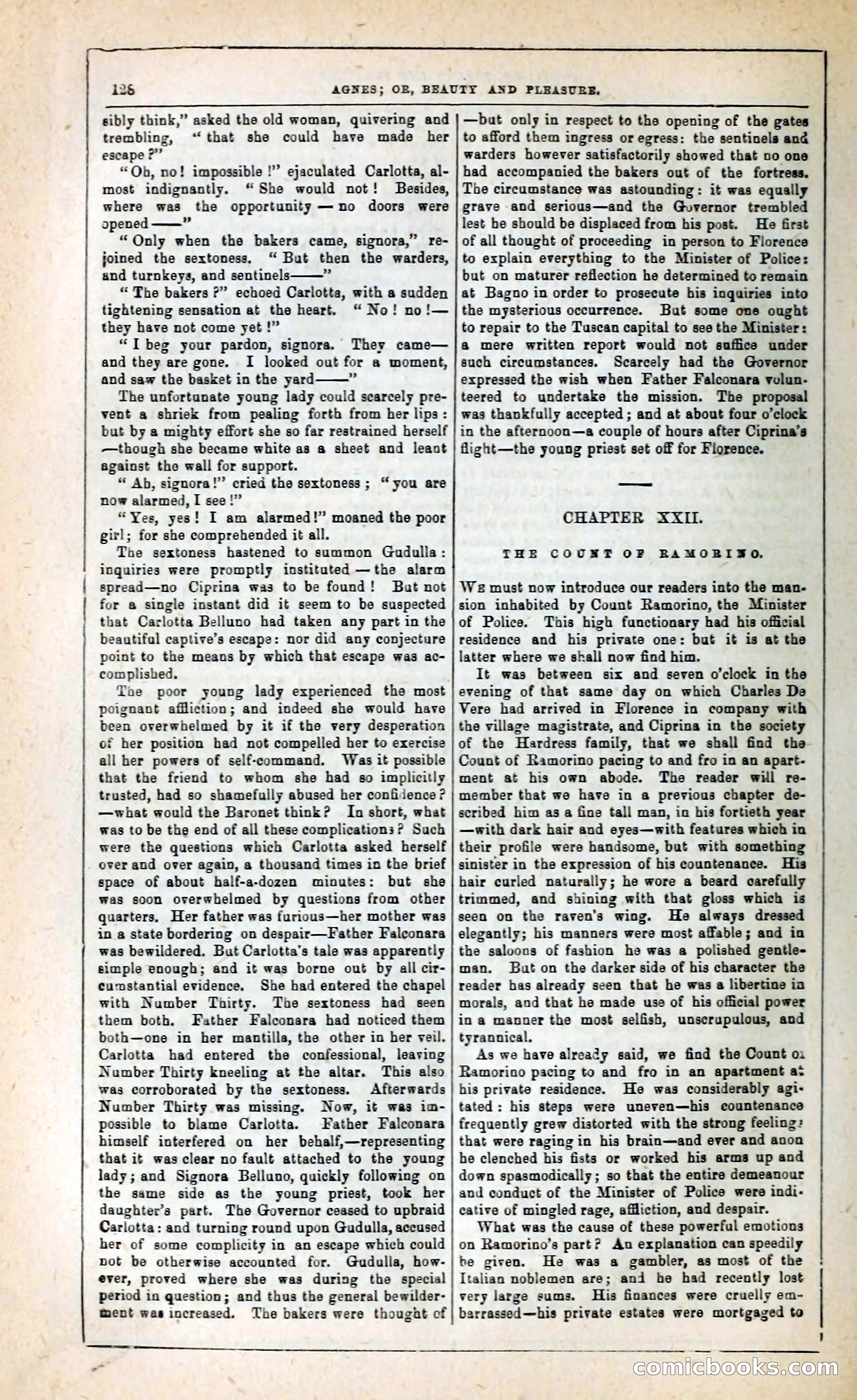
A restored page from Penny Dreadfuls, 1857. Page through the whole issue in the reader above.
📄 Transcribed text from this page (OCR, searchable)
Machine-transcribed from the original scan — historical spelling and the odd misread are preserved.
128 AGNES; OE, BEAUTY AND PLEASURE, sibly think,” asked the old woman, quivering and trembling, “that she could have made her escape ?”” “Ob, no! impossible !”” ejaculated Carlotta, al- most indignantly. “She would not! Besides, where was the opportunity no doors were opened ~ “Only when the bakers came, signora,” re- joined the sextoness. “ But then the warders, and turnkeys, and sentinels 2: “ The bakers ?” echoed Carlotta, with a sudden tightening sensation at the heart. “No! no!— they have not come yet !” “TI beg your pardon, signora. They came— and they are gone. I looked out for a moment, and saw the basket in the yard 3 The unfortunate young lady could scarcely pre- vent a shriek from pealing forth from her lips: but by a mighty effort she so far restrained herself —though she became white as a sheet and leant against the wall for support. “ Ab, signora!” cried the sextoness ; “you are now alarmed, I see!” “Yes, yes! I am alarmed!” moaned the poor girl; for she comprehended it all. Tbe sextoness hastened to summon Gudulla: inquiries were promptly instituted —the alarm spread—no Ciprina was to be found! But not for a single instant did it seem to be suspected that Carlotta Belluno had taken any part in the beautifal captive’s escape: nor did any conjecture point to the means by which that escape was ac- complished. Toe poor young lady experienced the most poignant affliction; and indeed she would have been overwhelmed by it if the very desperation of her position had not compelled her to exercise all her powers of self-command. Was it possible that the friend to whom she had so implicitly trusted, had so shamefully abused her confidence? —what would the Baronet think? In short, what was to be the end of all these complications? Such were the questions which Carlotta asked herself over and over again, a thousand times in the brief space of about half-a-dozen minutes: but she was soon overwhelmed by questions from other quarters. Her father was furious—her mother was in a state bordering on despair—Father Falconara was bewildered. But Carlotta’s tale was apparently simple enough; and it was borne out by all cir- cumstantial evidence. She had entered the chapel with Number Thirty. The sextoness had seen them both. Father Falconara had noticed them both—one in her mantills, the other in her veil. Carlotta had entered the confessional, leaving Number Thirty kneeling at the altar. This also was corroborated by the sextoness. Afterwards Number Thirty was missing. Now, it was im- possible to blame Carlotta. Father Falconara himself interfered on her behalf,—representing that it was clear no fault attached to the young lady; and Signora Belluno, quickly following on the same side as the young priest, took her daughter’s part. The Governor ceased to upbraid Carlotta: and turning round upon Gudulla, aceused her of some complicity in an escape which could not be otherwise accounted for. Gudulla, how- ever, proved where she was during the special period in question; and thus the general bewilder- tment was increased. The bakers were thought of —but only in respect to the opening of the gates to afford them ingress or egress: the sentinels and warders however satisfactorily showed that no one had accompanied the bakers out of the fortress. The circumstance was astounding: it was equally grave and serious—and the Governor trembled lest he should be displaced from his post. He first of all thought of proceeding in person to Florence to explain everything to the Minister of Police: but on maturer reflection he determined to remain at Bagno in order to prosecute his inquiries into the mysterious occurrence. But some one ought to repair to the Tuscan capital to see the Minister: @ mere written report would not suffice under such circumstances. Scarcely had the Governor expressed the wish when Father Falconara volun- teered to undertake the mission. The proposal was thankfully accepted ; and at about four o’clock in the afternoon—a couple of hours after Ciprina’s flight—the young priest set off for Florence. ——w CHAPTER XXII. THE COUNT OF RAMOBIBO. We must now introduce our readers into the man- sion inhabited by Count Ramorino, the Minister of Police. This high functionary had his official residence and his private one: but it is at the latter where we skall now find him. It was between six and seven o’clock in the evening of that same day on which Charles De Vere had arrived in Florence in company with the village magistrate, and Ciprina in the society of the Hardress family, that we shall find the Count of Ramorino pacing to and fro in an apart- ment at his own abode. The reader wil re- member that we have in a previous chapter de- scribed him as a fine tall man, io his fortieth year —with dark hair and eyes—with features which in their profile were handsome, bat with something sinister in the expression of his countenance. His hair curled naturally; he wore a beard carefully trimmed, and shining with that gloss which is seen on the raven’s wing. He always dressed elegantly; his manners were most affable; and in the saloons of fashion he was a polished gentle- man. But on the darker side of his character the reader has already seen that he was a libertine ia morals, and that he made use of his official power in a manner the most selfish, unscrupulous, and tyrannical. As we have already said, we find the Count o1 Ramorioo pacing to and fro in an apartment at his private residence. He was considerably agi- tated: his steps were uneven—his countenance frequently grew distorted with the strong feeling» that were ragingin his brain—and ever and anon he clenched his fists or worked his arms up and down spasmodically; so that the entire demeanour and conduct of the Minister of Police were indi- cative of mingled rage, affliction, and despair. What was the cause of these powerful emotions on Ramorino’s part? Anu explanation can speedily be given. He was a gambler, as most of the Italian noblemen are; and he had recently lost very large sums. His finances were cruelly em- barrassed—his private estates were mortgaged to oO MiGbIoo co <S (©) |