
Penny Dreadfuls, 1857 · page 14 of 394
Agnes, or, Beauty and Pleasure — page 14: what you’re looking at
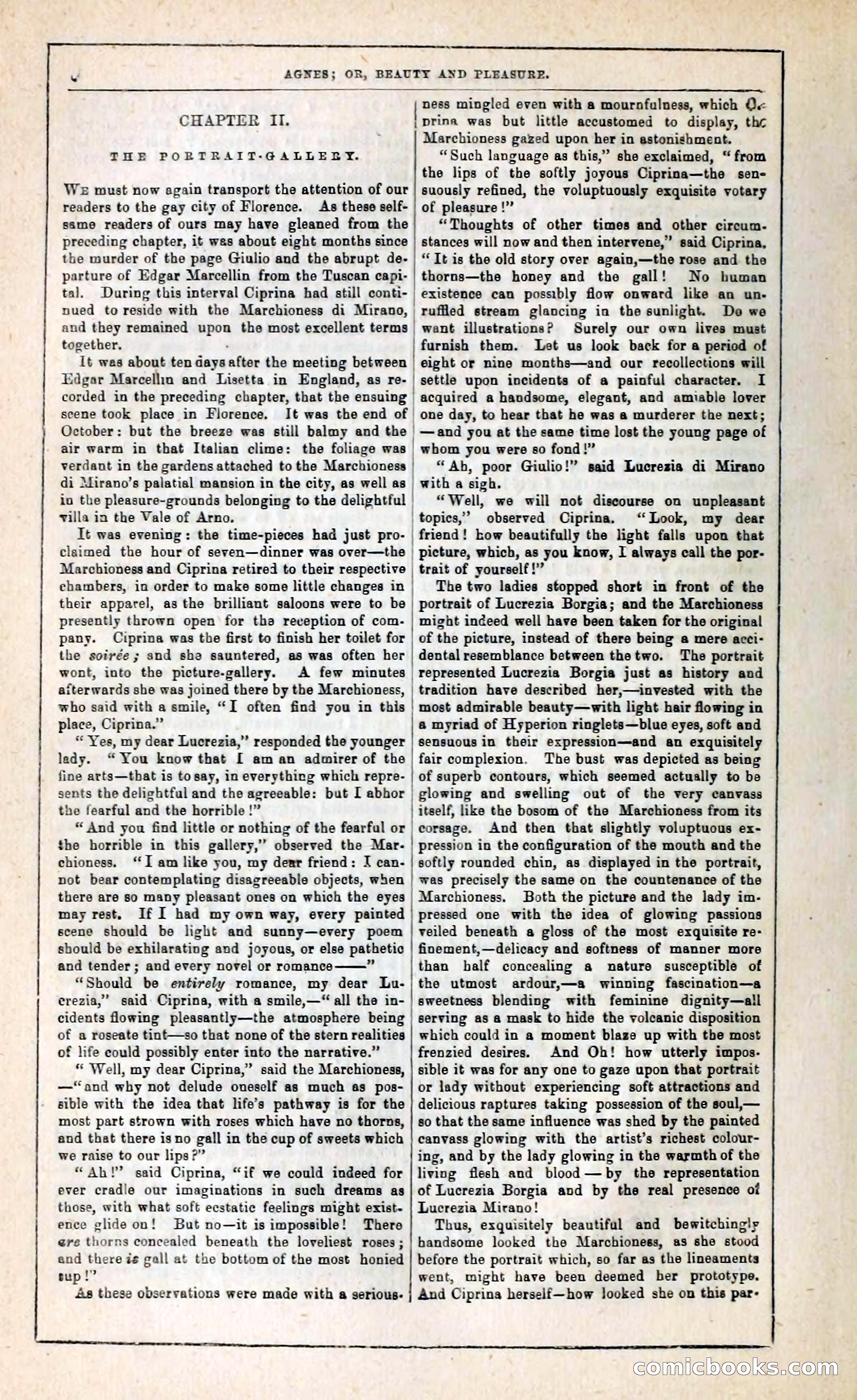
A restored page from Penny Dreadfuls, 1857. Page through the whole issue in the reader above.
📄 Transcribed text from this page (OCR, searchable)
Machine-transcribed from the original scan — historical spelling and the odd misread are preserved.
CHAPTER II. THE POERTRAIT-GALLELY. We must now again transport the attention of our readers to the gay city of Florence. As these self- same readers of ours may have gleaned from the preceding chapter, it was about eight months since the murder of the page Giulio and the abrupt de- parture of Edgar Marcellin from the Tuscan capi- tal. During this interval Ciprina had still conti- nued to reside with the Marchioness di Mirano, | and they remained apoN the most excellent terms | together. ‘Tt was about ten days after the meeting between Edgar Marcellin and Lisetta in England, as re- corded in the preceding chapter, that the ensuing | scene took place in Florence. It was the end of October: but the breeze was still balmy and the air warm in that Italian clime: the foliage was verdant in the gardens attached to the Marchioness di Mirano’s palatial mansion in the city, as well as _ io the pleasure-grounds belonging to the delightful | villa in the Vale of Arno. It was evening: the time-pieces had just pro- claimed the hour of seven—dinner was over—the Marchioness and Ciprina retired to their respective chambers, in order to make some little changes in | their apparel, as the brilliant saloons were to be presently thrown open for the reveption of com- pany. Ciprina was the first to finish her toilet for the soirée ; snd she sauntered, as was often her wont, into the picture-gallery. A few minutes aiterwards she was joined there by the Marchioness, who said with a smile, “I often find you in this | place, Ciprina.” “Yes, my dear Lucrezia,” responded the younger lady. “You know that [ am an admirer of the fine arts—that is tosay, in everything which repre- sents the delightful and the agreeable: but I abhor the fearful and the horrible !” * And you find little or nothing of the fearful or | the horrible in this gallery,” observed the Mar. | chioness. ‘I am like you, my denr friend: I can- not bear contemplating disagreeable objects, when there are so many pleasant ones on which the eyes may rest. If I had my own way, every painted scene should be light and sunny—every poem should be exhilarating and joyous, or else pathetic and tender; and every novel or romance ” “Should be entirely romance, my dear Lu- erezia,’ said Ciprina, with a smile,—“ all the in- | cidents flowing pleasantly—the atmosphere being of a roseate tint—so that none of the stern realities of life could possibly enter into the narrative.” * Well, my dear Ciprina,” said the Marchioness, —“and why not delude oneself as much as pos- sible with the idea that life’s pathway is for the most part strown with roses which have no thorns, and that there is no gall in the cup of sweets which we raise to our lips?” “Ah!” said Ciprina, “if we could indeed for ever cradle our imaginations in such dreams as those, with what soft ecstatic feelings might exist- ence glide on! But no—it is impossible! There gre thorns concealed beneath the loveliest roses; and there ie gall at the bottom of the most honied sup!” As these observations were made with a serious- AGNES; OR, BEAUTY AND PLEASURE. | ness mingled even with a mournfulness, which O« prina was but little accustomed to display, the Marchioness gazed upon her in astonishment. “Such language as this,” she exclaimed, “ from the lips of the softly joyous Ciprina—the sen- suously refined, the voluptuously exquisite votary of pleasure !’” “Thoughts of other times and other circum. stances will now and then intervene,” said Ciprina, “It is the old story over again,—the rose and the thorns—the honey and the gall! No human existence can possibly flow onward like an un- ruffed stream glancing in the sunlight. Do we want illustrations? Surely our own lives must | furnish them. Let us look back for a period of eigtit oF nine months—and our recollections will Feder upon incidents of a painful character. I acquired a handsome, elegant, and amiable lover one day, to hear that he was a murderer the next; _—and you at the same time lost the young page of whom you were so fond!” “Ab, poor Giulio!” said Lucrezia di Mirano with a sigh. “Well, we will not discourse on unpleasant topics,” observed Ciprina. ‘Look, my dear friend! Low beautifully the light falls upon that picture, which, as you know, I always call the por- trait of yourself!” The two ladies stopped short in front of the portrait of Lucrezia Borgia; and the Marchioness might indeed well have been taken for the original of the picture, instead of there being a mere acci- dental resemblance between thetwo. The portrait represented Lucrezia Borgia just as history and baising es have described her,—invested with the most admirable beauty—with light hair flowing in a myriad of Hyperion ringlets—blue eyes, soft and sensuous in their expression—and an exquisitely fair complexion. The bust was depicted as being of superb contours, which seemed actually to be _glowing and swelling out of the very canvass "itself, like the bosom of the Marchioness from its | career And then that slightly voluptuous ex- _ pression in the configuration of the mouth and the softly rounded chin, as displayed in the portrait, was precisely the same on the countenance of the Marchioness. Both the picture and the lady im- pressed one with the idea of glowing passions veiled beneath a gloss of the most exquisite re- finement,—delicacy and softness of manner more than half concealing a nature susceptible of the utmost ardour,—a winning fascination—a sweetness blending with feminine dignity—all serving as a mask to hide the volcanic disposition which could in a moment blaze up with the most frenzied desires. And Oh! how utterly impos- sible it was for any one to gaze upon that portrait or lady without experiencing soft attractions and delicious raptures taking possession of the soul,— so that the same influence was shed by the painted canvass glowing with the artist’s richest colour- ing, and by the lady glowing in the warmth of the living flesh and blood —by the representation of Lucrezia Borgia and by the real presence of Lucrezia Mirano! Thus, exquisitely beautifal and bewitchingly handsome looked the Marchioness, as she stood before the portrait which, so far as the lineaments went, might have been deemed her prototype. j; And Ciprina herself—how looked she on this par- co Ghook (©) 5}