
Penny Dreadfuls, 1857 · page 16 of 394
Agnes, or, Beauty and Pleasure — page 16: what you’re looking at
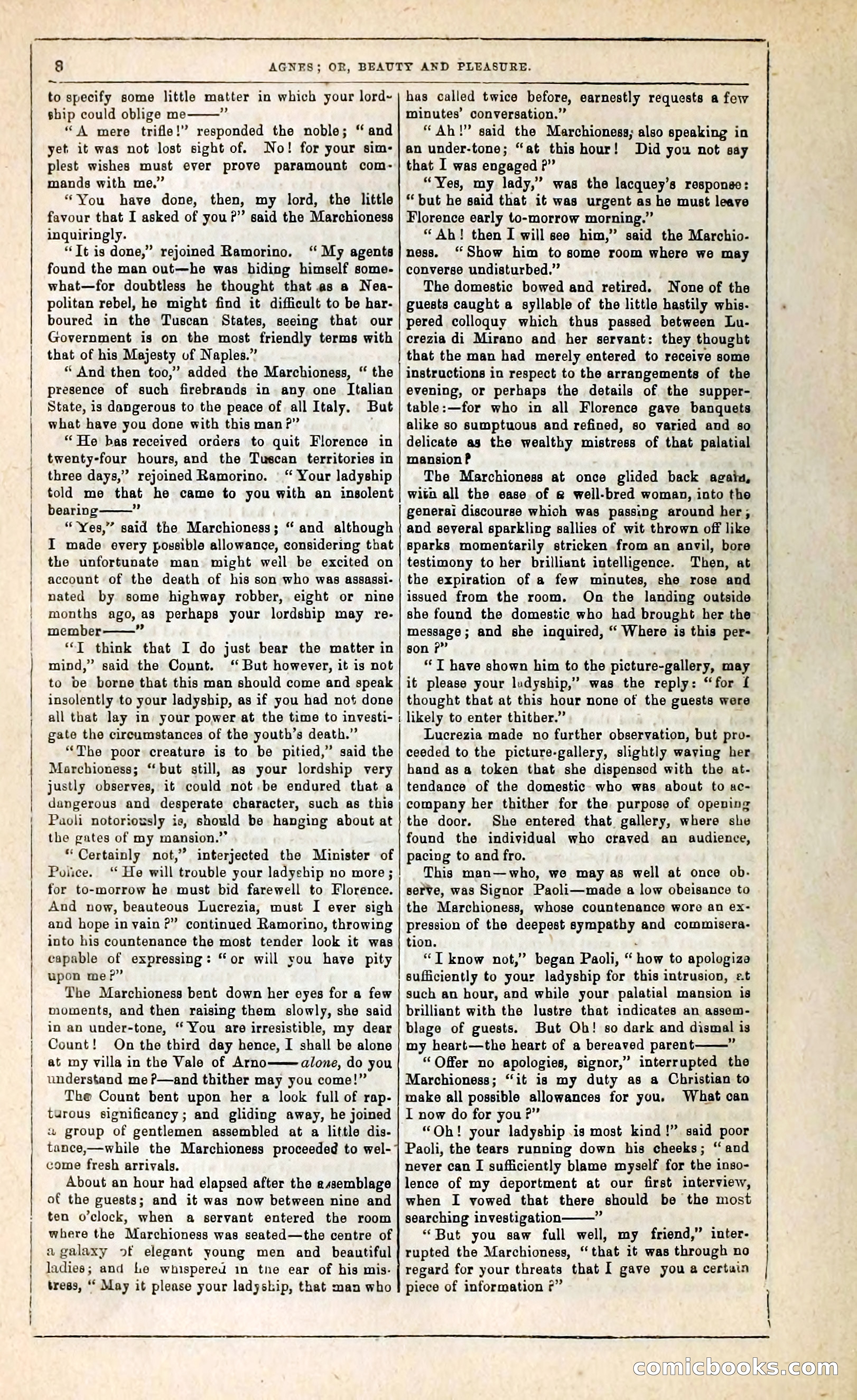
A restored page from Penny Dreadfuls, 1857. Page through the whole issue in the reader above.
📄 Transcribed text from this page (OCR, searchable)
Machine-transcribed from the original scan — historical spelling and the odd misread are preserved.
8 to specify some little matter in which your lord-~ ship could oblige me m “A mere trifle!” responded the noble; “ and yet it was not lost sight of. No! for your sim- plest wishes must ever prove paramount com- mands with me,” *You have done, then, my lord, the little favour that I asked of you?” said the Marchioness inquiringly. “Tt is done,” rejoined Ramorino, ‘ My agents found the man out—he was hiding himself some- what—for doubtless he thought that as a Nea- politan rebel, he might find it difficult to be har- bourec in the Tuscan States, seeing that our Government is on the most friendly terms with that of his Majesty of Naples.” “ And then too,” added the Marchioness, “ the presence of such firebrands in any one Italian State, is dangerous to the peace of all Italy. But what have you done with this manP” ‘He bas received orders to quit Florence in twenty-four hours, and the Tuscan territories in three days,’ rejoined Ramorino. “ Your ladyship told me that he came to you with an insolent bearing s “Yes,” said the Marchioness; “ and although I made every possible allowance, considering that the unfortunate man might weil be excited on account of the death of his son who was assassi- nated by some highway robber, eight or nine months ago, as perhaps your lordship may re- member ” ““T think that I do just bear the matter in mind,” said the Count. ‘‘ But however, it is not to be borne that this man should come and speak insolently to your ladyship, as if you had not done all that lay in your power at the time to investi- gate the circumstances of the youth’s death.” “The poor creature is to be pitied,” said the Marchioness; “but still, as your lordship very justly observes, it could not. be endured that a dangerous and desperate character, such as this Puoli notoriously is, should be hanging about at the gates of my mansion.” “Certainly not,” interjected the Minister of Police. “ He will trouble your ladyebip no more ; for to-morrow he must bid farewell to Florence. And now, beauteous Lucrezia, must I ever sigh and hope in vain ?” continued Ramorino, throwing into his countenance the most tender look it was capable of expressing: “or will you have pity upon meP” The Marchioness bent down her eyes for a few moments, and then raising them slowly, she said in an under-tone, “ You are irresistible, my dear Count! On the third day hence, I shall be alone at my villa in the Vale of Arno—— alone, do you understand me ?—and thither may you come!” The Count bent upon her a look full of rap- turous significancy; and gliding away, he joined «x group of gentlemen assembled at a little dis- tance,—while the Marchioness proceeded to wel- come fresh arrivals. About an hour had elapsed after the assemblage of the guests; and it was now between nine and ten o’clock, when a servant entered the room where the Marchioness was seated—the centre of a galaxy of elegant young men and beautiful ladies; and he whispered in tne ear of his mis- tress, ‘‘ May it please your ladyskip, that man who » Shei lt isnt agate a aa i a lc ne a a a AGNES; OR, BEAUTY AND PLEASURE. has called twice before, earnestly requests a few minutes’ conversation.” “ Ah!” said the Marchionesg; also speaking in an under-tone; “at this hour! Did you not say that I was engaged P” “Yes, my lady,” was the lacquey’s response: “but he said that it was urgent as he must leave Florence early to-morrow morning.” * Ah! then I will see him,” said the Marchio- ness. “Show him to some room where we may converse undisturbed.” The domestic bowed and retired. None of the guests caught a syllable of the little hastily whis- pered colloquy which thus passed between Lu- crezia di Mirano and her servant: they thouzht that the man had merely entered to receive some instructions in respect to the arrangements of the evening, or perhaps the details of the supper- table:—for who in all Florence gave banquets alike so sumptuous and refined, so varied and so delicate as the wealthy mistress of that palatial mansion P The Marchioness at once glided back agaiu, wito all the ease of e weill-bred woman, into the general discourse which was passing around her; and several sparkling sallies of wit thrown off like sparks momentarily stricken from an anvil, bore testimony to her brilliant intelligence. Then, at the expiration of a few minutes, she rose and issued from the room. On the landing outside she found the domestic who had brought her the message; and she inquired, “ Where is this per- son Pr” “‘T have shown him to the picture-gallery, may it please your ludyship,” was the reply: “for f thought that at this hour none of the guests were likely to enter thither.” ' Lucrezia made no further observation, but pro- ceeded to the picture-gallery, slightly waving her hand as a token that she dispensed with the at- tendance of the domestic: who was about to ac- company her thither for the purpose of opening the door. She entered that gallery, where she found the individual who craved an audience, pacing to and fro. This man—who, we may as well at once ob- serve, was Signor Paoli—made a low obeisance to the Marchioness, whose countenance wore an ex- pression of the deepest sympathy and commisera- tion. : “T know not,” began Paoli, “ how to apologiza sufficiently to your ladyship for this intrusion, e.t such an hour, and while your palatial mansion is brilliant with the lustre that indicates an assem- blage of guests. But Ob! so dark and dismal is my heart—the heart of a bereaved parent P) “ Offer no apologies, signor,” interrupted the Marchioness; “it is my duty as a Christian to make all possible allowances for yous What can I now do for you ?” “Oh! your ladyship is most kind!” said poor Paoli, the tears running down his cheeks; “and never can I sufficiently blame myself for the inso- lence of my deportment at our first interview, when I vowed that there should be the most searching investigation Y * But you saw full well, my friend,” inter- rupted the Marchioness, “that it was through no regard for your threats that I gave you a certain piece of information ?” chook (©) is)