
Penny Dreadfuls, 1857 · page 187 of 394
Agnes, or, Beauty and Pleasure — page 187: what you’re looking at
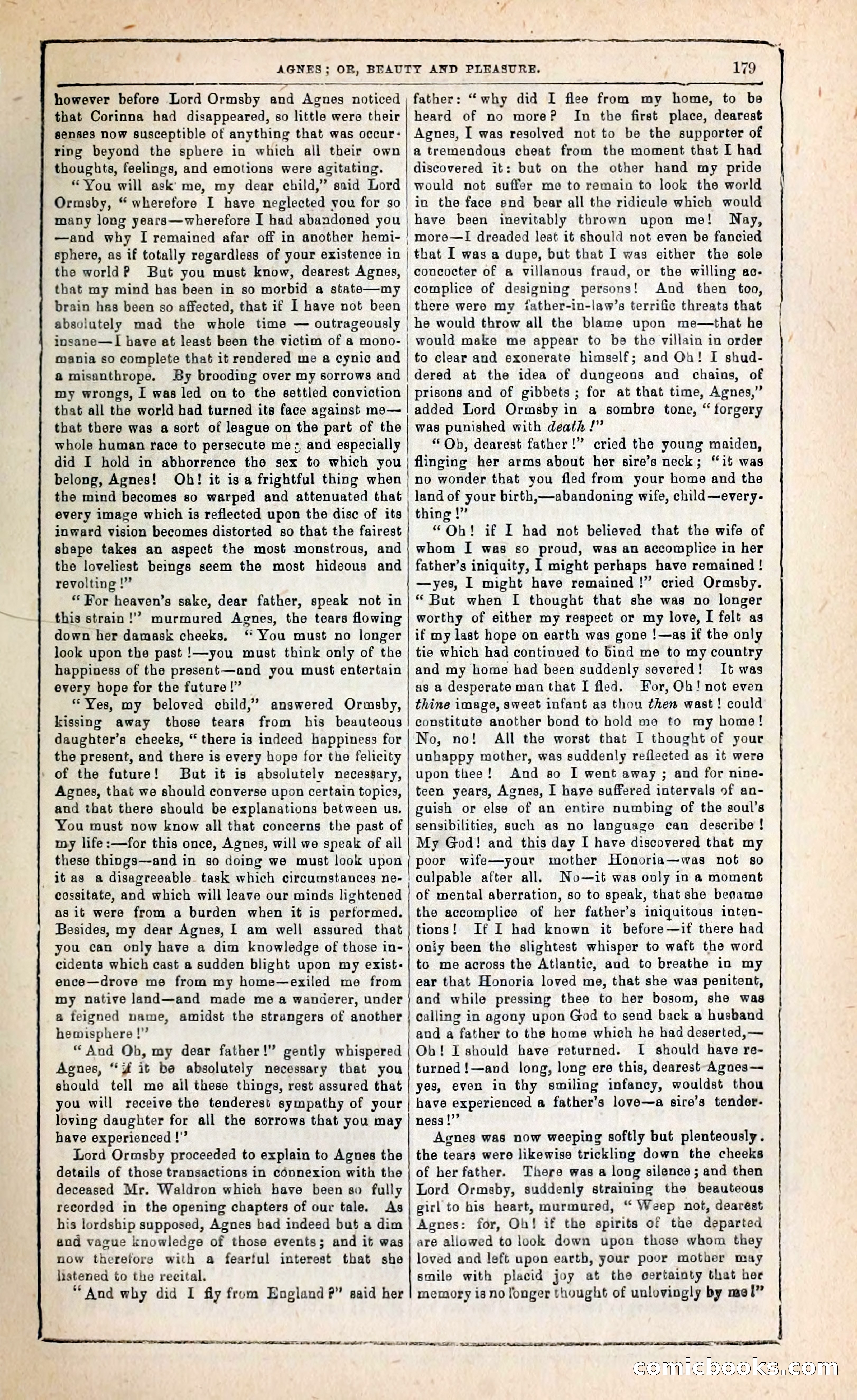
A restored page from Penny Dreadfuls, 1857. Page through the whole issue in the reader above.
📄 Transcribed text from this page (OCR, searchable)
Machine-transcribed from the original scan — historical spelling and the odd misread are preserved.
AGNES; OR, BEAUTY AND PLEASURE. however before Lord Ormsby and Agnes noticed that Corinna had disappeared, so little were their senses now susceptible of anything that was occur: ring beyond the spbere io which all their own thoughts, feelings, and emotions were agitating. * You will ask’ me, my dear child,” said Lord Ormsby, “ wherefore I have neglected you for so many long years—wherefore I had abandoned you —and why I remained afar off in another hemi- sphere, as if totally regardless of your existence in the worldP But you must know, dearest Agnes, that my mind has been in so morbid a state—my brain has been so affected, that if I have not been absvlutely mad the whole time — outrageously insane—lI have at least been the victim of a mono- mania so complete that it rendered me a cynic and a misanthrope. By brooding over my sorrows and my wrongs, I was led on to the settled conviction that all the world had turned its face against me— that there was a sort of league on the part of the whole human race to persecute me ;, and especially did I hold in abhorrence the sex to which you belong, Agnes! Oh! it is a frightful thing when the mind becomes so warped and attenuated that every image which is reflected upon the disc of its inward vision becomes distorted so that the fairest shape takes an aspect the most monstrous, and the loveliest beings seem the most hideous and revolting !” “For heaven’s sake, dear father, speak not in this strain!" murmured Agnes, the tears flowing down her damask cheeks. ‘* You must no longer look upon the past !—you must think only of the happiness of the present—and you must entertain every hope for the future!” “Yes, my beloved child,” answered Ormsby, kissing away those tears from his beauteous daughter’s cheeks, “there is indeed happiness for the present, and there is every hope for the felicity - of the future! But it is absolutely necessary, Agnes, that we should converse upon certain topics, and that there should be explanations between us. You must now know all that concerns the past of my life:—for this once, Agnes, will we speak of all these things—and in so doing we must look upon _itas a disagreeable task which circumstances ne- cessitate, and which will leave our minds lightened as it were from a burden when it is performed. Besides, my dear Agnes, I am well assured that you can only have a dim knowledge of those in- cidents which cast a sudden blight upon my exist- ence—drove me from my home—exiled me from my native land—and made me a wanderer, under a feigned name, amidst the strangers of another hemisphere !” “And Ob, my dear father!” gently whispered Agnes, “ it be absolutely necessary that you should tell me ail these things, rest assured that you will receive the tenderest sympathy of your loving daughter for all the sorrows that you may have experienced !” Lord Ormsby proceeded to explain to Agnes the details of those transactions in connexion with the deceased Mr. Waldron which have been so fully recorded in the opening chapters of our tale. As his lordship supposed, Agnes had indeed but a dim and vague knowledge of those events; and it was now therefore with a fearful interest that she listened to the recital. “And why did I fiy from England ?” said her — Ne NE ee Le Oe Oe! | Sie lee Ree Can eo eore father: “why did I flee from my home, to be heard of no more? In the first place, dearest Agnes, I was resolved not to be the supporter of a tremendous cheat from the moment that I had discovered it: but on the other hand my pride would not suffer me to remain to look the world in the face end bear all the ridicule which would have been inevitably thrown upon me! Nay, more—I dreaded lest it should not even be fancied that [ was a dupo, but that I was either the sole concocter of a villanous fraud, or the willing ac- complice of designing persons! And then too, there were my father-in-law’s terrific threats that he would throw all the blame upon me—that he would make me appear to be the villain in order to clear and exonerate himself; and Oh! I shud- dered at the idea of dungeons and chains, of prisons and of gibbets; for at that time, Agnes,” added Lord Ormsby in a sombre tone, “ forgery was punished with death !” “Ob, dearest father!” cried the young maiden, flinging her arms about her sire’s neck; “it was no wonder that you fled from your home and the land of your birth,—abandoning wife, child—every- thing !” * Oh! if I had not believed that the wife of whom I was so proud, was an accomplice in her father’s iniquity, I might perhaps have remained ! —yes, I might have remained !” cried Ormsby. * But when I thought that she was no longer worthy of either my respect or my love, I felt as if my last hope on earth was gone !—as if the only tie which had continued to bind me to my country and my home had been suddenly severed! It was as a desperate man that I fled. For, Oh! not even thine image, sweet infant as thou then wast! could constitute another bond to hold me to my home! No, no! All the worst that I thought of your unhappy mother, was suddenly reflected as it were upon thee! And so I went away ; and for nine- teen years, Agnes, I have suffered intervals of an- guish or else of an entire numbing of the soul’s sensibilities, such as no language can describe ! My God! and this day I have discovered that my poor wife—your mother Honoria—was not so culpable after all. No—it was only in a moment of mental aberration, so to speak, that she became the accomplice of her father’s iniquitous inten- tions! If I had known it before—if there had oniy been the slightest whisper to waft the word to me across the Atlantic, and to breathe in my ear that Honoria loved me, that she was penitent, and while pressing thee to her bosom, she was calling in agony upon God to send back a husband and a father to the home which he had deserted,— Ob! I should have returned. I should have re- turned !—and long, long ere this, dearest Agnes— yes, even in thy smiling infancy, wouldst thou have experienced a father’s love—a sire’s tender- ness !”’ Agnes was now weeping softly but plenteously. the tears were likewise trickling down the cheeks of her father. There was a long silence ; and then Lord Ormeby, suddenly straining the beauteous girl to his heart, murmured, “ Weep not, dearest Agnes: for, Ob! if the spirits of the departed are allowed to look down upon those whom they loved and left upon earth, your poor mother may smile with placid joy at the certainty that her memory is no longer thought of unlovingly by mot” a ichbook (©) 5}