
Penny Dreadfuls, 1857 · page 196 of 394
Agnes, or, Beauty and Pleasure — page 196: what you’re looking at
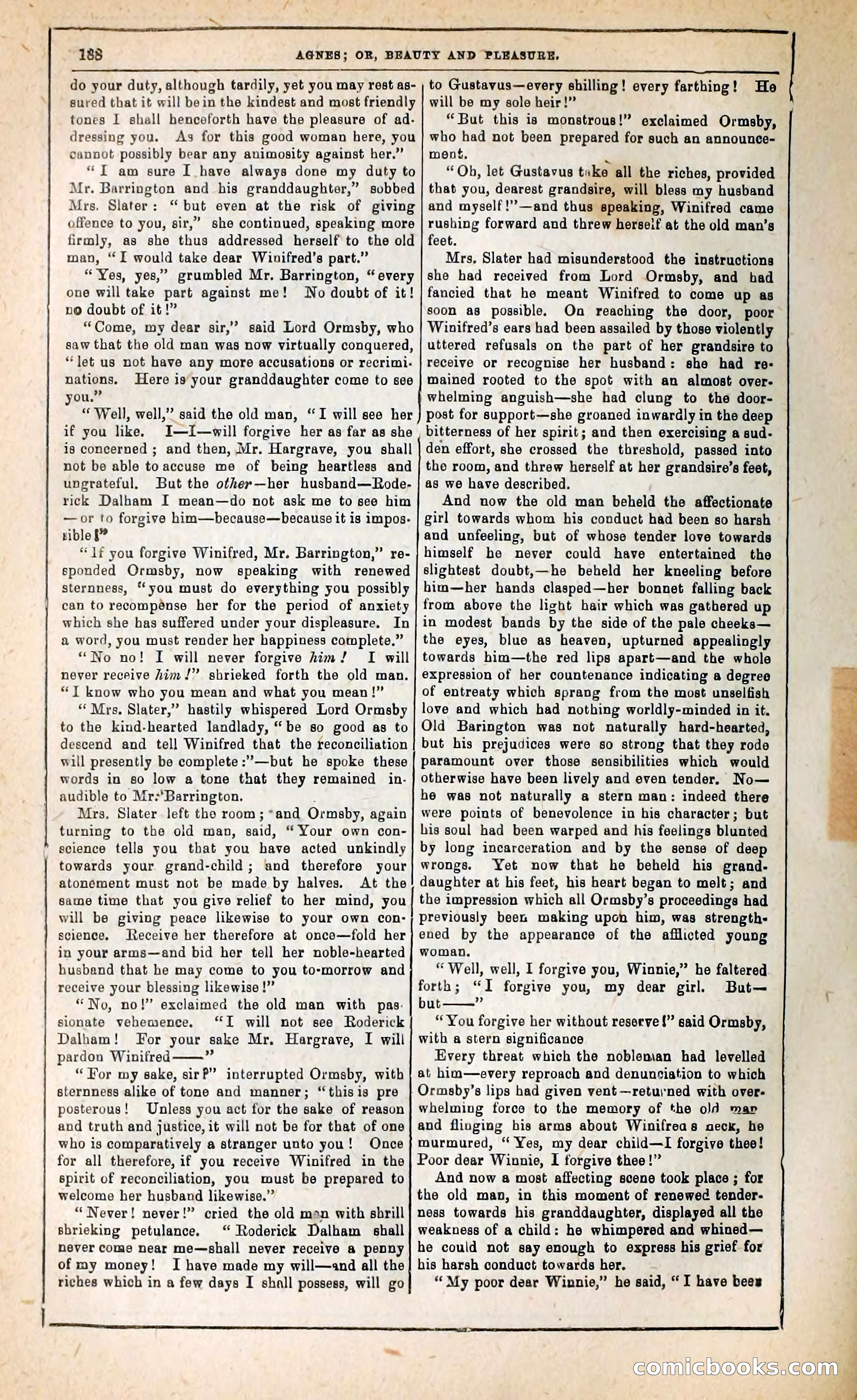
A restored page from Penny Dreadfuls, 1857. Page through the whole issue in the reader above.
📄 Transcribed text from this page (OCR, searchable)
Machine-transcribed from the original scan — historical spelling and the odd misread are preserved.
188 do your duty, although tardily, yet you may rest as- sured that it will bein the kindest and most friendly tones I shall henceforth have the pleasure of ad- dressing you. As for this good woman here, you cannot possibly bear any animosity against her.” “I am sure I have always done my duty to Mr. Barrington and his granddaughter,” sobbed Mrs. Slater: “but even at the risk of giving offence to you, sir,” she continued, speaking more firmly, as she thus addressed herself to the old man, “I would take dear Winifred’s part.” “Yes, yes,’ grumbled Mr. Barrington, “every one will take part against me! No doubt of it! no doubt of it!” “Come, my dear sir,’ said Lord Ormsby, who saw that the old man was now virtually conquered, “let us not have any more accusations or recrimi- nations. Here is your granddaughter come to see ou.” “Well, well,”’ said the old man, “I will see her if you like. I—I—will forgive her as far as she is concerned ; and then, Mr. Hargrave, you shall not be able toaccuse me of being heartless and ungrateful. But the other—her husband—Rode- rick Dalham I mean—do not ask me to see him —or to forgive him—because—because it is impos- rible §” “If you forgive Winifred, Mr. Barrington,” re- sponded Ormsby, now speaking with renewed sternness, “you must do everything you possibly can to recompénse her for the period of anxiety which she has suffered under your displeasure. In a word, you must render her happiness complete.” “No no! I will never forgive him! I will never receive him!” shrieked forth the old man. “I know who you mean and what you mean!” ““ Mrs, Slater,” hastily whispered Lord Ormsby to the kind-hearted landlady, “be so good as to descend and tell Winifred that the reconciliation will presently be complete :’—but he spoke these words in so low a tone that they remained in- audible to Mr-Barrington. Mrs, Slater left the room; *and Ormsby, again turning to the old man, said, “ Your own con- science tells you that you have acted unkindly | towards your grand-child; and therefore your atonément must not be made by halves. At the same time that you give relief to her mind, you will be giving peace likewise to your own con- science. Receive her therefore at once—fold her in your arms—and bid her tell her noble-hearted husband that he may come to you to-morrow and receive your blessing likewise !” “No, no!” exclaimed the old man with pas. sionate vehemence. “I will not see Roderick Dalham! For your sake Mr. Hargrave, I will pardon Winifred “ For my sake, sirP” interrupted Ormsby, with sternness alike of tone and manner; “thisis pre posterous! Unless you act for the sake of reason and truth and justice, it will not be for that of one who is comparatively a stranger unto you! Once for all therefore, if you receive Winifred in the spirit of reconciliation, you must be prepared to welcome her husband likewise.” “Never! never!” cried the old men with sbrill shrieking petulance. ‘“ Roderick Dalham shall never come near me—shall never receive a penny of my money! I have made my will—and all the riches which in a few days I shall possess, will go AGNES; OR, BEAUTY AND PLEASURE. ———— ee a to Gustavus—every shilling! every farthing! Hoe will be my sole heir!” “But this is monstrous!” exclaimed Ormsby, who had not been prepared for such an announce- ment, “Ob, let Gustavus take all the riches, provided that you, dearest grandsire, will bless my husband and myself!’’—and thus speaking, Winifred came rushing forward and threw herseif at the old man’s feet. Mrs, Slater had misunderstood the instructions she had received from Lord Ormsby, and had fancied that he meant Winifred to come up as soon as possible. On reaching the door, poor Winifred’s ears had been assailed by those violently uttered refusals on the part of her grandsire to recelve or recognise her husband: she had re- mained rooted to the spot with an almost over- whelming anguish—she had clung to the door- post for support—she groaned inwardly i In the deep bitterness of her spirit; and then exercising a sud- den effort, she crossed the threshold, passed into the room, ‘and threw herself at her grandsire’s feet, as we have described. And now the old man beheld the affectionate girl towards whom his conduct had been so harsh and unfeeling, but of whose tender love towards himself he never could have entertained the slightest doubt,—he beheld her kneeling before him—her hands clasped—her bonnet falling back from above the light hair which was gathered up in modest bands by the side of the pale cheeks— the eyes, blue as heaven, upturned appealingly towards him—the red lips apart—and the whole expression of her countenance indicating a degree of entreaty which sprang from the most unselfish love and which had nothing worldly-minded in it. Old Barington was not naturally hard-hearted, but his prejudices were so strong that they rode paramount over those sensibilities which would otherwise have been lively and even tender. No— he was not naturally a stern man: indeed there were points of benevolence in his character; but his soul had been warped and his feelings blunted by long incarceration and by the sense of deep wrongs. Yet now that he beheld his grand. daughter at his feet, his heart began to melt; and the impression which all Ormsby’s proceedings had previously been making upch him, was strength- ened by the appearance of the afflicted young woman. “Well, well, I forgive you, Winnie,” he faltered forth ; “I forgive you, my dear girl. But— but “You forgive her without reserve $” said Ormsby, with a stern significance Every threat which the nobleman had levelled at him—every reproach and denunciation to which Ormsby’s lips had given vent—returned with over- whelming force to the memory of the old map and flinging bis arms about Winifreas aecx, he murmured, ‘ Yes, my dear child—I forgive thee! Poor dear Winnie, I forgive thee!” And now a most affecting scene took place ; for the old man, in this moment of renewed tender- ness towards his granddaughter, displayed all the weakness of a child: he whimpered and whined— he could not say enough to express his grief for his harsh conduct towards her. “‘ My poor dear Winnie,” he said, “ I have bees (E@)