
Penny Dreadfuls, 1857 · page 200 of 394
Agnes, or, Beauty and Pleasure — page 200: what you’re looking at
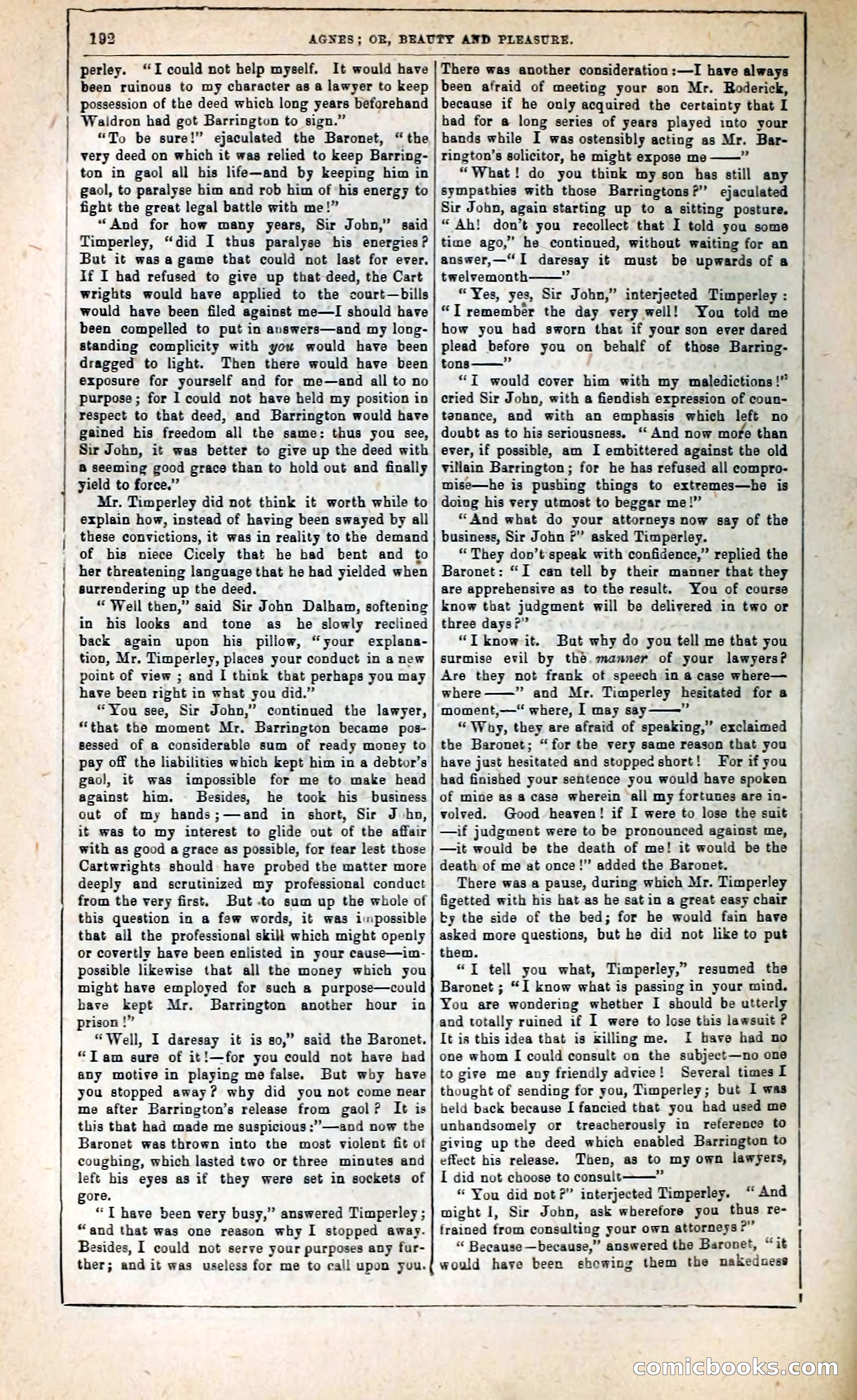
A restored page from Penny Dreadfuls, 1857. Page through the whole issue in the reader above.
📄 Transcribed text from this page (OCR, searchable)
Machine-transcribed from the original scan — historical spelling and the odd misread are preserved.
perley. “I could not help myself. It would have been ruinous to my character as a lawyer to keep possession of the deed which long years beforehand Waldron had got Barrington to sign.” “To be sure!” ejaculated the Baronet, “the very deed on which it was relied to keep Barring- ton in gaol all his life—and by keeping him in gaol, to paralyse him and rob him of ‘his energy to fight the great legal battle with me!” “And for how many years, Sir Jobn,” said _ Timperley, “did I thus paralyse his energies? But it was a game that could not last for ever. If I had refused to give up that deed, the Cart wrights would have applied to the court—bills would have been filed against me—I should have been compelled to put in answers—and my long- standing complicity with you would have been dragged to light. Then there would have been exposure for yourself and for me—and all to no purpose ; for I could not have held my position in respect to that deed, and Barrington would have gained his freedom all the same: thus you see, Sir John, it was better to give up the deed with 8 seeming good grace than to hold out and finally yield to force.” Mr. Timperley did not think it worth while to explain how, instead of having been swayed by all these convictions, it was in reality to the demand of his niece Cicely that he had bent and to her threatening language that he had yielded when surrendering up the deed. “ Weil then,” said Sir John Dalhan, softening in his looks and tone as he slowly reclined back again upon his pillow, “your explana- tion, Mr. Timperley, places your conduct in a new point of view ; and I think that perhaps you may have been right in what you did.” “You see, Sir John,” continued the lawyer, “that the moment Mr. Barrington became pos- sessed of a considerable sum of ready money to pay off the liabilities which kept him in a debtor’s gaol, it was impossible for me to make head against him. SBesides, he took his business out of my hands;—and in short, Sir J ho, it was to my interest to glide out of the affair with as good a grace as possible, for tear lest those Cartwrights should have probed the matter more deeply and scrutinized my professional conduct from the very first. But .to sum up the whole of this question in a few words, it was impossible that all the professional skill which might openly or covertly have been enlisted in your cause—im- possible likewise that all the money which you might have employed for such a purpose—could have kept Mr. Barrington another hour in prison !” “Well, I daresay it is so,” said the Baronet. “Tam sure of it!—for you could not have had any motive in playing me false. But why have you stopped away? why did you not come near me after Barrington’s release from gaol? It is this that had made me suspicious :”—and now the Baronet was thrown into the most violent fit of coughing, which lasted two or three minutes and left his eyes as if they were set in sockets of gore. “T have been very busy,” answered Timperley ; “and that was one reason why I stopped away. Besides, I could not serve your purposes any fur- ther; and it was useless for me to call upon you. AGNES; OR, BEAUTY AND PLEASURE. ; There was another consideration :—TI have always been afraid of meeting your son Mr. Roderick, because if he only acquired the certainty that I had for a long series of years played into your bands while I was ostensibly acting as Mr. Bar- rington’s solicitor, he might expose me ——” “What! do you think my son has still any sympathies with those Barringtons?’’ ejaculated Sir Jobn, again starting up to a sitting posture, “ Ah! don’t you recollect that I told you some time ago,” he continued, without waiting for an answer,—“I daresay it must be upwards of a twelvemonth 2 “Yes, yes, Sir John,” interjected Timperley : “T remember the day very well! You told me how you had sworn that if your son ever dared plead before you on behalf of those Barring- tons a “TI would cover him with my maledictions!” cried Sir John, with a fiendish expression of coun- tenance, and with an emphasis which left no doubt as to his seriousness. ‘And now mofe than ever, if possible, am I embittered against the old villain Barrington; for he has refused all compro- mise—he is pushing things to extremes—he is doing his very utmost to beggar me!” _ “And what do your attorneys now say of the business, Sir John ?” asked Timperley. “They don’t speak with confidence,” replied the Baronet: “I can tell by their manner that they are apprehensive as to the result. You of course know tbat judgment will be delivered in two or three days?” “T know it. But why do you tell me that you surmise evil by thé. manner of your lawyers? Are they not frank of speech in a case where— where ” and Mr. Timperley hesitated for a moment,—* where, | may say-———” * Why, they are afraid of speaking,” exclaimed the Baronet; “for the very same reason that you have just hesitated and stoppecshort! For if you had finished your sentence you would have spoken of mine as a case wherein all my fortunes are in- volved. Good heaven! if I were to lose the suit —if judgment were to be pronounced against me, —it would be the death of me! it would be the death of me at once!” added the Baronet. There was a pause, during which Mr. Timperley figetted with his hat as he satin a great easy chair ty the side of the bed; for he would fain have asked more questions, but he did not like to put them. “T tell you what, Timperley,” resumed the Baronet ; “I know what is passing in your mind, You are wondering whether I should be utterly and totally ruined if I were to lose this lawsuit ? It is this idea that is killing me. I have had no one whom I could consult on the subject—no one to give me any friendly advice! Several times I thought of sending for you, Timperley; but I was held back because I fancied that you had used me unhandsomely or treacherously in reference to giving up the deed which enabled Barrington to effect his release. Then, as to my own lawyers, I did not choose to consult . “ You did not?” interjected Timperley. “And might I, Sir John, ask wherefore you thus re- frained from consulting your own attorneys ?” “ Because —because,” answered the Baronet, “it would have been showing them the nakedness COMmMicoook<