
Penny Dreadfuls, 1857 · page 232 of 394
Agnes, or, Beauty and Pleasure — page 232: what you’re looking at
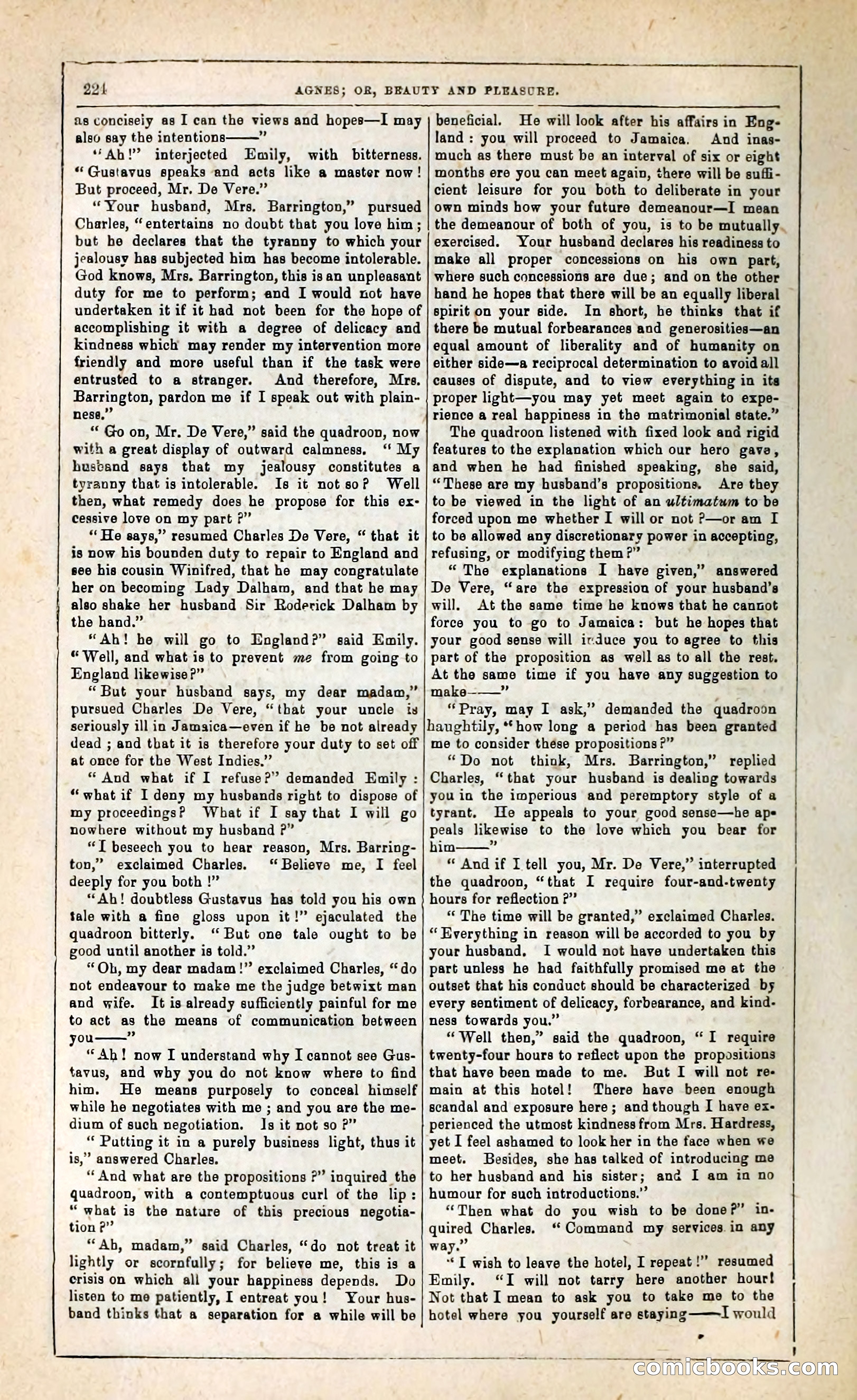
A restored page from Penny Dreadfuls, 1857. Page through the whole issue in the reader above.
📄 Transcribed text from this page (OCR, searchable)
Machine-transcribed from the original scan — historical spelling and the odd misread are preserved.
224. fs concisely as I can the views and hopes—I may also say the intentions " ‘‘Ah!” interjected Emily, with bitterness, “Gustavus speaks and acts like a master now! But proceed, Mr. De Vere.” “Your husband, Mrs. Barrington,” pursued Charles, “entertains no doubt that you love him; but he declares that the tyranny to which your jealousy has subjected him has become intolerable. God knows, Mrs. Barrington, this isan unpleasant duty for me to perform; and I would not have undertaken it if it had not been for the hope of accomplishing it with a degree of delicacy and kindness which may render my intervention more friendly and more useful than if the task were entrusted to a stranger. And therefore, Mra. Barrington, pardon me if I speak out with plain- nese,” “Go on, Mr. De Vere,” said the quadroon, now with a great display of outward calmness, ‘‘ My huscand says that my jealousy constitutes a tyranny that is intolerable. Is it notsoP Well then, what remedy does he propose for this ex- cessive love on my part P” “‘He says,’ resumed Charles De Vere, “ that it is now his bounden duty to repair to England and see his cousin Winifred, that he may congratulate her on becoming Lady Dalham, and that he may | also shake her husband Sir Roderick Dalham by the hand.” “Ah! he will go to England?” said Emily. “Well, and what is to prevent me from going to England likewise?” “But your husband says, my dear madam,” pursued Charles De Vere, “that your uncle ts seriously ill in Jamaica—even if he be not already dead ; and tbat it is therefore your duty to set off at once for the West Indies.” * And what if I refuse?” demanded Emily : “what if I deny my husbands right to dispose of my proceedings? What if I say that I will go nowhere without my husband P” “T beseech you to hear reason, Mrs. Barring- ton,” exclaimed Charles. ‘“ Believe me, I feel deeply for you both !” “Ah! doubtless Gustavus has told you his own tale with a fine gloss upon it!” ejaculated the quadroon bitterly. “But one tale ought to be good until another is told.” “Oh, my dear madam!” exclaimed Charles, “do not endeavour to make me the judge betwixt man and wife. It is already sufficiently painful for me to act as the means of communication between you ”? ““Ah! now I understand why I cannot see Gus- tavus, and why you do not know where to find him. He means purposely to conceal himself while he negotiates with me ; and you are the me- dium of such negotiation. Is it not so ?” “‘ Putting it in a purely business light, thus it is,” answered Charles. ‘‘And what are the propositions ?” inquired the quadroon, with a contemptuous curl of the lip: “what is the nature of this precious negotia- tion ?” “Ab, madam,” said Charles, “do not treat it lightly or scornfully; for believe me, this is a crisis on which all your happiness depends. Do listen to me patiently, I entreat you! Your hus- band thinks that a separation for a while will be AGNES; OB, BEAUTY AND PLEASURE. beneficial. He will look after his affairs in Eng- land : you will proceed to Jamaica. And inas- much as there must be an interval of six or eight months ere you can meet again, there will be suffi- cient leisure for you both to deliberate in your own minds how your future demeanour—I mean the demeanour of both of you, is to be mutually. exercised. Your husband declares his readiness to make all proper concessions on his own part, where such concessions are due; and on the other hand he hopes that there will be an equally liberal spirit on your side. In short, he thinks that if there be mutual forbearances and generosities—an equal amount of liberality and of humanity on either side—a reciprocal determination to avoid all causes of dispute, and to view everything in its proper light—you may yet meet again to expe- rience a real happiness in the matrimonial state.” The quadroon listened with fixed look and rigid features to the explanation which our hero gave, and when he had finished speaking, she said, “These are my husband’s propositions. Are they to be viewed in the light of an ultimatum to be forced upon me whether I will or not P—or am I to be allowed any discretionary power in accepting, refusing, or modifying them?” “ The explanations I have given,” answered De Vere, “are the expression of your husband’s will. At the same time he knows that he cannot foree you to go to Jamaica: but he hopes that your good sense will irduce you to agree to this part of the proposition as well as to all the rest. At the same time if you have any suggestion to make—-——” “Pray, may I ask,” demanded the quadrodn haughtily, **how long a period has been granted me to consider thése propositions?” “Do not think, Mrs. Barrington,” replied Charles, “that your husband is dealing towards you in the imperious and peremptory style of a tyrant, He appeals to your good sense—he ape peals likewise to the love which you bear for him : * And if I tell you, Mr. De Vere,” interrupted the quadroon, “that I require four-and-twenty hours for reflection ?”’ *‘ The time will be granted,” exclaimed Charles. “Everything in reason will be accorded to you by your husband, I would not have undertaken this part unless he had faithfully promised me at the outset that his conduct should be characterized by every sentiment of delicacy, forbearance, and kind- ness towards you.” “Well then,” said the quadroon, “I require twenty-four hours to reflect upon the propositions that have been made to me. But I will not re- main at this hotel! There have been enough scandal and exposure here; and though I have ex- perienced the utmost kindness from Mrs. Hardress, yet I feel ashamed to look her in the face when we meet. Besides, she has talked of introducing me to her husband and his sister; and I am in no humour for such introductions.’ “Then what do you wish to be done?” in- quired Charles. “Command my services.in any way.” “T wish to leave the hotel, I repeat!” resumed Emily. “I will not tarry here another hour! Not that I mean to ask you to take me to the hotel where you yourself are staying——I would > ; a ©) Si} ighbooksrco 5}