
Penny Dreadfuls, 1857 · page 251 of 394
Agnes, or, Beauty and Pleasure — page 251: what you’re looking at
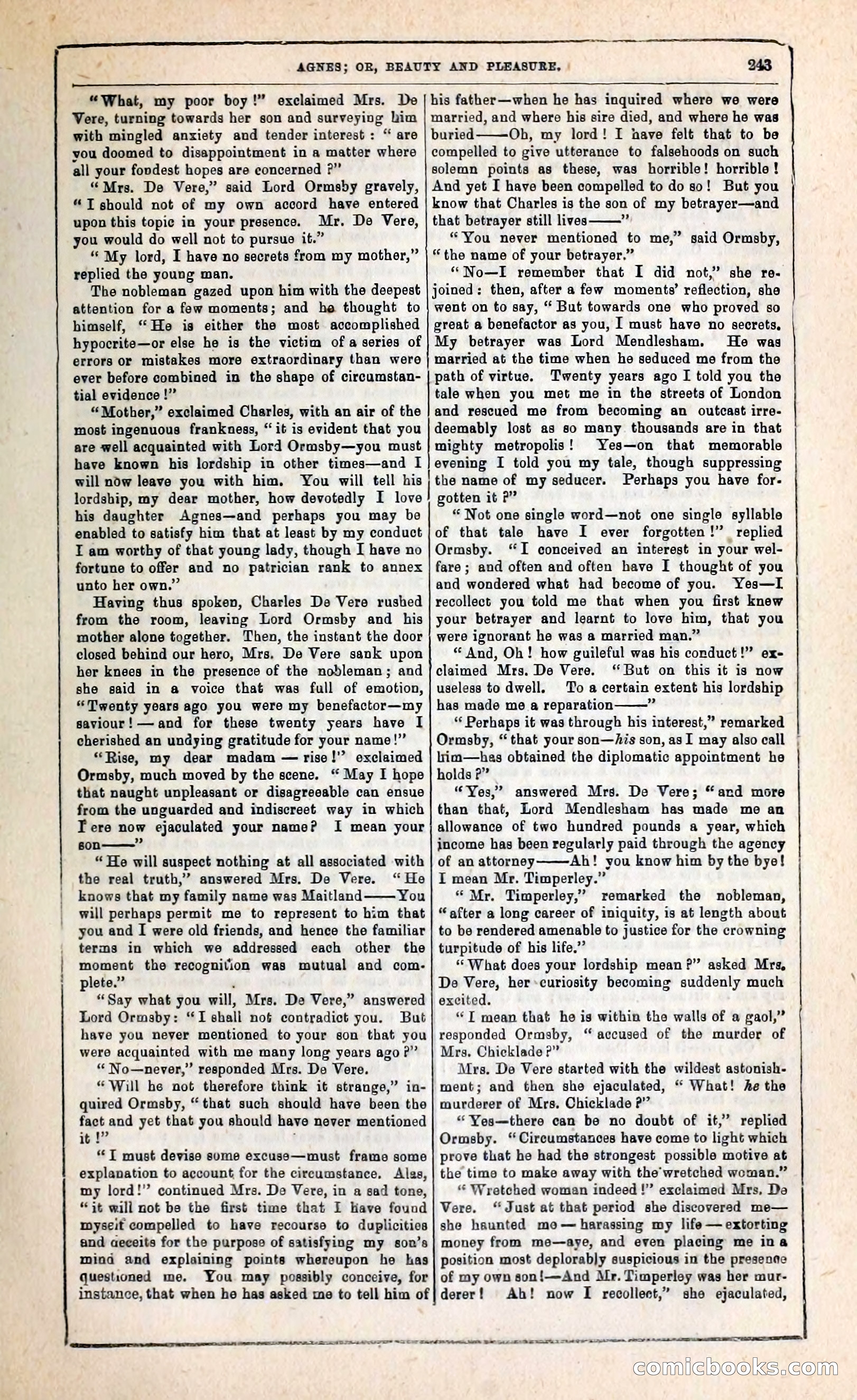
A restored page from Penny Dreadfuls, 1857. Page through the whole issue in the reader above.
📄 Transcribed text from this page (OCR, searchable)
Machine-transcribed from the original scan — historical spelling and the odd misread are preserved.
= F AGNES; OR, BEAUTY AND PLEASURE, | a ee ee 243 “What, my poor boy!” exclaimed Mrs. De Vere, turning towards her son and surveying him with mingled anxiety and tender interest : “ are vou doomed to disappointment in a matter where all your fondest hopes are concerned ?”’ “Mrs. De Vere,” said Lord Ormsby gravely, “T should not of my own accord have entered upon this topic in your presence. Mr. De Vere, you would do well not to pursue it.” “My lord, I have no secrets from my mother,” replied the young man. The nobleman gazed upon him with the deepest attention for a few moments; and he thought to himself, “He is either the most accomplished hypocrite—or else he is the victim of a series of errors or mistakes more extraordinary than were ever before combined in the shape of circumstan- tial evidence !” “Mother,” exclaimed Charles, with an air of the most ingenuous frankness, “it is evident that you are well acquainted with Lord Ormsby—you must have known his lordship in other times—and I will now leave you with him. You will tell his lordship, my dear mother, how devotedly I love his daughter Agnes—and perhaps you may be enabled to satisfy him that at least by my conduct T am worthy of that young lady, though I have no fortune to offer and no patrician rank to annex unto her own.” Having thus spoken, Charles De Vere rushed from the room, leaving Lord Ormsby and his mother alone together. Then, the instant the door elosed behind our hero, Mrs, De Vere sank upon her knees in the presence of the nobleman; and she said in a voice that was full of emotion, Twenty years ago you were my benefactor—my saviour!— and for these twenty years have I cherished an undying gratitude for your name!” ‘Rise, my dear madam — rise!’ exclaimed Ormsby, much moved by the scene. “ May I hope that naught unpleasant or disagreeable can ensue from the unguarded and indiscreet way in which Tere now ejaculated your name? I mean your son " “ He will suspect nothing at all associated with the real truth,” answered Mrs. De Vere. “He knows that my family name was Maitland You will perhaps permit me to represent to him that you and I were old friends, and hence the familiar terms in which we addressed each other the moment the recognition was mutual and com- plete.” ‘ “Say what you will, Mre. De Vere,” answered Lord Ormsby: “I shall no& contradict you. But have you never mentioned to your son that you were acquainted with me many long years ago?” “* No—never,” responded Mrs. De Vere. * Will he not therefore think it strange,” in- quired Ormsby, “that such should have been the fact and yet that you should have never mentioned it !” **T must devise some excuss—must frame some explanation to account for the circumstance. Alas, my lord!’”’ continued Mrs. De Vere, in a sad tone, ‘it will not be the first time that I Have found myseit compelled to have recourse to duplicities and aeceits for the purpose of satisfying my son’s ming and explaining points whereupon he has questioned me. You may poasibly conceive, for instance, that when he has asked me to tell him of a eS Or SSO oT cee eer BE GOES EOE hee eee rca his father—when he has inquired where we were married, and where his sire died, and where he was buried Oh, my lord! I have felt that to be compelled to give utterance to falsehoods on such solemn points as these, was horrible! horrible ! And yet I have been compelled to do so! But you know that Charles is the son of my betrayer—and that betrayer still lives ds “You never mentioned to me,” said Ormsby, “the name of your betrayer.” ‘“No—I remember that I did not,” she re- joined: then, after a few moments’ reflection, she went on to say, “ But towards one who proved so great a benefactor as you, I must have no secrets, My betrayer was Lord Mendlesham. He was married at the time when he seduced me from the path of virtue. Twenty years ago I told you the tale when you met me in the streets of London and rescued me from becoming an outcast irre- deemably lost as so many thousands are in that mighty metropolis! Yes—on that memorable evening I told you my tale, though suppressing the name of my seducer. Perhaps you have for- gotten it ?” “ Not one single word—not one single syllable of that tale have I ever forgotten!” replied Ormsby. “I conceived an interest in your wel- fare ; and often and often have I thought of you and wondered what had become of you. Yes—I recollect you told me that when you first knew your betrayer and learnt to love him, that you were ignorant he was a married man.” “ And, Oh! how guileful was his conduct!” ex- claimed Mrs. De Vere. “But on this it is now useless to dwell. To a certain extent his lordship has made me a reparation » ** Perhaps it was through his interest,” remarked Ormsby, “ that your son—his son, asI may also call lrim—has obtained the diplomatic appointment he holds P” “Yes,” answered Mrs. De Vere; “and more than that, Lord Mendlesham has made me an allowance of two hundred pounds a year, which income has been regularly paid through the agency of an attorney Ah! you know him by the bye! I mean Mr. Timperley.” ** Mr. Timperley,’ remarked the nobleman, “after a long career of iniquity, is at length about to be rendered amenable to justice for the crowning turpitude of his life.” ““ What does your lordship mean?” asked Mrs, De Vere, her curiosity becoming suddenly much excited. ““T mean that he is within the walls of a gaol,” responded Ormsby, “accused of the murder of Mrs. Chicklade ?” Mrs. De Vere started with the wildest astonish- ment; and then she ejaculated, “ What! he the murderer of Mrs, Chicklade ?” ““Yes—there can be no doubt of it,’ replied Ormsby. “Circumstances have come to light which prove that he had the strongest possible motive at the time to make away with the wretched woman.” “‘ Wretched woman indeed !” exclaimed Mrs, Da Vere. “Just at that period she discovered me— she haunted mo— harassing my life —extorting money from me—aye, and even placing me ina position most deplorably suspicious in the presende of my own son!—And Mr. Timperley was her mur- derer! Ah! now [I recollect,” she ejaculated, COMmiclookk co 5}