
Penny Dreadfuls, 1857 · page 253 of 394
Agnes, or, Beauty and Pleasure — page 253: what you’re looking at
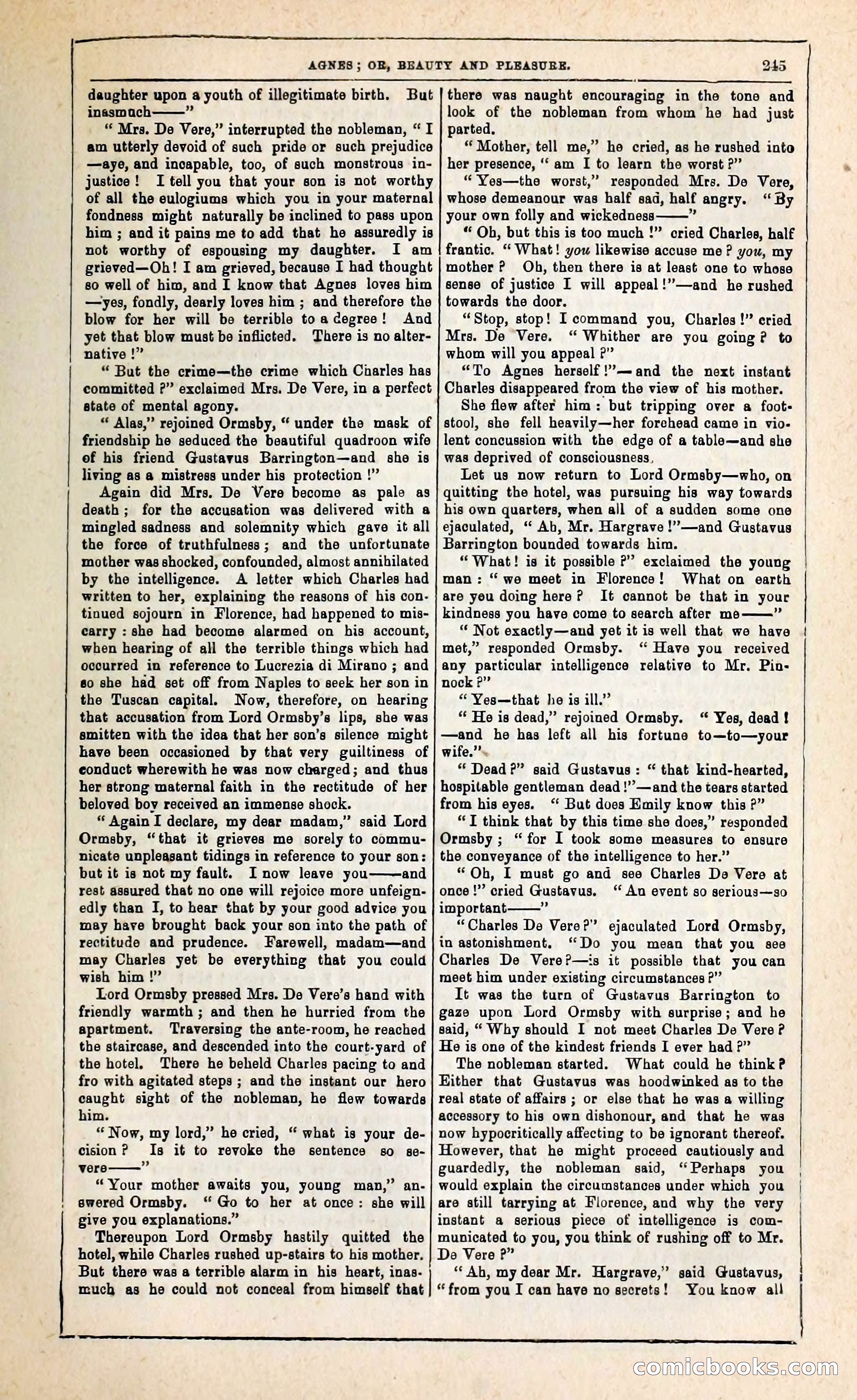
A restored page from Penny Dreadfuls, 1857. Page through the whole issue in the reader above.
📄 Transcribed text from this page (OCR, searchable)
Machine-transcribed from the original scan — historical spelling and the odd misread are preserved.
ET A AGNES; OR, BEAUTY AND PLEASURE, daughter upon a youth of illegitimate birth. But inssmach ve “‘ Mrs. De Vere,” interrupted the nobleman, “ I am utterly devoid of such pride or such prejudice —aye, and incapable, too, of such monstrous in- justice! I tell you that your son is not worthy of all the eulogiums which you in your maternal fondness might naturally be inclined to pass upon him ; and it pains me to add that he assuredly is not worthy of espousing my daughter. I am grieved—Oh! I am grieved, because I had thought so well of him, and I know that Agnes loves him —yes, fondly, dearly loves him ; and therefore the blow for her will be terrible toacegree! And yet that blow must be inflicted. There is no alter- native !” “ But the crime—the crime which Charles has committed ?” exclaimed Mrs. De Vere, in a perfect atate of mental agony. Alas,” rejoined Ormsby, “ under the mask of friendship he seduced the beautiful quadroon wife ef his friend Gustavus Barrington—and she is living as @ mistress under his protection !” Again did Mrs. De Vere become as pale as death; for the accusation was delivered with a mingled sadness and solemnity which gave it all the force of truthfulness; and the unfortunate mother was shocked, confounded, almost annihilated by the intelligence. A letter which Charles had written to her, explaining the reasons of his con- tinued sojourn in Florence, had happened to mis- carry : she had become alarmed on his account, when hearing of all the terrible things which had occurred in reference to Lucrezia di Mirano ; and eo she had set off from Naples to seek her son in the Tuscan capital. Now, therefore, on hearing that accusation from Lord Ormsby’s lips, she was smitten with the idea that her son’s silence might have been occasioned by that very guiltiness of eonduct wherewith he was now charged; and thus her strong maternal faith in the rectitude of her beloved boy received an immense shock. * Again I declare, my dear madam,” said Lord Ormsby, “that it grieves me sorely to commu- nicate unpleasant tidings in reference to your son: but it is not my fault. I now leave you and rest assured that no one will rejoice more unfeign- edly than I, to hear that by your good advice you may have brought back your son into the path of rectitude and prudence. Farewell, madam—and may Charles yet be everything that you could wish him !” Lord Ormsby pressed Mrs. De Vere’s hand with friendly warmth ; and then he hurried from the apartment. ‘Traversing the ante-room, he reached the staircase, and descended into the court-yard of the hotel. There he beheld Charles pacing to and fro with agitated steps ; and the instant our hero caught sight of the nobleman, he flew towards him. “Now, my lord,” he cried, “ what is your de- cision? Is it to revoke the sentence so se- vere de “Your mother awaits you, young man,” an- awered Ormsby. ‘ Go to her at once: she will give you explanations.” Thereupon Lord Ormsby hastily quitted the hotel, while Charles rushed up-stairs to his mother. But there was a terrible alarm in his heart, inas- much as he could not conceal from himself that} “from you I can have no secrets ! 245 there was naught encouraging in the tone and look of the nobleman from whom he had just parted. ‘** Mother, tell me,” he cried, as he rushed into her presence, ‘‘ am I to learn the worst P” “Yes—the worst,’ responded Mrs. De Vere, whose demeanour was half sad, half angry. “By your own folly and wickedness 2 ** Ob, but this is too much !” cried Charles, half frantic. “‘ What! you likewise accuse me? you, my mother ? Oh, then there is at least one to whose sense of justice I will appeal!”—and he rushed towards the door. “Stop, stop! IT command you, Charles!” eried Mrs. De Vere. “ Whither are you going? to whom will you appeal P” “To Agnes herself!’—and the next instant Charles disappeared from the view of his mother. She flew after him: but tripping over a foot- stool, she fell heavily—her forehead came in vio- lent concussion with the edge of a table—and she was deprived of consciousness, Let us now return to Lord Ormsby—who, on quitting the hotel, was pursuing his way towards his own quarters, when all of a sudden some one ejaculated, “‘ Ab, Mr. Hargrave !”—and Gustavus Barrington bounded towards him. “What! is it possible ?”’ exclaimed the young man: “we meet in Florence! What on earth are you doing here? It cannot be that in your kindness you have come to search after me——”’ “ Not exactly—and yet it is well that we have met,” responded Ormsby. “ Have you received any particular intelligence relative to Mr. Pino- nock P” **'Yes—that he is ill.” “* He is dead,” rejoined Ormsby. “ Yes, dead ! —and he has left all his fortune to—to—your wife.” ** Dead ?” said Gustavus: “ that kind-hearted, hospitable gentleman dead !”—and the tears started from his eyes. ‘ But does Emily know this P” “T think that by this time she does,” responded Ormsby ; “for I took some measures to ensure the conveyance of the intelligence to her.” “Oh, I must go and see Charles Do Vere at once!” cried Gustavus. “An event so serious—so important 7 “Charles De Vere?” ejaculated Lord Ormsby, in astonishment. ‘Do you mean that you see Charles De Vere?—is it possible that you can meet him under existing circumstances P” It was the turn of Gustavus Barrington to gaze upon Lord Ormsby with surprise; and he said, “ Why should I not meet Charles De Vere? He is one of the kindest friends I ever had ?” The nobleman started. What could he think? Either that Gustavus was hoodwinked as to the real state of affairs ; or else that he was a willing accessory to his own dishonour, and that he was now hypocritically affecting to be ignorant thereof. However, that he might proceed cautiously and guardedly, the nobleman said, ‘“‘ Perhaps you would explain the circumstances under which you are still tarrying at Florence, and why the very instant a serious piece of intelligence is com- municated to you, you think of rushing off to Mr. De Vere ?” “* Ah, my dear Mr. Hargrave,” said Gustavus, You know all SS So SHalEO) Comichboo ————————_———_—_—_-- srr. Oe nn