
Penny Dreadfuls, 1857 · page 266 of 394
Agnes, or, Beauty and Pleasure — page 266: what you’re looking at
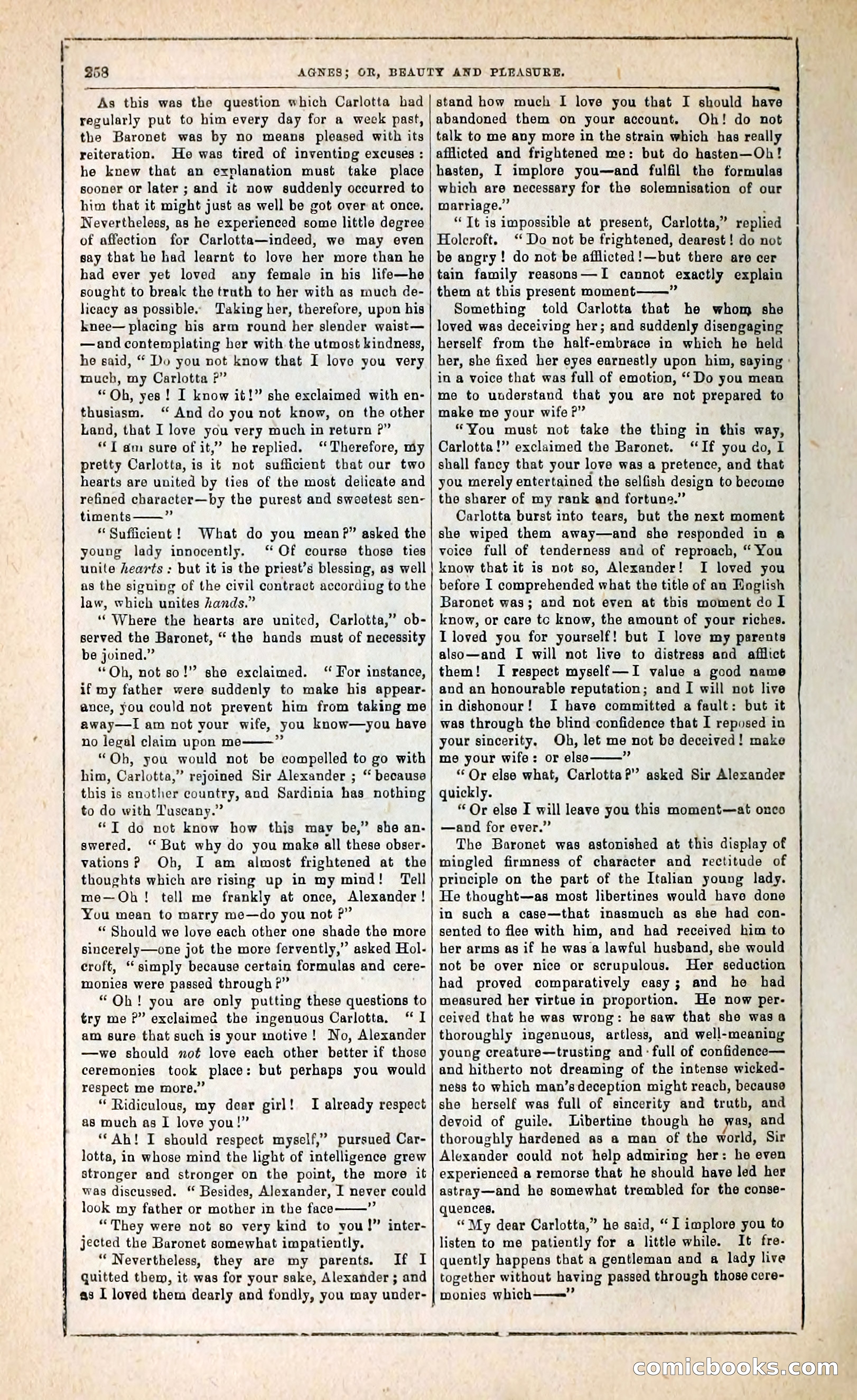
A restored page from Penny Dreadfuls, 1857. Page through the whole issue in the reader above.
📄 Transcribed text from this page (OCR, searchable)
Machine-transcribed from the original scan — historical spelling and the odd misread are preserved.
258 As this was the question which Carlotta had regularly put to him every day for a week past, the Baronet was by no means pleased with its reiteration. Ho was tired of inventing excuses : he knew that an explanation must take place sooner or later ; and it now suddenly occurred to him that it might just as well be got over at once. Nevertheless, as he experienced some little degree of affection for Carlotta—indeed, we may even say that he had learnt to love her more than he had ever yet loved any female in his life—he sought to break the truth to her with as much de- licacy as possible. Taking her, therefore, upon his knee— placing bis arm round her slender waist— —and contemplating her with the utmost kindness, he said, “ Do you not know that I love you very rauch, my Carlotta ?” “Oh, yes! I know it!” she exclaimed with en- thusiasm. “ And do you not know, on the other Land, that I love you very much in return P” ‘I am sure of it,” he replied. ‘Therefore, my pretty Carlotta, is if not sufficient that our two hearts are united by ties of the most delicate and refined character—by the purest and swoetest sen- timents of * Sufficient! What do you mean?” asked the young lady innocently. ‘‘ Of course those ties unite hearts : but it is the priest’s blessing, as well as the siguing of the civil contract according to the law, which unites hands.” ‘‘ Where the hearts are united, Carlotta,” ob- served the Baronet, “ the hands must of necessity be joined.” “Oh, not so!” she exclaimed. “ For instance, if my father were suddenly to make his appear- ance, you could not prevent him from taking me away—lI am not your wife, you know—you have no legal claim upon me “Oh, you would not be compelled to go with him, Carlotta,” rejoined Sir Alexander ; “ because this is another country, and Sardinia has nothing to do with Tuscany.” “TI do not know how this may be,” she an- swered. ‘But why do you make all these obser- vations? Oh, I am almost frightened at the thoughts which aro rising up in my mind! Tell me—Ob! tell me frankly at once, Alexander ! You mean to marry me—do you not ?” “‘ Should we love each other one shade the more sincerely—one jot the more fervently,” asked Hol- croft, “ simply because certain formulas and cere- monies were passed through P” “Oh! you are only putting these questions to try me P” exclaimed the ingenuous Carlotta. “I am sure that such is your motive! No, Alexander —we should not love each other better if those ceremonies took place: but perhaps you would respect me more.” “Ridiculous, my dear girl! as much as | love you!” **Ah! I should respect myself,” pursued Car- lotta, in whose mind the light of intelligence grew stronger and stronger on the point, the more it was discussed. “ Besides, Alexander, I never could look my father or mother in the face ¥ “They were not so very kind to you!” inter- jected the Baronet somewhat impatiently. ““ Nevertheless, they are my parents. If I quitted them, it was for your sake, Alexander ; and as I loved them dearly and fondly, you may under- I alroady respect Oe re ct 8) SS EO, Een ee ect = eth a i a i et ceeds, AGNES; OR, BEAUTY AND PLEASURE, : stand how much I love you that I should have abandoned them on your account. Oh! do not talk to me any more in the strain which has really afflicted and frightened me: but do hasten—Oh! hasten, I implore youmand fulfil the formulas which are necessary for the solemnisation of our marriage.” ; “Tt is impossible at present, Carlotta,” replied Holcroft. ‘Do not be frightened, dearest! do not be angry! do not be afflicted!—but there are cer tain family reasons—I cannot exactly explain them at this present moment * Something told Carlotta that he whom she loved was deceiving her; and suddenly disengaging herself from the half-embrace in which he held her, she fixed her eyes earnestly upon him, saying » in a voice that was full of emotion, “Do you mean me to understand that you are not prepared to make me your wife P” “You must not take the thing in this way, Carlotta!” exclaimed the Baronet. “If you do, I shall fancy that your love was a pretence, and that you merely entertained the selfish design to become the sharer of my rank and fortune.” Carlotta burst into tears, but the next moment she wiped them away—and she responded in a voice full of tenderness and of reproach, “ You know that it is not so, Alexander! I loved you before I comprehended what the title of an Hoglish Baronet was; and not even at this moment co I know, or care tc know, the amount of your riches. I loved you for yourself! but I love my parents also—and I will not live to distress and afflict them! I respect myself—I value a good name and an honourable reputation; and I will not live in dishonour! I have committed a fault: but it was through the blind confidence that I reposed in your sincerity, Oh, let me not be deceived! make me your wife: or else rg ‘Or else what, Carlotta?’ asked Sir Alexander quickly. © Or else I will leave you this moment—at onco —and for ever.” The Baronet was astonished at this display of mingled firmness of character and rectitude of principle on the part of the Italian young lady. He thought—as most libertines would have done in such a case—that inasmuch as she had con- sented to flee with him, and had received him to her arms as if he was a lawful husband, she would not be over nice or scrupulous. Her seduction had proved comparatively easy; and he had measured her virtue in proportion. He now per- ceived that he was wrong: he saw that she was a thoroughly ingenuous, artless, and well-meaning young creature—trusting and: full of confidence— and hitherto not dreaming of the intense wicked- ness to which man’s deception might reach, because she herself was full of sincerity and truth, and devoid of guile. Libertine though he was, and thoroughly hardened as a man of the world, Sir Alexander could not help admiring her: he even experienced a remorse that he should have led her astray—and he somewhat trembled for the conse- quences. “ My dear Carlotta,” he said, “ I implore you to listen to me patiently for a little while. It fre- quently happens that a gentleman and a lady live together without having passed through those cere- monies which——” cComichook (E() 3