
Penny Dreadfuls, 1857 · page 268 of 394
Agnes, or, Beauty and Pleasure — page 268: what you’re looking at
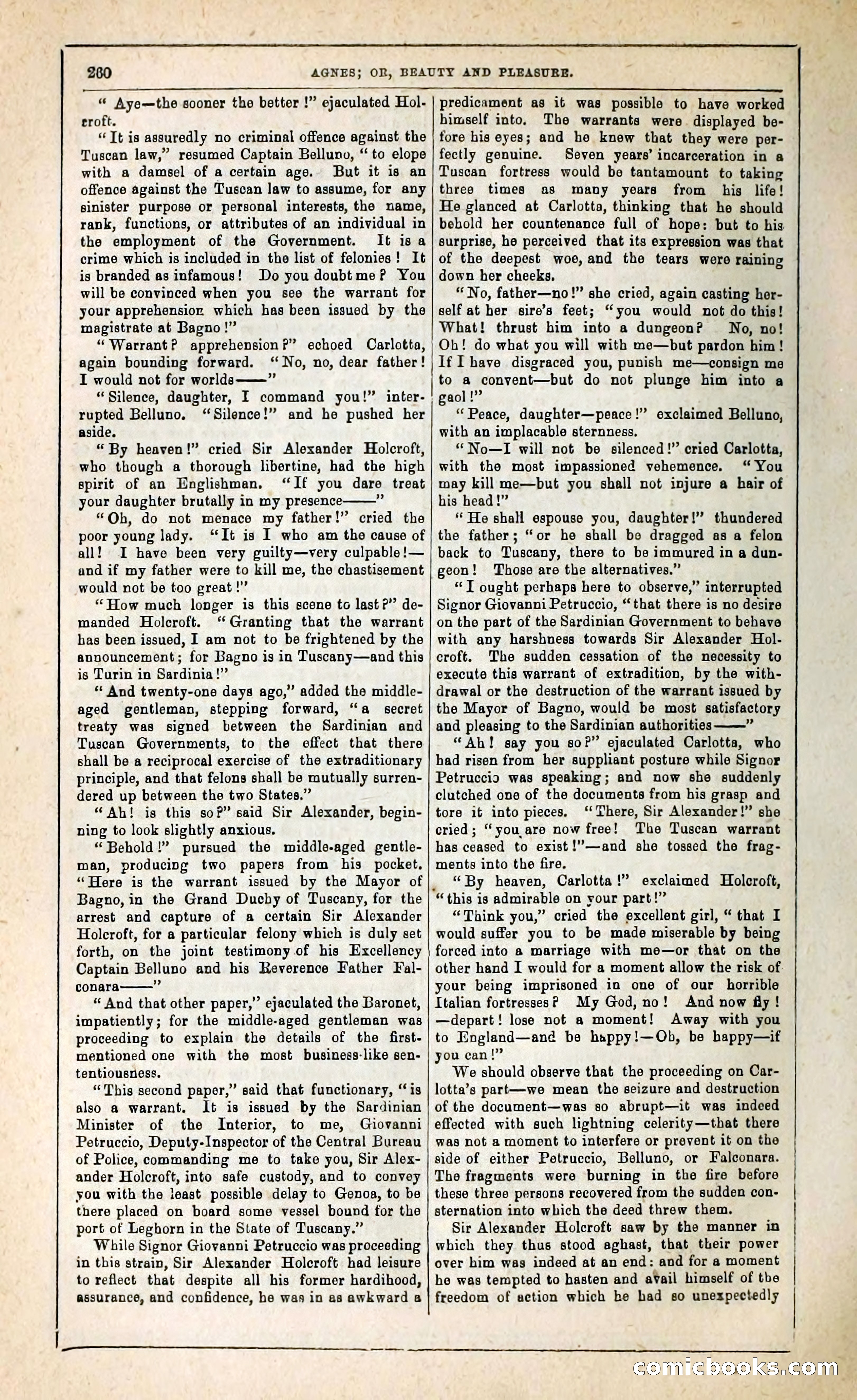
A restored page from Penny Dreadfuls, 1857. Page through the whole issue in the reader above.
📄 Transcribed text from this page (OCR, searchable)
Machine-transcribed from the original scan — historical spelling and the odd misread are preserved.
260 “ Aye—the sooner the better !” ejaculated Hol- croft. “Tt is assuredly no criminal offence against the Tuscan law,” resumed Captain Belluno, “ to elope with a damsel of a certain age. But it is an offence against the Tuscan law to assume, for any sinister purpose or personal interests, the name, rank, functions, or attributes of an individual in the employment of the Government. It isa crime which is included in the list of felonies! It is branded as infamous! Do you doubtme? You will be convinced when you see the warrant for your apprehensior. which has been issued by the magistrate at Bagno!” “Warrant? apprehension?” echoed Carlotta, again bounding forward. ‘No, no, dear father! I would not for worlds-——” “Silence, daughter, I command you!” inter- rupted Belluno, “Silence!” and he pushed her aside. “ By heaven!” cried Sir Alexander Holcroft, who though a thorough libertine, had the high spirit of an Englishman. “If you dare treat your daughter brutally in my presence % “Oh, do not menace my father!’ cried the poor young lady. “It is I who am the cause of all! I have been very guilty—very culpable !— and if my father were to kill me, the chastisement would not be too great!’ “How much longer is this scene to last?” de- manded Holcroft. ‘Granting that the warrant has been issued, I am not to be frightened by the announcement; for Bagno is in Tuscany—and this is Turin in Sardinia!” ‘** And twenty-one days ago,” added the middle- aged gentleman, stepping forward, “a_ secret treaty was signed between the Sardinian and Tuscan Governments, to the effect that there shall be a reciprocal exercise of the extraditionary principle, and that felons shall be mutually surren- dered up between the two States,” “Ah! is this so?” said Sir Alexander, begin- ning to look slightly anxious. “Behold!” pursued the middle-aged gentle- man, producing two papers from his pocket. “Here is the warrant issued by the Mayor of Bagno, in the Grand Duchy of Tuscany, for the arrest and capture of a certain Sir Alexander Holcroft, for a particular felony which is duly set forth, on the joint testimony.of his Excellency Captain Belluno and his Reverence Father Fal- conara v, “ And that other paper,” ejaculated the Baronet, impatiently; for the middle-aged gentleman was proceeding to explain the details of the first- mentioned one with the most business-like sen- tentiousness. “This second paper,” said that functionary, “‘is also a warrant. It is issued by the Sardinian Minister of the Interior, to me, Giovanni Petruccio, Deputy-Inspector of the Central Bureau of Police, commanding me to take you, Sir Alex- ander Holcroft, into safe custody, and to convey you with the least possible delay to Genoa, to be there placed on board some vessel bound for the port of Leghorn in the State of Tuscany.” While Signor Giovanni Petruccio was proceeding in this strain, Sir Alexander Holcroft had leisure to reflect that despite all his former hardihood, assurance, and confidence, he was in as awkward a —_—_ ; gaol AGNES; OR, BEAUTY AND PLEASURE. predicament as it was possible to have worked himeelf into. The warrants were displayed be- fore his eyes; and he knew that they were per- fectly genuine. Seven years’ incarceration in a Tuscan fortress would be tantamount to taking three times as many years from his life! He glanced at Carlotta, thinking that he should behold her countenance full of hope: but to his surprise, he perceived that its expression was that of the deepest woe, and the tears were raining down her cheeks. “No, father—no!” she cried, again casting her- self at her sire’s feet; “you would not do this! What! thrust him into a dungeon? No, no! Ob! do what you will with me—but pardon him! If Ihave disgraced you, punish me—consign me to a convent—but do not plunge him into a 1)? “Peace, daughter—peace!” exclaimed Belluno, with an implacable sternness, * No—I will not be silenced!” cried Carlotta, with the most impassioned vehemence. “You may kill me—but you shall not injure a hair of his head!” ‘He shall espouse you, daughter!” thundered the father; “or he shall be dragged as a felon back to Tuscany, there to be immured in 4 dun- geon! Those are the alternatives.” “T ought perhaps here to observe,” interrupted Signor Giovanni Petruccio, “that there is no desire on the part of the Sardinian Government to behave with any harshness towards Sir Alexander Hol- croft. The sudden cessation of the necessity to execute this warrant of extradition, by the with- drawal or the destruction of the warrant issued by the Mayor of Bagno, would be most satisfactory and pleasing to the Sardinian authorities % “Ah! say you so?” ejaculated Carlotta, who had risen from her suppliant posture while Signor Petruccio was speaking; and now she suddenly clutched one of the documents from his grasp and tore it into pieces. ‘There, Sir Alexander!” she cried; “you are now free! The Tuscan warrant has ceased to exist!”—and she tossed the frag- ments into the fire. “By heaven, Carlotta!” exclaimed Holcroft, “this is admirable on your part!” “Think you,” cried the excellent girl, “ that I would suffer you to be made miserable by being forced into a marriage with me—or that on the other hand I would for a moment allow the risk of. your being imprisoned in one of our horrible Italian fortresses? My God, no! And now fy! —depart! lose not a moment! Away with you to England—and be happy!—Ob, be happy—if you can!” We should observe that the proceeding on Car- lotta’s part—we mean the seizure and destruction of the document—was so abrupt—it was indeed effected with such lightning celerity—that there was not a moment to interfere or prevent it on the side of either Petruccio, Belluno, or Falconara. The fragments were burning in the fire before these three persons recovered from the sudden con- sternation into which the deed threw them. Sir Alexander Holcroft saw by the manner in which they thus stood aghast, that their power over him was indeed at an end: and for a moment he was tempted to hasten and avail himself of the freedom of action which be had so unexpectedly Ehboo (E() 3)