
Penny Dreadfuls, 1857 · page 284 of 394
Agnes, or, Beauty and Pleasure — page 284: what you’re looking at
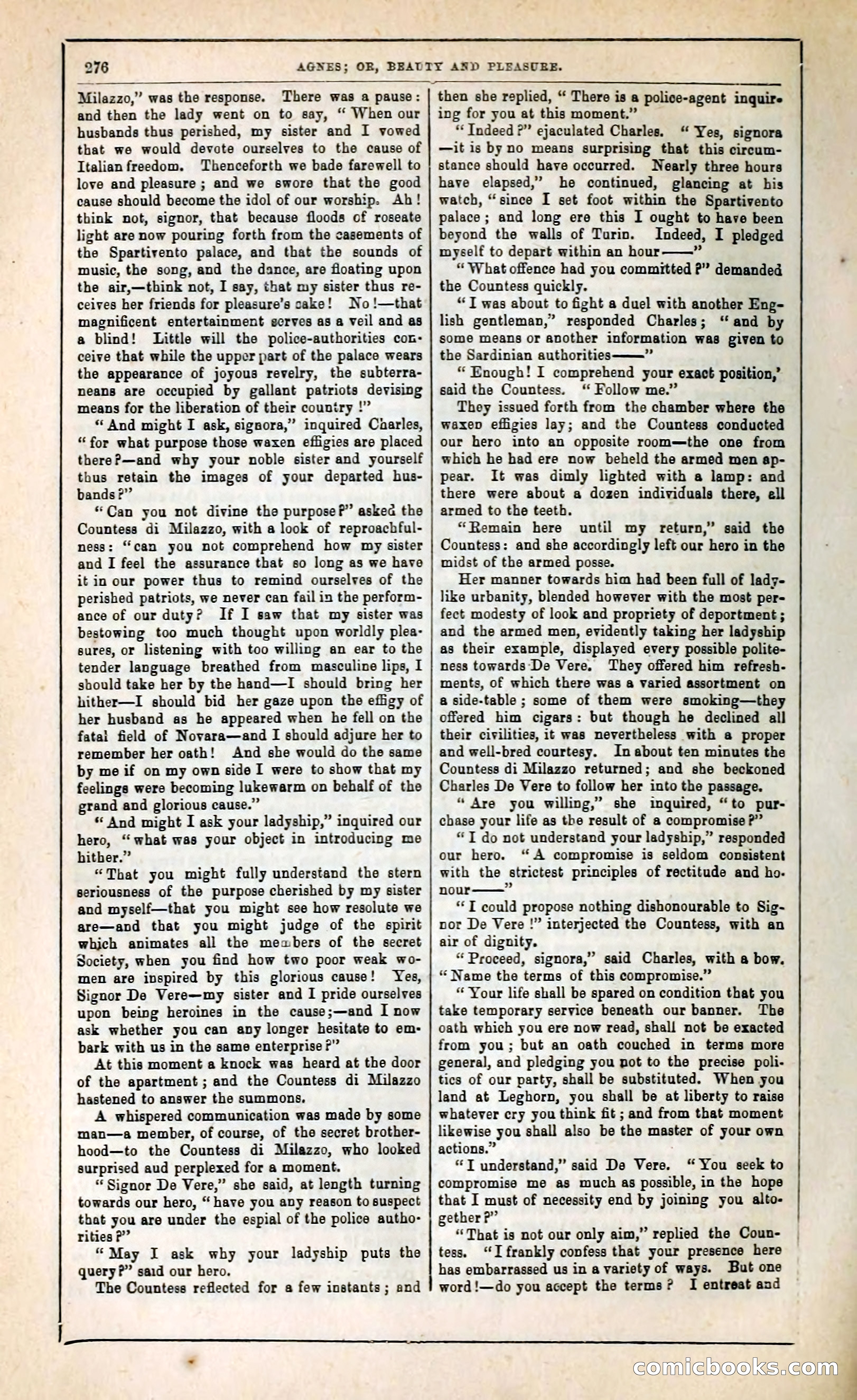
A restored page from Penny Dreadfuls, 1857. Page through the whole issue in the reader above.
📄 Transcribed text from this page (OCR, searchable)
Machine-transcribed from the original scan — historical spelling and the odd misread are preserved.
— 276 Milazzo,” was the response. There was a pause: and then the lady went on to say, ‘ When our husbands thus perished, my sister and I vowed that we would devote ourselves to the cause of Italian freedom. Thenceforth we bade farewell to love and pleasure ; and we swore that the good cause should become the idol of our worship. Ah! think not, signor, that because floods of roseate light are now pouring forth from the casements of the Spartivento palace, and that the sounds of music, the song, and the dance, are floating upon the air,—think not, I say, that my sister thus re- ceives her friends for pleasure’s cake! No!—that magnificent entertainment serves as a veil and as a blind! Little will the police-authorities con- ceive that while the upper part of the palace wears the appearance of joyous revelry, the subterra- neans are occupied by gallant patriots devising means for the liberation of their country !” * And might I ask, signora,” inquired Caarles, “for what purpose those waxen effigies are placed thereP?—and why your noble sister and yourself thus retain the images of your departed hus- bands?” “Can you not divine the purpose?” askea the Countess di Milazzo, with a look of reproachful- ness: “can you not comprehend how my sister and I feel the assurance that so long as we have it in our power thus to remind ourselves of the perished patriots, we never can fail in the perform- ance of our duty? If I saw that my sister was bestowing too much thought upon worldly plea- sures, or listening with too willing an ear to the tender language breathed from masculine lips, I should take her by the hand—I should bring her hither—I should bid her gaze upon the effigy of her husband as he appeared when he fell on the fatai field of Novara—and I should adjure her to remember her oath! And she would do the same by me if on my own side I were to show that my feelings were becoming lukewarm on behalf of the grand and glorious cause.” ** And might I ask your ladyship,” inquired our hero, “what was your object in introducing me hither.” “That you might fully understand the stern seriousness of the purpose cherished by my sister and myself—that you might see how resolute we are—and that you might judge of the spirit which animates all the members of the secret Society, when you find how two poor weak wo- men are inspired by this glorious cause! Yes, Signor De Vere—my sister and I pride ourselves upon being heroines in the cause;—and I now ask whether you can apy longer hesitate to em- bark with us in the same enterprise?” At this moment a knock was heard at the door of the apartment ; and the Countess di Milazzo hastened to answer the summons, A whispered communication was made by some man—a member, of course, of the secret brother- hood—to the Countess di Milazzo, who looked surprised aud perplexed for a moment. “Signor De Vere,” she said, at length turning towards our hero, “ have you any reason to suspect that you are under the espial of the police autho- rities ?” “ May I ask why your ladyship puts the query?” said our hero. The Countess reflected for a few instants ; and then she replied, “ There is a police-agent inquire ing for you at this moment.” “Indeed ?” ejaculated Charles. “ Yes, signora —it is by no means surprising that this circum- stance should have occurred. Nearly three hours have elapsed,” he continued, glancing at his watch, “since I set foot within the Spartivento palace; and long ere this I ought to have been beyond the walls of Turin. Indeed, I pledged myself to depart within an hour-——” “ What offence had you committed ?” demanded the Countess quickly. “‘T was about to fight a duel with another Eng- lish gentleman,” responded Charles; “ and by some means or another information was given to the Sardinian authorities——” “ Enough! I comprehend your exact position,’ said the Countess. “ Follow me.” They issued forth from the chamber where the waxep effigies lay; and the Countess conducted our hero into an opposite room—the one from which he had ere now beheld the armed men ap- pear. It was dimly lighted with a lamp: and there were about a dozen individuals there, ell armed to the teeth. “Remain here until my return,” said the Countess: and she accordingly left our hero in the midst of the armed posse. Her manner towards him had been full of lady- like urbanity, blended however with the most per- fect modesty of look and propriety of deportment ; and the armed men, evidently taking her ladyship as their example, displayed every possible polite- ness towards'De Vere. They offered him refresh- ments, of which there was a varied assortment on @ side-table ; some of them were smoking—they offered him cigars: but though he declined all their civilities, it was nevertheless with a proper and well-bred courtesy. In about ten minutes the Countess di Milazzo returned; and she beckoned Charles De Vere to follow her into the passage. “Are you willing,” she inquired, “to pur- chase your life as tbe result of a compromise?” “T do not understand your ladyship,” responded our hero. “A compromise is seldom consistent with the strictest principles of rectitude and ho- nour : **T could propose nothing dishonourable to Sig- nor De Vere !” interjected the Countess, with an air of dignity. “ Proceed, signora,” said Charles, with a bow. “ Name the terms of this compromise.” “Your life shall be spared on condition that you take temporary service beneath our banner. The oath which you ere now read, shall not be exacted from you; but an oath couched in terms more general, and pledging you not to the precise poli- tics of our party, shall be substituted. When you land at Leghorn, you shall be at liberty to raise whatever cry you think fit ; and from that moment likewise you shall also be the master of your own actions.” “T understand,” said De Vere. “You seek to compromise me as much as possible, in the hope that I must of necessity end by joining you alto- gether P” “That is not our only aim,” replied the Coun- tess. ‘I frankly confess that your presence here has embarrassed us in a variety of ways. But one word !—do you accept the terms? I entreat and COMMicloolk< ———_ AGNES; OR, BEAUTY AND PLEASURE. )