
Penny Dreadfuls, 1857 · page 293 of 394
Agnes, or, Beauty and Pleasure — page 293: what you’re looking at
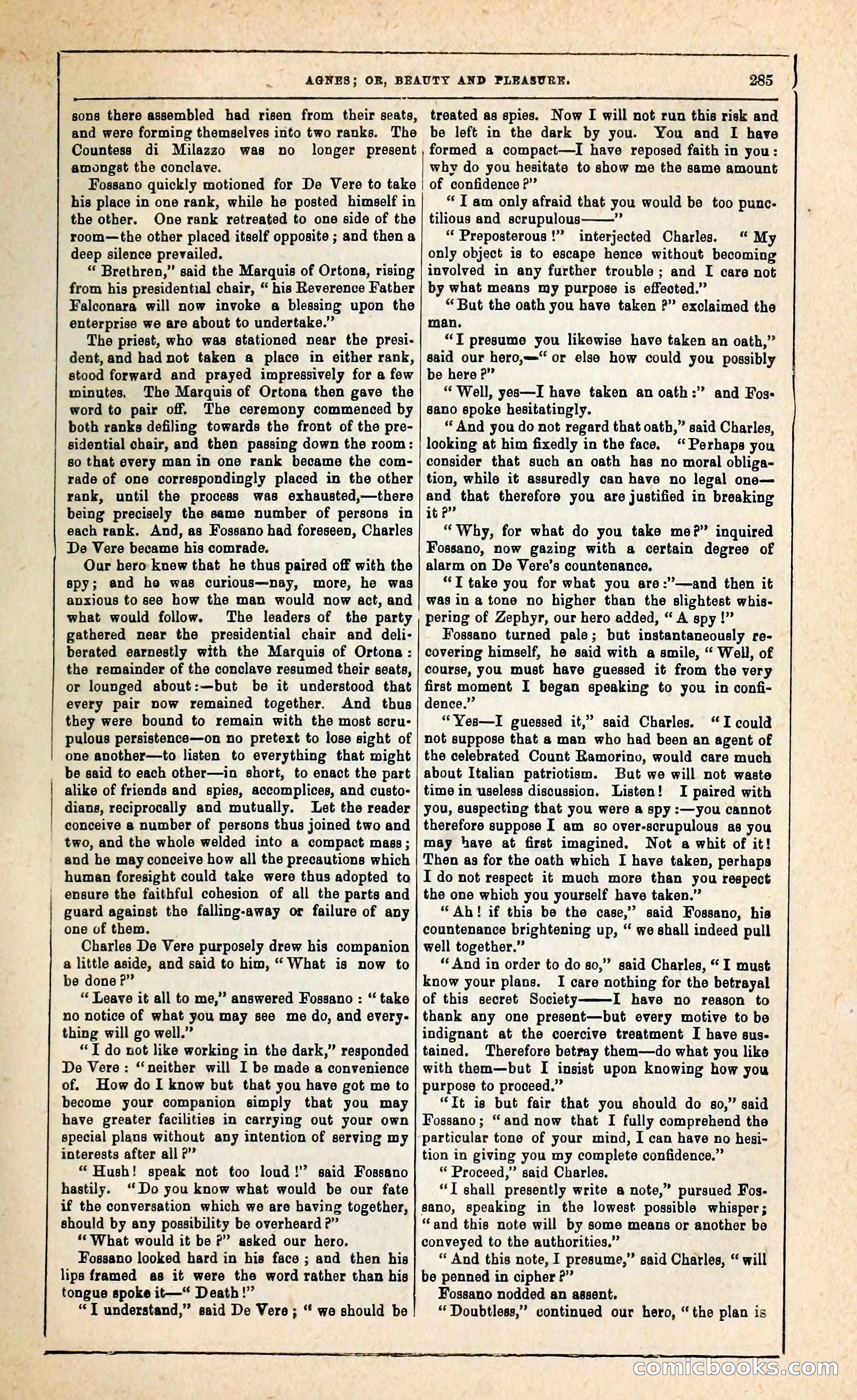
A restored page from Penny Dreadfuls, 1857. Page through the whole issue in the reader above.
📄 Transcribed text from this page (OCR, searchable)
Machine-transcribed from the original scan — historical spelling and the odd misread are preserved.
4 \ - AGNES; OR, BEAUTY AND PLEASURE. sons there assembled had risen from their seats, and were forming themselves into two ranks. The Countess di Milazzo was no longer present amongst the conclave. Fossano quickly motioned for De Vere to take his place in one rank, while he posted himeelf in the other. One rank retreated to one side of the room—the other placed itself opposite ; and then a deep silence prevailed. “ Brethren,” said the Marquis of Ortona, rising from his presidential chair, “ his Reverence Father Falconara will now invoke a blessing upon the enterprise we are about to undertake.” The priest, who was stationed near the presi- dent, and had not taken a place in either rank, stood forward and prayed impressively for a few minutes, The Marquis of Ortona then gave the word to pair off. The ceremony commenced by both ranks defiling towards the front of the pre- sidential chair, and then passing down the room: so that every man in one rank became the com- rade of one correspondingly placed in the other rank, until the process was exhausted,—there being precisely the same number of persons in each rank. And, as Fossano had foreseen, Charles De Vere became his comrade. Our hero knew that he thus paired off with the spy; and he was curious—nay, more, he was anxjous to see how the man would now act, and what would follow. The leaders of the party gathered near the presidential chair and deli- berated earnestly with the Marquis of Ortona: the remainder of the conclave resumed their seats, or lounged about:—but be it understood that every pair now remained together. And thus they were bound to remain with the most scru- pulous persistence—on no pretext to lose sight of one another—to listen to everything that might _ be said to each other—in short, to enact the part alike of friends and spies, accomplices, and custo- dians, reciprocally and mutually. Let the reader conceive a number of persons thus joined two and two, and the whole welded into a compact mass; and he may conceive how all the precautions which human foresight could take were thus adopted to | ensure the faithful cohesion of all the parts and guard against the falling-away or failure of any one of them. Charles De Vere purposely drew his companion a little aside, and said to him, “ What is now to be done P” ** Leave it all to me,” answered Fossano : “ take no notice of what you may see me do, and every- thing will go well.” “T do not like working in the dark,” responded De Vere: “neither will I be made a convenience of. How doI know but that you have got me to become your companion simply that you may have greater facilities in carrying out your own special plans without any intention of serving my interests after all ?” “Hush! speak not too loud!” said Fossano hastily. ‘Do you know what would be our fate if the conversation which we are having together, should by any possibility be overheard 2” ‘“ What would it be ?” asked our hero. Fossano looked hard in his face ; and then his lips framed as it were the word rather than his tongue spoke it—“ Death!” “TI understand,” said De Vere; “ we should be TC) PA INGC LOReA LRUN Om at Ne ae 285 treated as spies. Now I will not run this risk and be left in the dark by you. You and I have formed a compact—I have reposed faith in you: why do you hesitate to show me the same amount of confidence P” “‘ T am only afraid that you would be too punc- tilious and scrupulous - “ Preposterous !” interjected Charles. “ My only object is to escape hence without becoming involved in any further trouble; and I care not by what means my purpose is effected.” “But the oath you have taken ?” exclaimed the man. “‘T presume you likewise have taken an oath,” said our hero,“ or else how could you possibly be here P” “Well, yes—I have taken an oath:” and Foss sano spoke hesitatingly. “And you do not regard that oath,” said Charles, looking at him fixedly in the face. “Perhaps you consider that such an oath has no moral obliga- tion, while it assuredly can have no legal one— and that therefore you are justified in breaking it P” “Why, for what do you take me?” inquired Fossano, now gazing with a certain degree of alarm on De Vere’s countenance, “T take you for what you are:’—and then it was in a tone no higher than the slightest whis- pering of Zephyr, our hero added, “ A spy !” Fossano turned pale; but instantaneously re- covering himself, he said with a smile, “ Well, of course, you must have guessed it from the very first moment I began speaking to you in confi- dence.” ““Yes—lI guessed it,” said Charles. “TI could not suppose that a man who had been an agent of the celebrated Count Ramorino, would care much about Italian patriotism. But we will not waste time in useless discussion. Listen! I paired with you, suspecting that you were a spy :—you cannot therefore suppose I am so over-scrupulous as you may have at first imagined. Not a whit of it! Then as for the oath which I have taken, perhaps I do not respect it much more than you respect the one which you yourself have taken.” “Ah! if this be the case,’’ said Fossano, his countenance brightening up, “ we shall indeed pull well together.” ‘And in order to do so,”’ said Charles, “ I must know your plans. I care nothing for the betrayal of this secret Society I have no reason to thank any one present—but every motive to be indignant at the coercive treatment I have sus- tained. Therefore betray them—do what you like with them—but I insist upon Knowing how you purpose to proceed.” “Tt is but fair that you should do so,” said Fossano; “and now that I fully comprehend the particular tone of your mind, I can have no hesi- tion in giving you my complete confidence.” “* Proceed,” said Charles. “T shall presently write a note,” pursued Fos. sano, speaking in the lowest possible whisper; “and this note will by some means or another be conveyed to the authorities,” “ And this note, I presume,” said Charles, “ will be penned in cipher ?” Fossano nodded an assent, “ Doubtless,’ continued our hero, “the plan is COU | CIOOIKNSTEO iin