
Penny Dreadfuls, 1857 · page 296 of 394
Agnes, or, Beauty and Pleasure — page 296: what you’re looking at
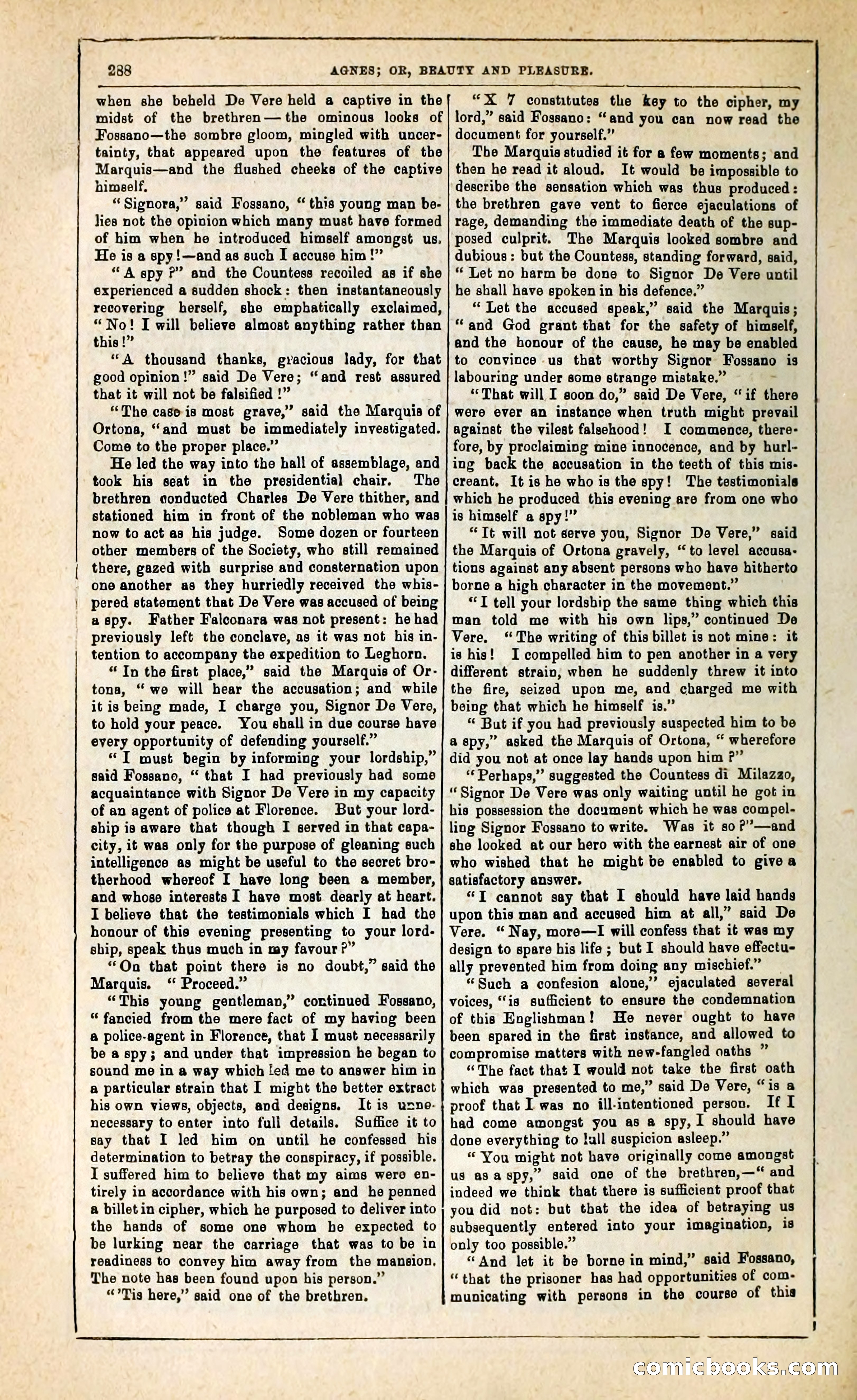
A restored page from Penny Dreadfuls, 1857. Page through the whole issue in the reader above.
📄 Transcribed text from this page (OCR, searchable)
Machine-transcribed from the original scan — historical spelling and the odd misread are preserved.
’ : - ee 288 AGNES; OR, BEAUTY AND PLEASURE. when she beheld De Vere held a captive in the midst of the brethren—the ominous looks of Fossano—the sombre gloom, mingled with uncer- tainty, that appeared upon the features of the Marquis—and the flushed cheeks of the captive himeelf, “Signora,” said Fossano, “ this young man be- lies not the opinion which many must have formed of him when he introduced himself amongst us. He is a spy!—and as such I accuse him !” “A spy P” and the Countess recoiled as if she experienced a sudden shock: then instantaneously recovering herself, she emphatically exclaimed, “No! I will believe almost anything rather than this!” ‘‘A thousand thanks, gyacious lady, for that good opinion!” said De Vere; “and rest assured that it will not be falsified !” ‘The case is most grave,” said the Marquis of Ortona, “and must be immediately investigated. Come to the proper place.” He led the way into the hall of assemblage, and took his seat in the presidential chair. The brethren conducted Charles De Vere thither, and stationed him in front of the nobleman who was now to act as his judge. Some dozen or fourteen other members of the Society, who still remained there, gazed with surprise and consternation upon one another as they hurriedly received the whis- pered statement that De Vere was accused of being aspy. Father Falconara was not present: he had previously left the conclave, as it was not his in- tention to accompany the expedition to Leghorn. “In the first place,” said the Marquis of Or- tona, “we will hear the accusation; and while it is being made, I charge you, Signor De Vere, to hold your peace. You shall in due course have every opportunity of defending yourself.” ‘IT must begin by informing your lordship,” said Fossano, “ that I had previously had some acquaintance with Signor De Vere in my capacity of an agent of police at Florence. But your lord- ship is aware that though I served in that capa- city, it was only for the purpose of gleaning such intelligence as might be useful to the secret bro- therhood whereof I have long been a member, and whose interests I have most dearly at heart. I believe that the testimonials which I had tho honour of this evening presenting to your lord- ship, speak thus much in my favour?” “On that point there is no doubt,” said the Marquis. ‘ Proceed.” “This young gentleman,” continued Fossano, “fancied from the mere fact of my having been a police-agent in Florence, that I must necessarily be a spy; and under that impression he began to sound me in a way which fed me to answer him in a particular strain that I might the better extract his own views, objects, and designs. It is uzne- necessary to enter into fuli details. Suffice it to say that I led him on until he confessed his determination to betray the conspiracy, if possible. I suffered him to believe that my aims were en- tirely in accordance with his own; and he penned a billetin cipher, which he purposed to deliver into the hands of some one whom he expected to be lurking near the carriage that was to be in readiness to convey him away from the mansion, The note has been found upon his person.” “Tis here,” said one of the brethren. “X 7 constitutes the key to the cipher, my lord,” said Fossano: “and you can now read the document for yourself.’ The Marquis studied it for a few moments; and then he read it aloud. It would be impossible to describe the sensation which was thus produced: the brethren gave vent to fierce ejaculations of rage, demanding the immediate death of the sup- posed culprit. The Marquis looked sombre and dubious : but the Countess, standing forward, said, * Let no harm be done to Signor De Vere until he shall have spoken in his defence.” “Let the accused speak,” said the Marquis; “and God grant that for the safety of himself, and the honour of the cause, he may be enabled to convince us that worthy Signor Fossano is labouring under some strange mistake.” 4 ‘That will I soon do,” said De Vere, “if there were ever an instance when truth might prevail against the vilest falsehood! I commence, there- fore, by proclaiming mine innocence, and by hurl- ing back the accusation in the teeth of this mis- creant, It is he who is the spy! The testimonials which he produced this evening are from one who is himself a spy!” *Té will not serve you, Signor De Vere,” said the Marquis of Ortona gravely, “to level accusa- tions against any absent persons who have hitherto borne a high character in the movement.” “T tell your lordship the same thing which this man told me with his own lips,” continued De Vere. “Tho writing of this billet is not mine: it is his! I compelled him to pen another in a very different strain, when he suddenly threw it into the fire, seized upon me, and charged me with being that which he himself is.” “ But if you had previously suspected him to be a spy,” asked the Marquis of Ortona, “ wherefore did you not at once lay hands upon him ?” ‘‘ Perhaps,” suggested the Countess di Milazao, ‘Signor De Vere was only waiting until he got in his possession the document which he was compel- ling Signor Fossano to write. Was it so?’’—and she looked at our hero with the earnest air of one who wished that he might be enabled to give a satisfactory answer. “T cannot say that I should have laid hands upon this man and accused him at all,” said De Vere. “ Nay, more—I will confess that i¢ was my design to spare his life ; but I should have effectu- ally prevented him from doing any mischief.” “Such a confesion alone,” ejaculated several voices, “is sufficient to ensure the condemnation of this Englishman! THe never ought to have been spared in the first instance, and allowed to compromise matters with new-fangled oaths ” “The fact that I would not take the firsé oath which was presented to me,” said De Vere, “is a proof that I was no ill-intentioned person. If I had come amongst you as a spy, I should have done everything to lull suspicion asleep.” “ You might not have originally come amongst us asaspy,” said one of the brethren,—“ and indeed we think that there is sufficient proof that you did not: but that the idea of betraying us subsequently entered into your imagination, is only too possible.” “And let it be borne in mind,” said Fossano, “that the prisoner has had opportunities of com- municating with persons in the course of this (COPMICLIOOLKS nO) a3