
Penny Dreadfuls, 1857 · page 298 of 394
Agnes, or, Beauty and Pleasure — page 298: what you’re looking at
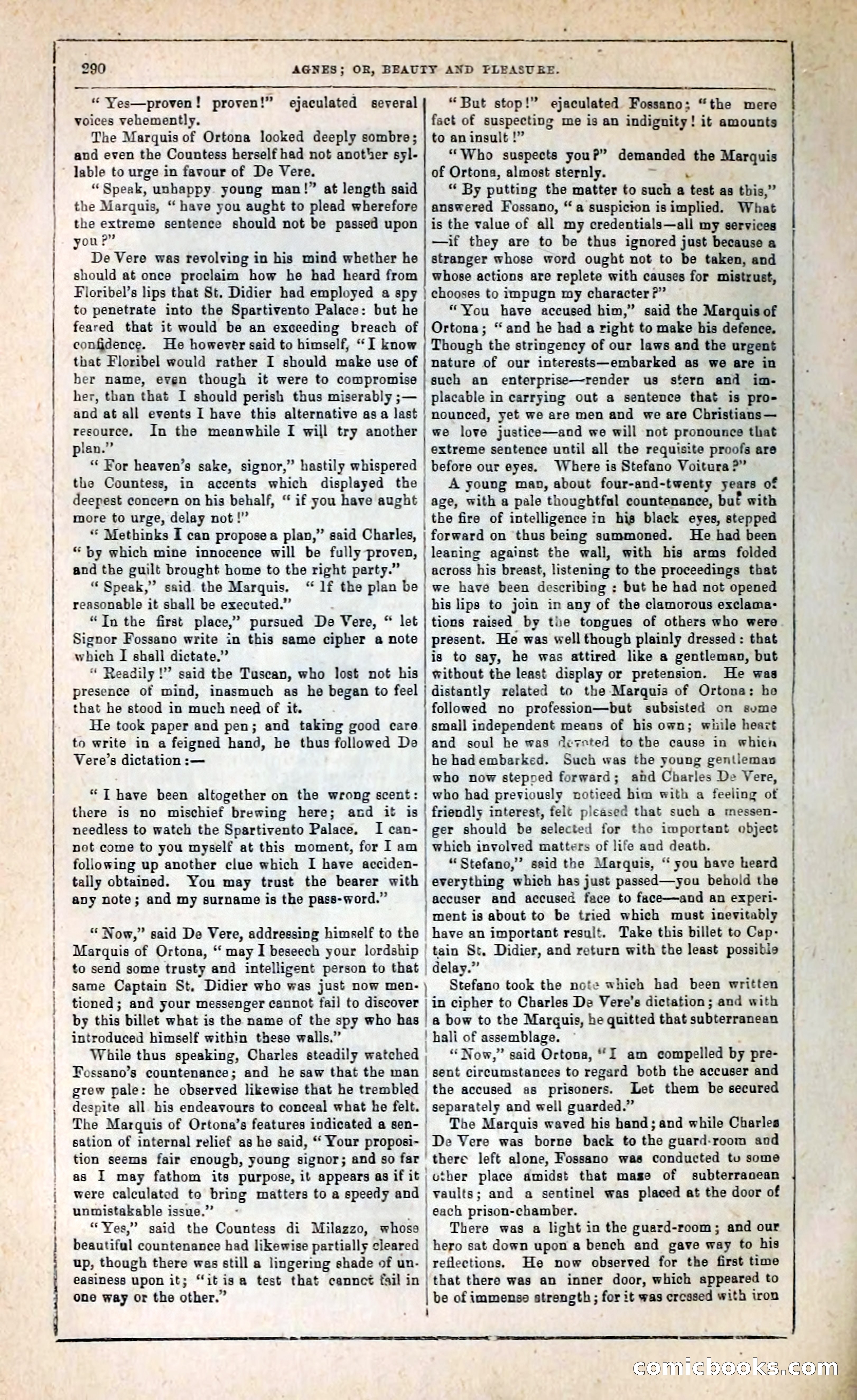
A restored page from Penny Dreadfuls, 1857. Page through the whole issue in the reader above.
📄 Transcribed text from this page (OCR, searchable)
Machine-transcribed from the original scan — historical spelling and the odd misread are preserved.
ES ES EO SPS Se * Yes—proven! proven!” ejaculated several voices vehemently. The Marquis of Ortona looked deeply sombre; and even the Countess herself had not another syl- lable to urge in favour of De Vere. “Speak, unhappy. young man!” at length said the Marquis, “ have you aught to plead wherefore the extreme sentence should not be passed upon you?” De Vere was revolving in his mind whether he should at once proclaim how he had heard from AGNES; OR, BEAUTY AND FLEASUEBE. “But stop!” ejaculated Fossano; “the mere fact of suspecting me is an indignity! it amounts to aninsult !” ‘Who suspects you?” demanded the Marquis of Ortona, almost sternly. “ By putting the matter to such a ad as this,” answered Fossano, “a suspicion isimplied. What is the value of all my credentials—all my services —if they are to be thus ignored just because a stranger whose word ought not to be taken, and whose actions are replete with causes for mistrust, Floribel’s lips that St. Didier had employed a spy | chooses to impugn my character ?” to penetrate into the Spartivento Palace: but he feared that it would be an exceeding breach of confidence. He however said to himself, “ I know that Floribel would rather I should make use of her name, even though it were to compromise her, than that I should perish thus miserably ;— and at all events I have this alternative asa last resource. plan.” “‘ For heaven’s sake, signor,” the Countess, in accents which displayed the | deepest concern on his behalf, “ if you have aught | more to urge, delay not!” “© Methinks I can propose a plan,” said Charles, “by which mine innocence will be fully proven, and the guilt brought home to the right perty.” “ Speak,” said. the Marquis. reasonable it shall be executed.” hastily whispered | “You have accused him,” said the Marquis of Ortona; “and he had a right to make bis defence. Though the stringency of our laws and the urgent nature of our interests—embarked as we are in such an enterprise—render us stern and im- Ss in carrying out a sentence that is pro- nounced, yet we are men and we are Christians— In the meanwhile I will try another | Go aoation anil: we love justice—and we will not pronounce that extreme sentence until all the requisite proofs are before our eyes. Where is Stefano Voitura ?” A young map, about four-and-twenty years of age, with a pale thoughtfal countenance, but with | the fire of intelligence in his black eyes, stepped forward on thus being summoned. He had been ‘leaning against the wall, with his arms folded across his breast, listening to the proceedings that “‘ 1f£ the plan be} we have been describing : but he had not opened his lips to join in any of the clamorous exclama- “Tn the first place,” pursued De Vere, “ let | tions raised by tie tongues of others who were Signor Fossano write in this same cipher a note | present. He was well though plainly dressed: that Ww hieli I shall dictate.” “ Readily !” said the Tuscan, who lost not his | without the least display or pretension. is to say, he was attired like a gentleman, but He was presence of mind, inasmuch as he began to feel | distantly related to the Marquis of Ortona: he that he stood in much need of it. followed no profession—but subsisted on sume He took paper and pen; and taking good care | small independent means of his own; while heart to write in a feigned hand, he thus followed De | and soul he was deveted to the cause in which Vere’s dictation :— he hadembarked. Such was the young gentlemas who now stepped forward; and Charles De Vere, “T have been altogether on the wrong scent: | who had previously noticed him with a feeling of there is no mischief brewing here; and it is needless to watch the Spartivento Palace. friendly interest, felt pleased that such a messen- I can- | ger should be selected for tho important object not come to you myself at this moment, for I am | which involved matters of life and death. following up another clue which I have acciden- tally obtained. avy note; and my surname is the pass-word.” “ Now,” said De Vere, addressing himself to the Marquis of Ortona, “ may I beseech your lordship | to send some trusty and intelligent person to that | same Captain St. Didier who was just now men- tioned; and your messenger cannot fail to discover by this billet what is the name of the spy who has introduced himself within these walls.” While thus speaking, Charles steadily watched | Fossano’s countenance; and he saw that the man | grew pale: he observed likewise that he trembled | despite all bis endeavours to conceal what he felt. | The Marquis of Ortona’s features indicated a sen- | “Stefano,” said the Marquis, “ you bave heard You may trust the bearer with | everything which has just passed—you behold the accuser and accused face to face—and an expert- | ment is about to be tried which must inevitably have an important result. Take this billet to Cap- tain St. Didier, and return with the least possible | delay.” Stefano took the note which had been written in cipher to Charles De Vere’s dictation; and with a bow to the Marguis, he quitted that subterranean | hali of assemblage. | Now,” said Ortona, “I am compelled by pre- re circumstances to regard both the accuser and the accused as prisoners. Let them be secured separately and well guarded.” The Marquis waved his hand; and while Charles sation of internal relief as he said, “ Your proposi- De Vere was borne back to the guard-room and tion seems fair enough, young signor; and so far’ there left alone, Fossano was conducted tu some as I may fathom its purpose, it appears asifit;cther place amidst that mase of subterracean were calculated to bring matters to a speedy and vaults; and a sentinel was placed at the door of unmistakable issue.’ ih prison-chamber. “Yes,” said the Countess di Milazzo, whose | There was a light in the guard-room; and our beautiful countenance had likewise partially cleared | hero sat down upon a bench and gave way to his up, though there was still a lingering shade of un- | reflections. He now observed for the first time easiness upon it; “it isa test that cannct fail in| that there was an inner door, which appeared to one way or the other.” be of immense strength ; for it was ercssed with iron i Choo S