
Penny Dreadfuls, 1857 · page 310 of 394
Agnes, or, Beauty and Pleasure — page 310: what you’re looking at
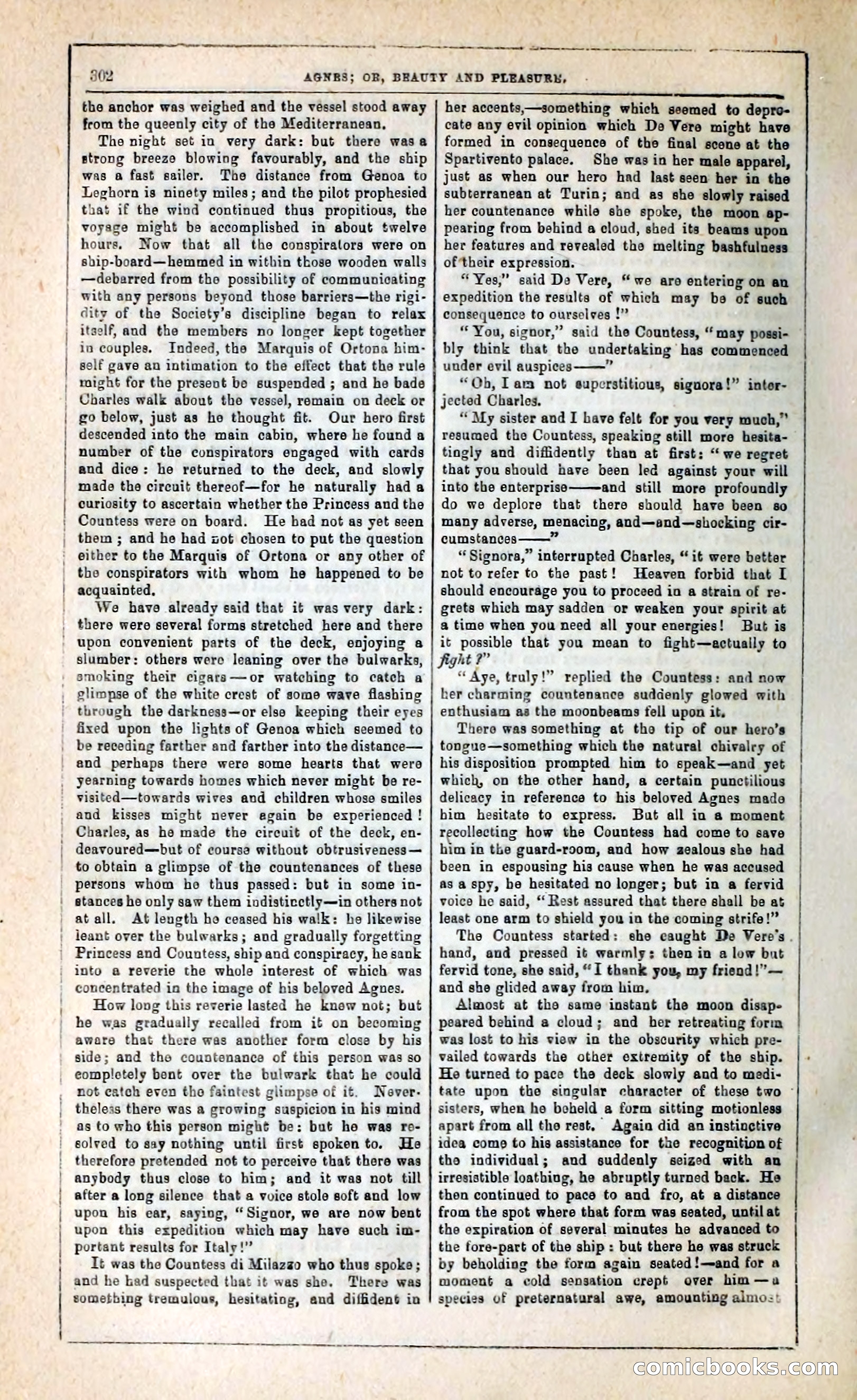
A restored page from Penny Dreadfuls, 1857. Page through the whole issue in the reader above.
📄 Transcribed text from this page (OCR, searchable)
Machine-transcribed from the original scan — historical spelling and the odd misread are preserved.
502 AGNES; OR, BEAUTY AND PLEASURE, = [ nsteellieeetiesieenetnetiedieeesininmeatematiedinamnate em ar ET aS TC CE EEE Ree the anchor was weighed and the vessel stood away from the queenly city of the Mediterranean, The night set in very cark: but there wasa strong breeze blowing favourably, and the ship was a fast sailer. The distance from Genoa to Leghorn is ninety miles; and the pilot prophesied that if the wind continued thus propitious, the voyage might be accomplished in about twelve hours. Now that all the conspirators were on sbip-board—hemmed in within those wooden walls —debarred from the possibility of communicating with any persons beyond those barriers—the rigi- dity of the Society’s discipline began to relax itself, and the members no longer kept together in couples. Indeed, the Marquis of Ortona him- self gave an intimation to the effect that the rule roight for the present be suspended ; and he bade Charles walk about the vessel, remain on deck or go below, just as he thought fit. Our hero first descended into the main cabin, where he found a number of the conspirators engaged with cards and dice: he returned to the deck, and slowly made the circuit thereof—for he naturally had a curiosity to ascertain whether the Princess and the Countess were on board. He bad not as yet seen them ; and he had sot chosen to put the question either to the Marquis of Ortona or any other of the conspirators with whom he happened to be acquainted, We have already said that it was very dark: _ there were several forms stretched here and there ' upon convenient parts of the deck, enjoying a slumber: others were leaning over the bulwarks, smoking their cigars—or watching to catch a _ glimpse of the white crest of some wave flashing through the darkness—or else keeping their eyes fixed upon the lights of Genoa which seemed to _ be receding farther and farther into the distance— end perhaps there were some hearts that were yearning towards homes which never might be re- visited—towards wives and children whose smiles _ and kisses might never egain be experienced ! atall. Charles, as he made the circuit of the deck, en- deavoured—but of coursa without obtrusiveness— to obtain a glimpse of the countenances of these persons whom he thus passed: but in some in- stances he only saw them indisticctly—in others not At length ho ceased his walk: he likewise jeant over the bulwarks; and gradually forgetting | Princess and Countess, ship and conspiracy, he sank _ into a reverie the whole interest of which was ee a a ee Cee ee concentrated in the image of his beloved Agnes. How long this reverie lasted he know not; but he was gradually recalled from it on becoming aware that there was another form close by his side; and the countenance of this person was so eompletely bent over the bulwark that he could not catch even the faintest glimpse of it. Never- theless there was a growing suspicion in his mind as to who this person might be: but he was ro- solved to say nothing until first spoken to. He therefore pretended not to perceive that there was anybody thus close to him; and it was not till after a long silence that a voice stole soft and low upon his ear, saying, “Signor, we are now bent upon this expedition which may have such im- portant results for Italy!” It was the Countess di Milazao who thus spoke; and he kad suspected that it was she. There was something tremulous, hesitating, and diffidené in her accents,—something which seemed to depro- cate any evil opinion which De Vere might have formed in consequence of the final scone at the Spartivento palace. She was in her male apparel, just as when our hero had last seen her in the subterranean at Turin; and as she slowly raised her countenance while she spoke, the moon ap- pearing from behind a cloud, shed its beams upon her features and revealed the melting bashfulness of their expression. * Yes,” said De Vere, “we aro entering on an expedition the results of which may bo of such consequence to ourselves !” ‘You, signor,” said the Countess, “ may possi- bly think that the undertaking has commenced under evil auspices ? “Qh, Tam not superstitious, siguora!” inter- jected Charles. “My sister and I have felt for you very much,” resumed the Countess, speaking still more hesita- tingly and diffidently than at first: “ we regret that you should have been led against your will into the enterprise and still more profoundly do we deplore that there should have been so many adverse, menacing, and—and—shocking cir- cumstances “ Signora,” interrupted Charles, “it were better not to refer to the past! Heaven forbid that I should encourage you to proceed io a strain of re- grets which may sadden or weaken your spirit at a time when you need all your energies! But is it possible that you mean to fight—actually to Sight ?” “Aye, truly!” replied the Countess: and now her charming countenance suddenly glowed with enthusiam as the moonbeams fell upon it, There was something at tho tip of our hero’s tongue—something which the natural chivalry of his disposition prompted him to speak—and yet which, on the other hand, a certain punctilious delicacy in reference to his beloved Agnes made him hesitate to express. But all in a moment recollecting how the Countess had come to save him in the guard-room, and how aealous she had been in espousing his cause when he was accused as a spy, be hesitated no longer; but in a fervid voice he said, *‘ Rest assured that there shall be at least one arm to shield you in the coming strife!” The Countess started: she caught De Vere’s . hand, and pressed it warmly: then ia a low but fervid tone, she said, “I thank you, my friend!” — and she glided away from him. Almost at tho same instant the moon disap- peared behind a cloud; and her retreating form was lost to his view in the obscurity which pre- vailed towards the other extremity of the ship. He turned to pace the deck slowly and to medi- tate upon the singular character of these two ~ sisters, when he beheld a form sitting motionless apart from all the rest, Again did an instinctive idea come to his assistance for the recognition of the individual; and suddenly seized with an irresistible loathing, he abruptly turned back. He then continued to pace to and fro, at a distance from the spot where that form was seated, until at the expiration of several minutes he advanced to the fore-part of the ship : but there he was struck by beholding the form again seated!—and for a moment a cold sensation crep6 over him—a species of preternatural awe, amounting almos: boo (©) | sg Nee (©) 5}