
Penny Dreadfuls, 1857 · page 317 of 394
Agnes, or, Beauty and Pleasure — page 317: what you’re looking at
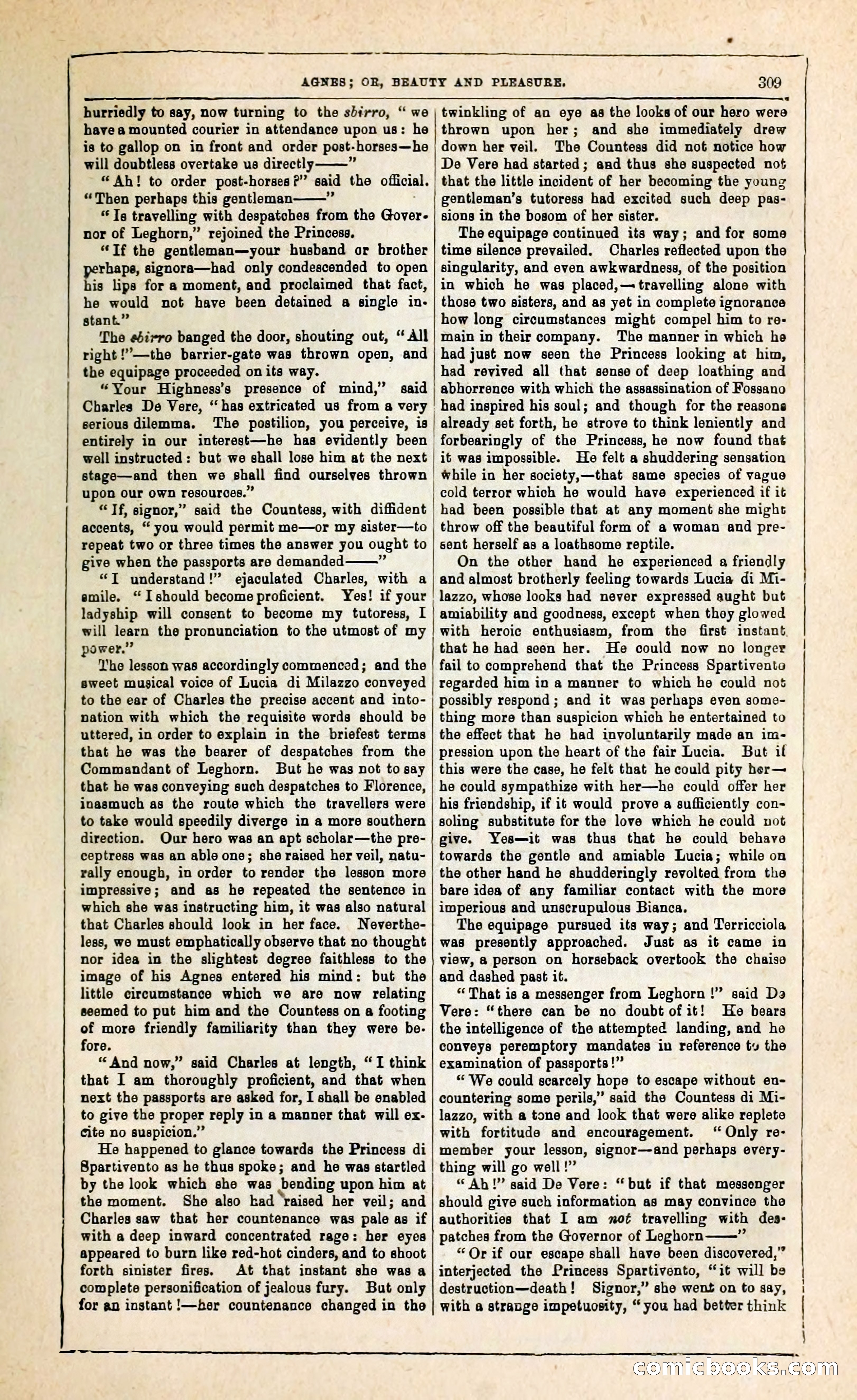
A restored page from Penny Dreadfuls, 1857. Page through the whole issue in the reader above.
📄 Transcribed text from this page (OCR, searchable)
Machine-transcribed from the original scan — historical spelling and the odd misread are preserved.
AGNES; OR, BEAUTY AND PLEASURE, hurriedly to say, now turning to the sbirro, “ we have a mounted courier in attendance upon us: he is to gallop on in front and order post-horses—he will doubtless overtake us directly 4 “ Ah! to order post-horses ?P” eaid the official. “Then perhaps this gentleman ‘Is travelling with despatches from the Gover- nor of Leghorn,” rejoined the Princess. “Tf the gentleman—your husband or brother rhaps, signora—had only condescended to open Vis lips for a moment, and proclaimed that fact, he would not have been detained a single in. stant.” The esirro banged the door, shouting out, “ All right !’’—the barrier-gate was thrown open, and the equipage proceeded on its way. “Your Highness’s presence of mind,’ said Charles De Vere, “has extricated us from & very serious dilemma. The postilion, you perceive, is entirely in our interest—he has evidently been well instructed: but we shall lose him at the next stage—and then we shall find ourselves thrown upon our own resources.” “Tf, signor,” said the Countess, with diffident accents, “ you would permit me—or my sister—to repeat two or three times the answer you ought to give when the passports are demanded *T understand!” ejaculated Charles, with a smile. “Ishould become proficient. Yes! if your ladyship will consent to become my tutoress, I will learn the pronunciation to the utmost of my power.” The lesson was accordingly commenced; and the sweet musical voice of Lucia di Milazzo conveyed to the ear of Charles the precise accent and into- nation with which the requisite words should be uttered, in order to explain in the briefest terms that he was the bearer of despatches from the Commandant of Leghorn. But he was not to say that he was conveying such despatches to Florence, inasmuch as the route which the travellers were to take would speedily diverge in a more southern direction. Our hero was an apt scholar—the pre- ceptress was an able one; she raised her veil, natu- rally enough, in order to render the lesson more impressive; and as he repeated the sentence in which she was instructing him, it was also natural that Charles should look in her face. Neverthe- less, we must emphatically observe that no thought nor idea in the slightest degree faithless to the image of his Agnes entered his mind: but the little circumstance which we are now relating seemed to put him and the Countess on a footing of more friendly familiarity than they were be- fore. “ And now,” said Charles at length, “I think that I am thoroughly proficient, and that when next the passports are asked for, I shall be enabled to give the proper reply in a manner that will ex- cite no suspicion.” He happened to glance towards the Princess di Spartivento as he thus spoke; and he was startled by the look which she was bending upon him at the moment. She also kad raised her veil; and Charles saw that her countenance was pale as if with a deep inward concentrated rage: her eyes appeared to burn like red-hot cinders, and to shoot forth sinister fires. At that instant she was a complete personification of jealous fury. But only for an instant !—her countenance changed in the 309 twinkling of an eye as the looks of our hero were thrown upon her; and she immediately drew down her veil. The Countess did not notice how De Vere had started; aad thus she suspected not that the little incident of her becoming the younz gentleman’s tutoress had excited such deep pas- sions in the bosom of her sister. The equipage continued its way; and for some time silence prevailed. Charles reflected upon the singularity, and even awkwardness, of the position in which he was placed,—travelling alone with those two sisters, and as yet in complete ignorance how long circumstances might compel him to re- main in their company. The manner in which he had just now seen the Princess looking at him, had revived all that sense of deep loathing and abhorrence with which the assassination of Fossano had inspired his soul; and though for the reasons already set forth, he strove to think leniently and forbearingly of the Princess, he now found that it was impossible. He felt a shuddering sensation while in her society,—that same species of vague cold terror which he would have experienced if it had been possible that at any moment she might throw off the beautiful form of a woman and pre- sent herself as a loathsome reptile. On the other hand he experienced a friendly and almost brotherly feeling towards Lucia di Mi- lazzo, whose looks had never expressed aught but amiability and goodness, except when thoy glowed with heroic enthusiasm, from the first instant that he had seen her. He could now no longer fail to comprehend that the Princess Spartivento regarded him in a manner to which he could not possibly respond ; and it was perhaps even some- thing more than suspicion which he entertained to the effect that he had involuntarily made an im- pression upon the heart of the fair Lucia. But if this were the case, he felt that he could pity her— he could sympathize with her—he could offer her his friendship, if it would prove a sufficiently con- soling substitute for the love which he could not give. Yes—it was thus that he could behave towards the gentle and amiable Lucia; while on the other hand he shudderingly revolted from the bare idea of any familiar contact with the more imperious and unscrupulous Bianca. The equipage pursued its way; and Terricciola was presently approached. Just as it came in view, @ person on horseback overtook the chaise and dashed past it. ‘That is a messenger from Leghorn !” said Da Vere: “there can be no doubt of it! He bears the intelligence of the attempted landing, and he conveys peremptory mandates in reference ty the examination of passports!” ‘We could scarcely hope to escape without en- countering some perils,” said the Countess di Mi- lazzo, with a tone and look that were alike replete with fortitude and encouragement. “Only re- member your lesson, signor—and perhaps every- thing will go well !” * Ah!” said De Vere: “but if that messenger should give such information as may convince the authorities that I am xo¢ travelling with des- patches from the Governor of Leghorn ——” “Or if our escape shall have been discovered,” interjected the Princess Spartivento, “it will be destruction—death! Signor,” she went on to say, with a strange impetuosity, “you had better think Comichboo nn) ’ — SaGO© iin