
Penny Dreadfuls, 1857 · page 324 of 394
Agnes, or, Beauty and Pleasure — page 324: what you’re looking at
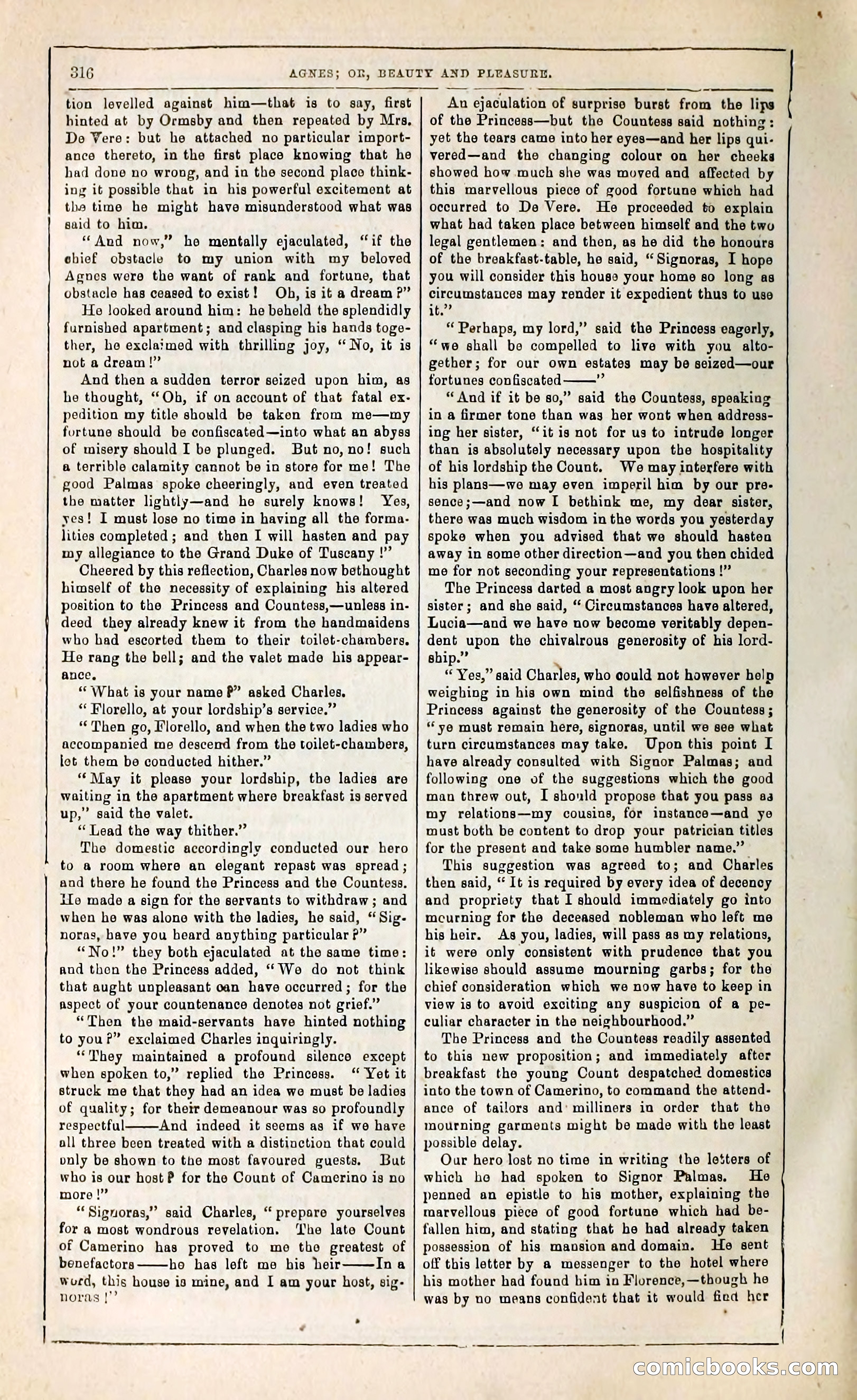
A restored page from Penny Dreadfuls, 1857. Page through the whole issue in the reader above.
📄 Transcribed text from this page (OCR, searchable)
Machine-transcribed from the original scan — historical spelling and the odd misread are preserved.
O16 tion levelled against him—that is to say, first hinted at by Ormsby and then repeated by Mrs, De Vere: but he attached no particular import- ance thereto, in the first place knowing that he had done no wrong, and in the second place think- ing it possible that in his powerful excitement at the time he might have misunderstood what was said to him. “And now,” he mentally ejaculated, “if the chief obstacle to my union with my beloved Agves were the want of rank and fortune, that obstacle has ceased to exist! Oh, is it a dream P” He looked around him: he beheld the splendidly furnished apartment; and clasping his hands toge- ther, he exclaimed with thrilling joy, ‘No, it is not a cream!” And then a sudden terror seized upon him, as he thought, “Ob, if on account of that fatal ex- pedition my title should be taken from me—my fortune should be confiscated—into what an abyss of misery should I be plunged. But no, no! such a terrible calamity cannot be in store for me! The good Palmas spoke cheeringly, and even treated the matter lightly—and he surely knows! Yes, yes! I must lose no time in having all the forma- lities completed ; and then I will hasten and pay my allegiance to the Grand Duke of Tuscany !” Cheered by this reflection, Charles now bethought himself of the necessity of explaining his altered position to the Princess and Countess,—unless in- deed they already knew it from the handmaidens who had escorted them to their toilet-chambers. He rang the bell; and the valet made his appear- ance. ‘What is your name P” asked Charles. *‘ Florello, at your lordship’s service.” ‘Then go, Ilorello, and when the two ladies who accompanied me descend from the toilet-chambers, lot them be conducted hither.” “May it please your lordship, the ladies are waiting in the apartment where breakfast is served up,” said the valet. “‘ Lead the way thither.” The domestic accordingly conducted our hero to a room where an elegant repast was spread; and there he found the Princess and the Countess. ite made a sign for the servants to withdraw; and when he was alone with the ladies, he said, “Sig- noras, have you beard anything particular P” “No!” they both ejaculated at the same time: and thon the Princess added, ‘‘We do not think that aught unpleasant oan have occurred; for the aspect of your countenance denotes not grief.” “Then the maid-servants have hinted nothing to youP” exclaimed Charles inquiringly. “They maintained a profound silence except when spoken to,” replied the Princess. ‘“ Yet it struck me that they had an idea we must be ladies of quality; for therr demeanour was so profoundly respectful And indeed it seems as if we have all three been treated with a distinction that could only be shown to the most favoured guests. But who is our host P for the Count of Camerino is no more !” “‘Signoras,’”’ said Charles, “ prepare yourselves for a most wondrous revelation. ‘he late Count of Camerino has proved to me the greatest of benefactors he has left me his heir Ina word, this house is mine, and I am your host, sig- >? noras | AGNES; OR, BEAUTY AND PLEASURE. ———_- An ejaculation of surprise burst from the lips of the Princess—but the Countess said nothing: yet the tears came into her eyes—and her lips qui- vered—and the changing colour on her cheeks showed how much she was moved and affected by this marvellous piece of good fortune which had occurred to De Vere. He proceeded to explain what had taken place between himself and the two legal gentlemen: and then, as he did the honours of the breakfast-table, he said, “Signoras, I hope you will consider this house your home so long as circumstauces may render it expedient thus to use it.” “Perhaps, my lord,” said the Princess eagerly, “we shall be compelled to live with you alto- gether; for our own estates may be seized—our fortunes confiscated 4 “And if it be so,” said the Countess, speaking in a firmer tone than was her wont when address- ing her sister, “it is not for us to intrude longer than is absolutely necessary upon the hospitality of his lordship the Count. We may interfere with his plans—we may even imperil him by our pre- sence;—and now I bethink me, my dear sister, there was much wisdom in the words you yesterday spoke when you advised that we should hasten away in some other direction—and you then chided me for not seconding your representations !” The Princess darted a most angry look upon her sister; and she said, “ Circumstances have altered, Lucia—and we have now become veritably depen- dent upon the chivalrous generosity of his lord- ship.” “Yes,” said Charles, who could not however help weighing in his own mind the selfishness of the Princess against the generosity of the Countess; ye must remain here, signoras, until we see what turn circumstances may take. Upon this point I have already consulted with Signor Palmas; and following one of the suggestions which the good man threw out, I should propose that you pass aa my relations—my cousins, for instance—and ye must both be content to drop your patrician titles for the present and take some humbler name.” This suggestion was agreed to; and Charles then said, “ It is required by every idea of decency and propriety that I should immediately go into mcurning for the deceased nobleman who left me his heir. As you, ladies, will pass as my relations, it were only consistent with prudence that you likewise should assume mourning garbs; for the chief consideration which we now have to keep in view is to avoid exciting any suspicion of a pe- culiar character in the neighbourhood.” The Princess and the Countess readily assented to this new proposition; and immediately after breakfast the young Count despatched domestics into the town of Camerino, to command the attend- ance of tailors and’ milliners in order that the mourning garments might be made with the least possible delay. Our hero lost no time in writing the letters of which be had spoken to Signor Palmas. He penned an epistle to his mother, explaining the marvellous piece of good fortune which had be- fallen him, and stating that he had already taken possession of his mansion and domain. He sent off this letter by a messenger to the hotel where his mother had found him in Florence,—though he was by no means confident that it would fied her ,. echook — er (©) 8