
Penny Dreadfuls, 1857 · page 334 of 394
Agnes, or, Beauty and Pleasure — page 334: what you’re looking at
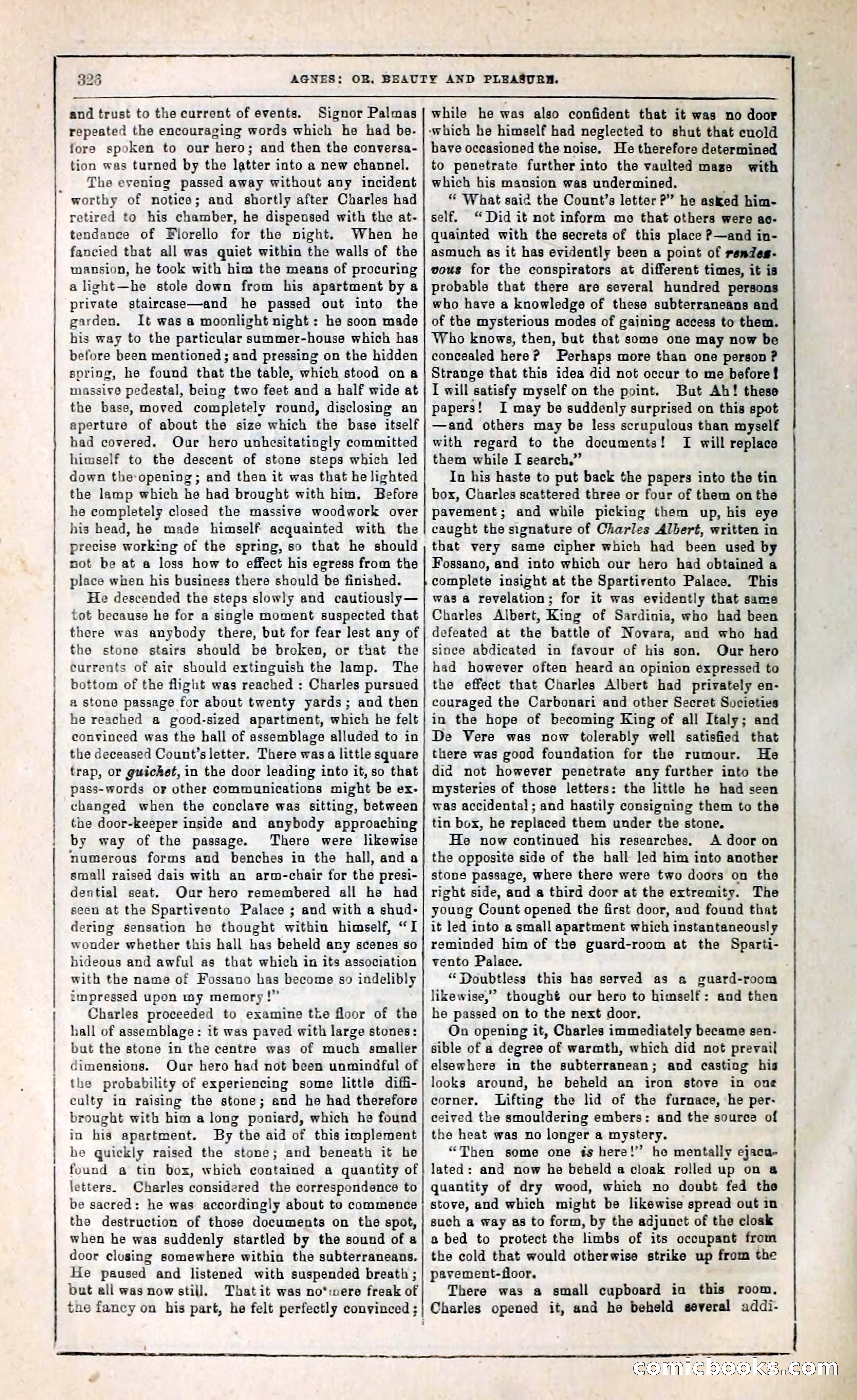
A restored page from Penny Dreadfuls, 1857. Page through the whole issue in the reader above.
📄 Transcribed text from this page (OCR, searchable)
Machine-transcribed from the original scan — historical spelling and the odd misread are preserved.
Se 326 AGNES: OR, BEAUTY AND PLEASURE. and trust to the current of events. Signor Palmas repeated the encouraging words which he had be- fore spoken to our hero; and then the conversa- tion was turned by the latter into a new channel. The evening passed away without any incident ‘ worthy of notice; and shortly after Charles had retired to his chamber, he dispensed with the at- tendanece of Fiorello for the night. When he fancied that all was quiet within the walls of the mansion, he took with him the means of procuring a light—he stole down from his apartment by a private staircase—and he passed out into the garden. It was a moonlight night: he soon made his way to the particular summer-house which has before been mentioned ; and pressing on the hidden spring, he found that the table, which stood ona massive pedestal, being two feet and a half wide at the base, moved completely round, disclosing an aperture of about the size which the base itself had covered. Our hero unhesitatingly committed himself to the descent of stone steps which led down the-opening; and then it was that he lighted the lamp which he had brought with him, Before he completely closed the massive woodwork over his head, he made himself acquainted with the precise working of the spring, so that he should not be at a loss how to effect his egress from the place when his business there should be finished. He descended the steps slowly and cautiously— tot because he for a single moment suspected that there was anybody there, but for fear lest any of the stone stairs should be broken, or that the currents of air should extinguish the lamp. The bottom of the flight was reached : Charles pursued a stone passage for about twenty yards; and then he reached a good-sized apartment, which he felt convinced was the hall of assemblage alluded to in the deceased Count’s letter. There wasa little square trap, or guicket, in the door leading into it, so that pass-words or other communications might be ex- changed when the conclave was sitting, between the door-keeper inside and anybody approaching by way of the passage. There were likewise numerous forms and benches in the hall, anda small raised dais with an arm-chair for the presi- dential seat. Our hero remembered all he had seen at the Spartivento Palace ; and with a shud- dering sensation he thought within himself, “I wouder whether this hall has beheld any scenes so hideous and awful as that which in its association with the name of Fossano has become so indelibly impressed upon my memory !” Charles proceeded to examine tke floor of the hall of assemblage: it was paved with large stones: but the stone in the centre was of much smaller dimensions. Our hero had not been unmindful of the probability of experiencing some little diffi- culty in raising the stone; and he had therefore brought with him a long poniard, which he found in his apartment. By the aid of this implement he quickly raised the stone; and beneath it he found a tin box, which contained a quantity of letters. Charles considered the correspondence to be sacred: he was accordingly about to commence the destruction of those documents on the spot, when he was suddenly startled by the sound of a door clusing somewhere within the subterraneans. He paused and listened with suspended breath ; but all was now still, Thatit was no*were freak of the fancy on his part, he felt perfectly convinced ; while he was also confident that it was no door -which he himeelf had neglected to shut that euold have occasioned the noise. He therefore determined to penetrate further into the vaulted maze with which his mansion was undermined. “ What saic the Count’s letter ?” he asked him- self. “Did it not inform me that others were ac- quainted with the secrets of this place ?—and in- asmuch as it has evidently been a point of rendeg- vous for the conspirators at different times, it is probable that there are several hundred persons who have a knowledge of these subterraneans and of the mysterious modes of gaining access to them. Who knows, then, but that some one may now be concealed here? Perhaps more than one person ? Strange that this idea did not occur to me before! I will satisfy myself on the point. But Ah! these papers! I may be suddenly surprised on this spot —and others may be less scrupulous than myself with regard to the documents! I will replace them while I search,” In his haste to put back the papers into the tin box, Charles scattered three or four of them on the pavement; and while picking them up, his eye caught the signature of Charles Albert, written in that very same cipher which had been used by Fossano, and into which our hero had obtained a complete insight at the Spartirento Palace. This was a revelation; for it was evidently that same Charles Albert, King of Sardinia, who had been defeated at the battle of Novara, and who had since abdicated in favour of his son. Our hero had however often heard an opinion expressed to the effect that Charles Albert had privately en- couraged the Carbonari and other Secret Societies in the hope of becoming King of all Italy; and De Vere was now tolerably well satisfied that there was good foundation for the rumour. He dic not however penetrate any further into the mysteries of those letters: the little he had seen was accidental; and hastily consigning them to the tin box, he replaced them under the stone. He now continued his researches. A door on the opposite side of the hall led him into another stone passage, where there were two doors on the right side, and a third door at the extremity. The young Count opened the first door, and found that it led into a small apartment which instantaneously reminded him of the guard-room at the Sparti- vento Palace. “Doubtless this has served a3 a guard-room likewise,” thoughé our hero to himself: and then he passed on to the next door. On opening it, Charles immediately became sen- sible of a degree of warmth, which did not prevail elsewhere in the subterranean; and casting his looks around, he beheld an iron stove in one corner. Lifting the lid of the furnace, he per- ceived the smouldering embers: and the sourca of the heat was no longer a mystery. “Then some one ¢s here!’’ he mentally ejaca- lated: and now he beheld a cloak rolled up on a quantity of dry wood, which no doubt fed the stove, and which might be likewise spread out in such a way as to form, by the adjunct of the cloak a bed to protect the limbs of its occupant from the cold that would otherwise strike up from the pavement-floor. There was a small cupboard in this room. Charles opened it, and he beheld several addi- oO CoOmichboo A) S -—_—— 5}