
Penny Dreadfuls, 1857 · page 358 of 394
Agnes, or, Beauty and Pleasure — page 358: what you’re looking at
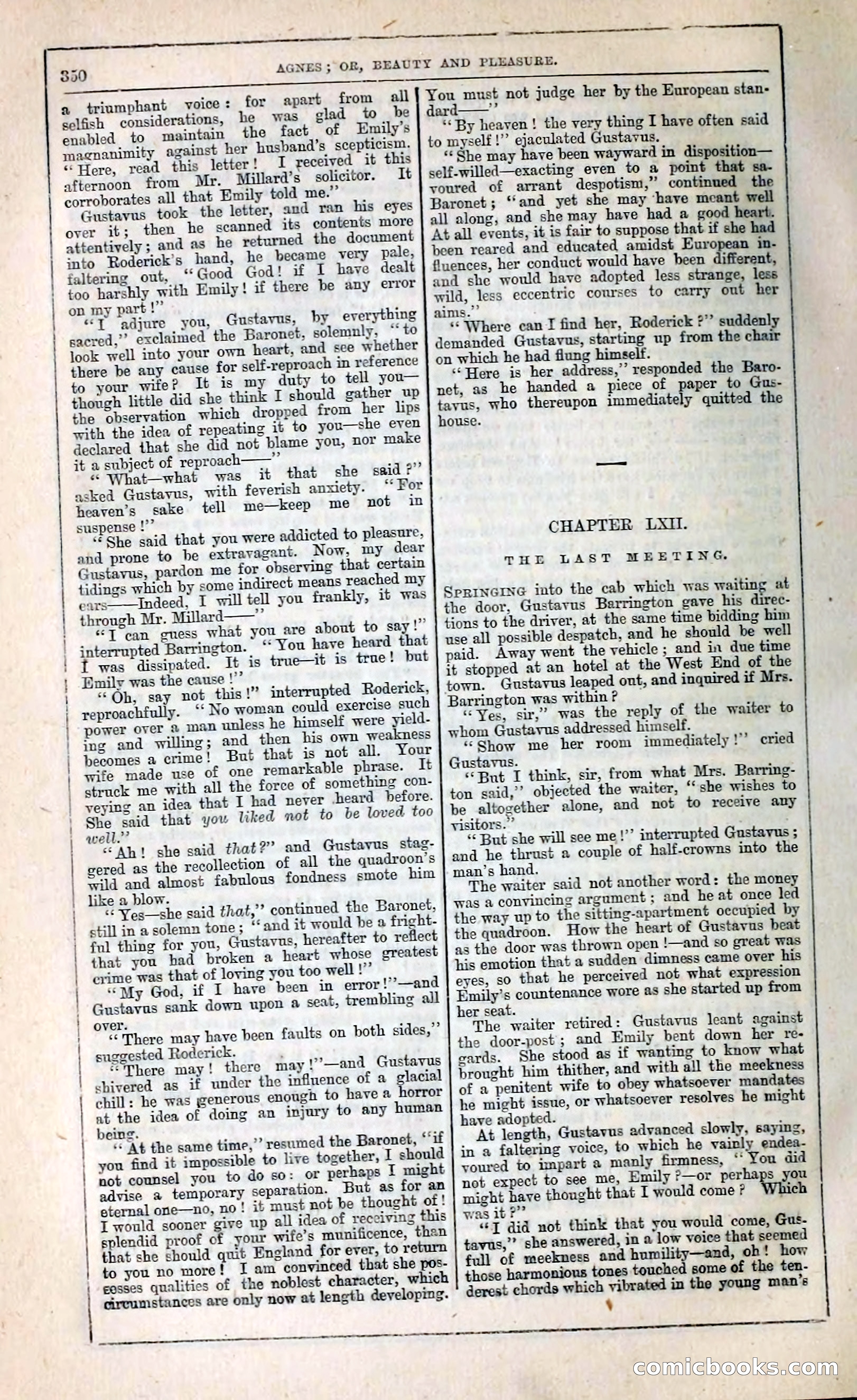
A restored page from Penny Dreadfuls, 1857. Page through the whole issue in the reader above.
📄 Transcribed text from this page (OCR, searchable)
Machine-transcribed from the original scan — historical spelling and the odd misread are preserved.
LL P a Sn. an a EE 350 for apart from all he was g to be enabled to maintain the fact of Emily's magnanimity against her husband’s scepticism. “Here, read this letter! I received it this afternoon from Mr. Millard’s solicitor. It corroborates all that Emily told me.” Gustavus took the letter, and ran his eyes over it; then he scanned its contents more attentively ; and as he returned the document “nto Roderick’s hand, he became very pale, faltering out, ‘* Good God! if I have dealt too harshly with Emily! if there be any error on my part! «JT adjure you, Gustavus, by everything sacred,’ exclaimed the Baronet. solemnly, “‘to look well into your own heart, and see whether there be any cause for self-reproach in reference to your wife? It is my duty to tell you— though little did she think I should gather up the observation which dropped from her lips with the idea of repeating it to you—she even declared that she did not blame you, nor make it a subject of reproach——”’ “ What—what was it that she said ?” asked Gustavus, with feverish anxiety. ‘For heaven’s sake tell me—keep me not in suspense !”’ ‘She said that you were addicted to pleasure, and prone to be extravagant. Now, my dear Gustavus, pardon me for observing that certaim tidings which by some indirect means reached my Indeed, I will tell you frankly, it was through Mr. Millard——”’ *T can gness what you are about to say!” interrupted Barrington. “You have heard that t was dissipated. It is true—it is true! but Emily was the cause ue “Oh, say not this 1? interrupted Roderick, reproachfully. ‘‘ No woman could exercise such power over ® man unless he himself were yield- ing and willing; and then his own weakness becomes a crime! But that is not all. Your wife made use of one remarkable phrase. It struck me with all the force of something con- veying an idea that I had never heard before. She said that you liked mot to be loved too well.” < Ah! she said that?” and Gustavus stag- gered as the recollection of all the quadroon’s wild and almost fabulous fondness smote him like a blow. ‘€ Yes—she said that,”’ a triumphant voice : selfish considerations, continued the Baronet, still in a solemn tone; “and it would he a fright- ful thing for you, Gustavus, hereafter to reflect that you bad broken a heart whose greatest crime was that of loving you too well !”’ “My God, if I have been in error!’’—and Gustavus sank down upon a seat, trembling all over. ‘There may have been faults on both sides,”’ suggested Roderick. ' There may! there may shivered as if under the influence of a glacial chill: he was generous enough to have a horror at the idea of doing an injury to any human being. ‘* At the same time,” resumed the Baronet, “‘if you find it impossible to live together, I should not counsel you to do so: or perhaps I might advise a temporary separation. But as for an eternal one—no, no! it must not be thought of! I would sooner give up all idea of receiving this splendid proof of your wife’s munificence, than that she chould quit England for ever, to return to you no more! I am convinced that she pos- gesses qualities of the noblest character, which circumstances are only now at length developing. and Gustavus — i ___ r AGNES ; OR, BEAUTY AND PLEASURE. aa je ee ee You must not judge her by the European stan- ee dard—— ‘‘ By heaven ! the very thing I have often said to meet hes aaa Gustavus. «She may have been wayward in disposition— self-willed—exacting even to a point that sa- youred of arrant despotism,” continued the Baronet; ‘and yet she may ‘haye meant well all along, and she may have had a good heart. ‘At all events, it is fair to suppose that if she had been reared and educated amidst Euro in- fluences, her conduct would have been differen s and she would have adopted less strange, less wild, less eccentric courses to carry out her aims.” ‘* Where can I find her, demanded Gustavus, starting on which he had flung himself. ‘‘Here is her address,’ responded the Baro- net, as he handed a piece of paper to Gus- eve who thereupon immediately quitted the ouse. Roderick ?”’ suddenly up from the chair CHAPTER LXI. THE LAST MEETING. SprRINGING into the cab which was waiting at the door, Gustavus Barrington gave his direc- tions to the driver, at the same time bidding him use all possible despatch, and he should be well paid. Away went the vehicle ; and in due time it stopped at an hotel at the West End of the town. Gustavus leaped ont, and inquired if Mrs. Barrington was within P “Yes, sir,’ was the reply of the waiter to whom Gustavus addressed himself. ‘Show me her room immediately 1 cried Gustavus. “But 1 think, sir, from what Mrs. Barring- ton said,’ objected the waiter, ‘she wishes to be altogether alone, and not to receive any visitors.” : “But she will see me!”’ interrupted Gustavus ; and he thrust a couple of half-crowns into the man’s hand. The waiter said not another word : the money was a convincing argument ; and he at once led the way up to the sitting-apartment occupied by the quadroon. How the heart of Gustavus beat as the door was thrown open !—and so great was his emotion that a sudden dimness came over his eyes, so that he perceived not what expression Emily’s countenance wore as she started up from her seat. The waiter retired: Gustavus leant against the door-post; and Emily bent down her re- cards. She stood as if wanting to know what brought him thither, and with all the meekness of a penitent wife to obey whatsoever mandates he might issue, or whatsoever resolves he might have adopted. At length, Gustavus advanced slowly, saying, in a faltering voice, to which he vainly endea- voured to impart a manly firmness, * You did not expect to see me, Emily ?—or perhaps you might have thought that I would come ? ich was it ?” “J did not think that you would come, Gus- tavus,” she answered, in a low voice that seemed full of meekness and humility—and, oh! how those harmonious tones touched some of the ten- derest chords which vibrated im the young man’s ‘ Ghook