
Penny Dreadfuls, 1857 · page 366 of 394
Agnes, or, Beauty and Pleasure — page 366: what you’re looking at
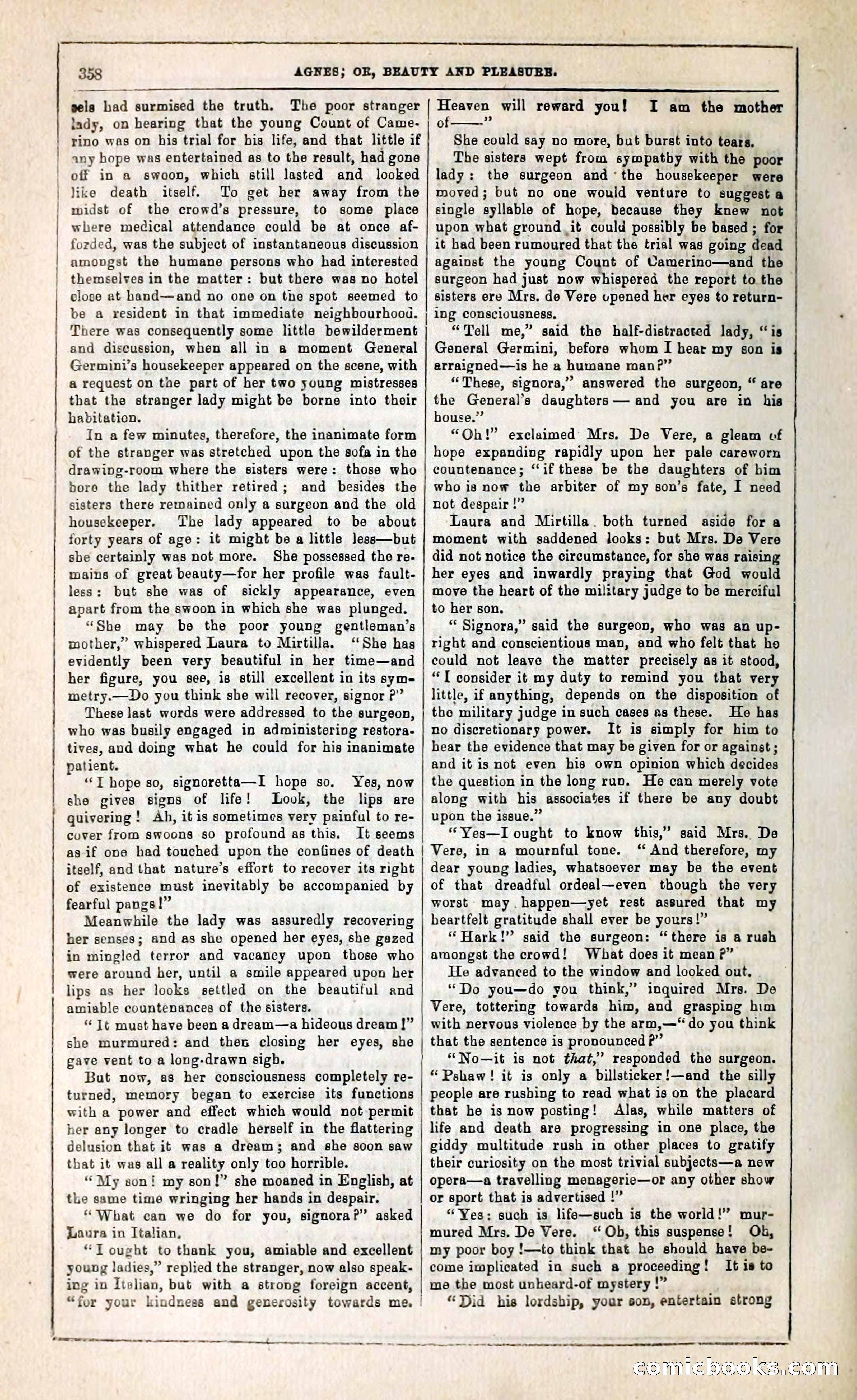
A restored page from Penny Dreadfuls, 1857. Page through the whole issue in the reader above.
📄 Transcribed text from this page (OCR, searchable)
Machine-transcribed from the original scan — historical spelling and the odd misread are preserved.
tt ssn sets — ; lt Th 358 AGNES; OR, BEAUTY AND PLEASUBE. sela had surmised the truth. The poor stranger lady, on hearing that the young Count of Came- rino was on his trial for his life, and that little if any hope was entertained as to the result, had gone off in a swoon, which still lasted and looked like death itself. To get her away from the midst of the crowd’s pressure, to some place where medical attendance could be at once af- forded, was the subject of instantaneous discussion amongst the humane persons who had interested themselves in the matter: but there was no hotel elose at hand—and no one on the spot seemed to be a resident in that immediate neighbourhood. | There was consequently some little bewilderment and discussion, when all in a moment General Germini’s housekeeper appeared on the scene, with a request on the part of her two young mistresses that the stranger lady might be borne into their habitation. In a few minutes, therefore, the inanimate form of the stranger was stretched upon the sofa in the drawing-room where the sisters were: those who bore the lady thither retired; and besides the sisters there remained only a surgeon and the old housekeeper. The lady appeared to be about forty years of age: it might be a little less—but she certainly was not more. She possessed the re- maius of great beauty—for her profile was fault- less: but she was of sickly appearance, even apart from the swoon in which she was plunged. “She may be the poor young gentleman’s mother,” whispered Laura to Mirtilla. ‘‘She has evidently been very beautiful in her time—and her figure, you see, is still excellent in its syme metry.—Do you think she will recover, signor ?” These last words were addressed to the surgeon, who was busily engaged in administering restora- tives, and doing what he could for bis inanimate patient. ‘‘T hope so, signoretta—I hope so. Yes, now she gives signs of life! Look, the lips are quivering! Ah, it is sometimes very painful to re- cover from swoons so profound as this. It seems as if one had touched upon the confines of death | itself, and that nature’s effort to recover its right of existence must inevitably be accompanied by fearful pangs!” Meanwhile the lady was assuredly recovering her senses; and as she opened her eyes, she gazed in mingled terror and vacancy upon those who were around her, until a smile appeared upon her lips as her looks settled on the beautiful and amiable countenances of the sisters. ‘“‘1¢ must have been a dream—a hideous dream |” she murmured: and then closing her eyes, she gave vent to a long-drawn sigh. But now, as her consciousness completely re- turned, memory began to exercise its functions with a power and effect which would not permit her any longer to cradle herself in the flattering delusion that it was a dream; and she soon saw that it was all a reality only too horrible. “My son! my son!” she moaned in English, at the same time wringing her hands in despair. “What can we do for you, signora?” asked Laura in Italian, “T ought to thank you, amiable and excellent young ladies,” replied the stranger, now also speak- ing in Itslian, but with a strong foreign accent, “for your kindness and generosity towards me oe Heaven will reward you! I am the mother oe She could say no more, but burst into tears, The sisters wept from sympathy with the poor lady: the surgeon andthe housekeeper were moved; but no one would venture to suggest a single syllable of hope, because they knew not upon what ground it could possibly be based ; for it had been rumoured that the trial was going dead against the young Count of Camerino—and the surgeon had just now whispered the report to the sisters ere Mrs. de Vere upened her eyes to return- ing consciousness. “Tell me,” said the half-distracted lady, “is General Germini, before whom I hear my son is erraigned—is he a humane man?” “These, signora,” answered the surgeon, “ are the General’s daughters — and you are in his house.” “Qh!” exclaimed’ Mrs. De Vere, a gleam of hope expanding rapidly upon her pale careworn countenance; ‘“‘if these be the daughters of him who is now the arbiter of my son’s fate, I need not despair !” Laura and Mirtilla. both turned aside for a moment with saddened looks: but Mrs. De Vere did not notice the circumstance, for she was raising her eyes and inwardly praying that God would move the heart of the military judge to be merciful to her son. “ Signora,” said the surgeon, who was an up- right and conscientious man, and who felt that ho could not leave the matter precisely as it stood, “I consider it my duty to remind you that very little, if anything, depends on the disposition of the military judge in such cases as these. He has no discretionary power. It is simply for him to hear the evidence that may be given for or against ; and it is not even his own opinion which decides the question in the long run. He can merely vote slong with his associates if there be any doubt upon the issue.” *Yes—I ought to know this,” said Mrs. De Vere, in 8 mournful tone. ‘ And therefore, my dear young ladies, whatsoever may be the event of that dreadful ordeal—even though the very worst may happen—yet rest assured that my heartfelt gratitude shall ever be yours!” ** Hark!” said the surgeon: “there is a rush amongst the crowd! What does it mean ?” He advanced to the window and looked out. “Do you—do you think,” inquired Mrs. De Vere, tottering towards him, and grasping him with nervous violence by the arm,—“do you think that the sentence is pronounced P”’ *No—it is not that,’ responded the surgeon. “Pshaw! it is only a billsticker!—and the silly people are rushing to read what is on the placard that he is now posting! Alas, while matters of life and death are progressing in one place, the giddy multitude rush in other places to gratify their curiosity on the most trivial subjects—a new opera—a travelling menagerie—or any other show or sport that is advertised !” “Yes: such is life—such is the world!” mur- mured Mrs. De Vere. ‘Oh, this suspense! Ob, my poor boy !—to think that he should have be- come implicated in such a proceeding! It is to me the most unheard-of mystery !” “Did his lordship, your son, entertain strong — St amet oe ee MIE LDOOLK (©) estes (C@) }