
Penny Dreadfuls, 1857 · page 387 of 394
Agnes, or, Beauty and Pleasure — page 387: what you’re looking at
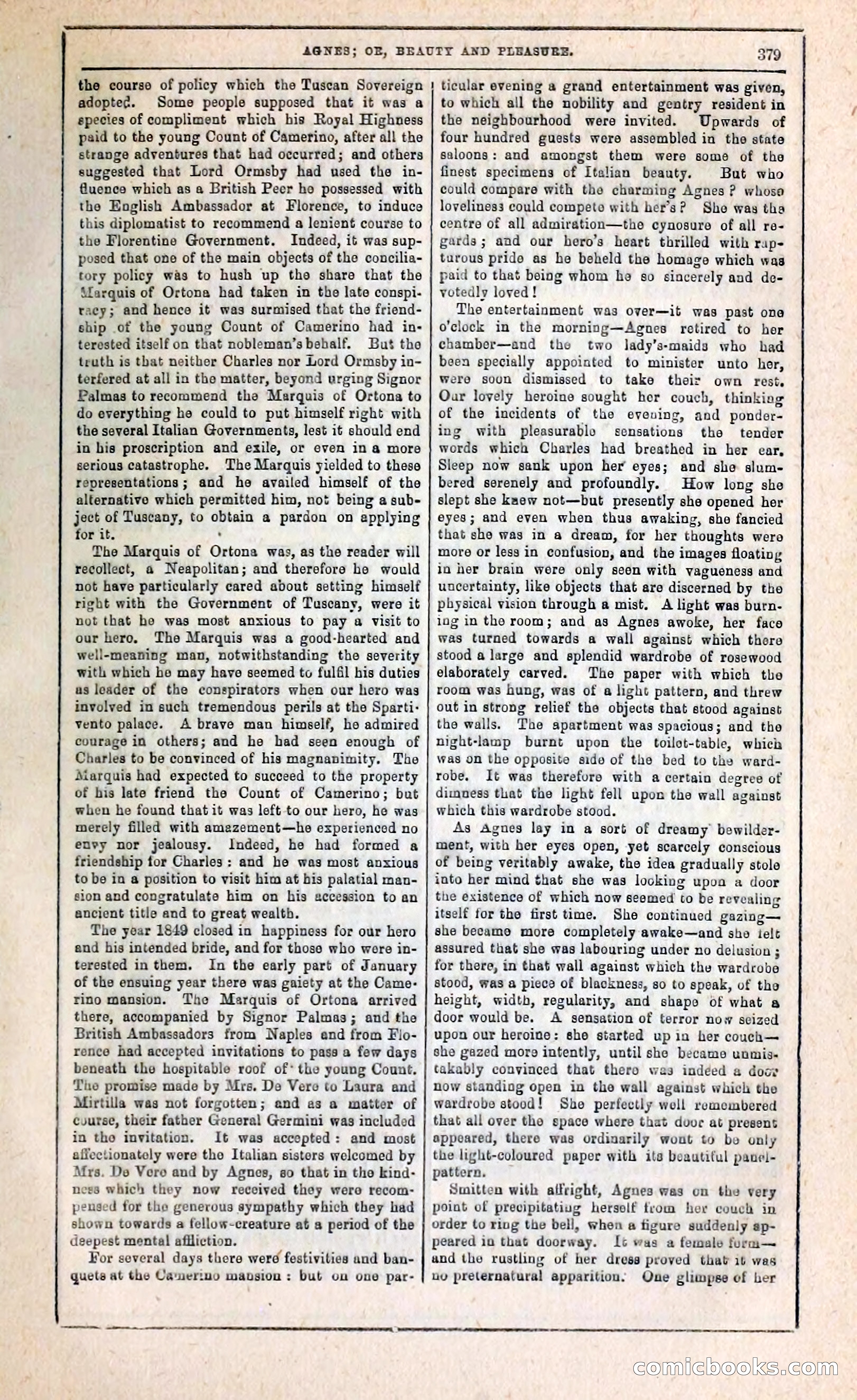
A restored page from Penny Dreadfuls, 1857. Page through the whole issue in the reader above.
📄 Transcribed text from this page (OCR, searchable)
Machine-transcribed from the original scan — historical spelling and the odd misread are preserved.
AGNES; OF, BEAUTY AND PLEASURE. avg the course of policy which the Tuscan Sovereign } adopte¢. Some people supposed that it was a species of compliment which his Royal Highness paid to the young Count of Camerino, after all the strange adventures that had occurred; and others suggested that Lord Ormsby had used the in- fluence which as a British Peer he possessed with the English Ambassador at Florence, to induce this diplomatist to recommend a lenient course to the Florentine Government. Indeed, it was sup- posed that one of the main objects of the concilia- tory policy was to hush up the share that the Sfarquis of Ortona had taken in the late conspi- racy; and hence it was surmised that the friend- ship of the young Count of Camerino had in- terested itself on that nobleman’s behalf. But tho truth is that neither Charles nor Lord Ormsby in- terfered at all in the matter, beyond urging Signor Palmas to recommend the Marguis of Ortona to do everything he could to put himself right with the several Italian Governments, lest it should end in his proscription and exile, or even in a more serious catastrophe. The Marquis yielded to these representations; and he availed himself of the alternative which permitted him, not being a sub- ject of Tuscany, to obtain a pardon on applying for it. : The Marquis of Ortona was, as the reader will recollect, a Neapolitan; and therefore he would not have particularly cared about setting himself right with the Government of Tuscany, were it not that he was most anxious to pay a Visit to our hero. The Marquis was a good-hearted and well-meaning man, notwithstanding the severity with which he may have seemed to fulfil his duties as leader of the conspirators when our hero was involved in such tremendous perils at the Sparti- vento palace. A brave man himself, he admired courage in others; and he had seen enough of Charles to be convinced of his magnanimity. The Marquis had expected to succeed to the property of his late friend the Count of Camerino; but when he found that it was left-to our hero, he was merely filled with amezement—ho experienced no envy nor jealousy. Indeed, he had formed a friendship for Charles: and he was most anxious to be in a position to visit him at bis palatial man- sion and congratulate him on his accession to an ancient title and to great wealth. The year 1849 closed in happiness for our hero and his intended bride, and for those who wore in- terested in them. In the early part of January of the ensuing year there was gniety at the Came- rino mansion. The Marquis of Ortona arrived there, accompanied by Signor Palmas; and the British Ambassadors from Naples end from Flo- rence had accepted invitations to pass a few days beneath the hospitable roof of* the young Count. The promise made by Mrs. De Vere to Laura and Mirtilla was not forgotten; and as a matter of cuurse, their father General Germini was included in tho invitation. It was accepted: and most affectionately were the Italian sisters welcomed by Mrs. De Vere and by Agnes, so that in the kind- ness which they now received they were recom- pensed for the generous sympathy which they had shown towards a fellow-creature at a period of the deepest mental affliction. For several days there werd festivities and ban- guets at the Caner:no mansion: but on one par- ticular evening a grand entertainment was given, to which all the nobility and gentry resident in the neighbourhood were invited. Upwards of four hundred guests were assembled in the state saloons: and amongst them were some of the finest specimens of Italian beauty. But who could compare with the charming Agnes ? whose loveliness could compete with her’s? Sho was tha centre of all admiration—the cynosure of all re- gards ; and our hero’s heart thrilled with rup- turous pride as he beheld the homage which was paid to that being whom he so sincerely and de- votedly loved! The entertainment was over—it was past one o’clock in the morning—Agnes retired to hor chamber—and the two lady’s-maids who had been specially appointed to minister unto her, Were soun dismissed to take their own rest. Our lovely heroine sought her couch, thinking of the incidents of the evening, and ponder- ing with pleasurablo sensations the tender words which Charles had breathed in her ear, Sleep now sank upon her eyes; and she slum- bered serenely and profoundly. How long she slept she kaew not—but presently she opened her eyes; and even when thus awaking, she fancied that she was in a dream, for her thoughts were more or less in confusion, and the images floating in her brain were only seen with vagueness and uncertainty, like objects that are discerned by the physical vision through a mist. A light was burn- ing in the room; and as Agnes awoke, her faco was turned towards a wall against which there stood a large and splendid wardrobe of rosewood elaborately carved. The paper with which tbe room was hung, was of a light pattern, and threw out in strong relief the objects that stood against the walls. The apartment was spacious; and the night-lamp burnt upon the toilot-table, which was on the opposite side of the bed to the ward- robe. It was therefure with a certain degree of dimuess that the light fell upon the wall against which this wardrobe stood. As Agues lay in a sort of dreamy’ bewilder- ment, with her eyes open, yet scarcely conscious of being veritably awake, the idea gradually stole into her mind that she was looking upoa a door the existence of which now seemed to be revealing itself for the first time. She continued gazing— she became more completely awake—and sho ielt assured that she was labouring under no delusion ; for there, in that wall against which the wardrobe stood, was a piece of blackness, so to speak, of tho height, width, regularity, and shape of what a door would be. A sensation of terror now seized upon our heroine: she started up in her couch— she gazed more intently, until she became unmis- takably convinced that thero was indéed a doov now standiog open in the wall against which the wardrobe stood! She perfectly woll remembered that all over the space where that door at present appeared, there was ordinarily wont to bo only the light-coloured paper with its beautiful panel- pattern. Smitten with alfright, Agnes was on the very point of precipitatiug herself from her couch in order to ring the bell, when a figure suddenly ap- peared io that doorway. 1¢ was a female furm— and the rustling of her dress proved that it was no preternatural apparition. One glimpse of Ler elooolk ©) co 5}