
Penny Dreadfuls, 1857 · page 397 of 394
Agnes, or, Beauty and Pleasure — page 397: what you’re looking at
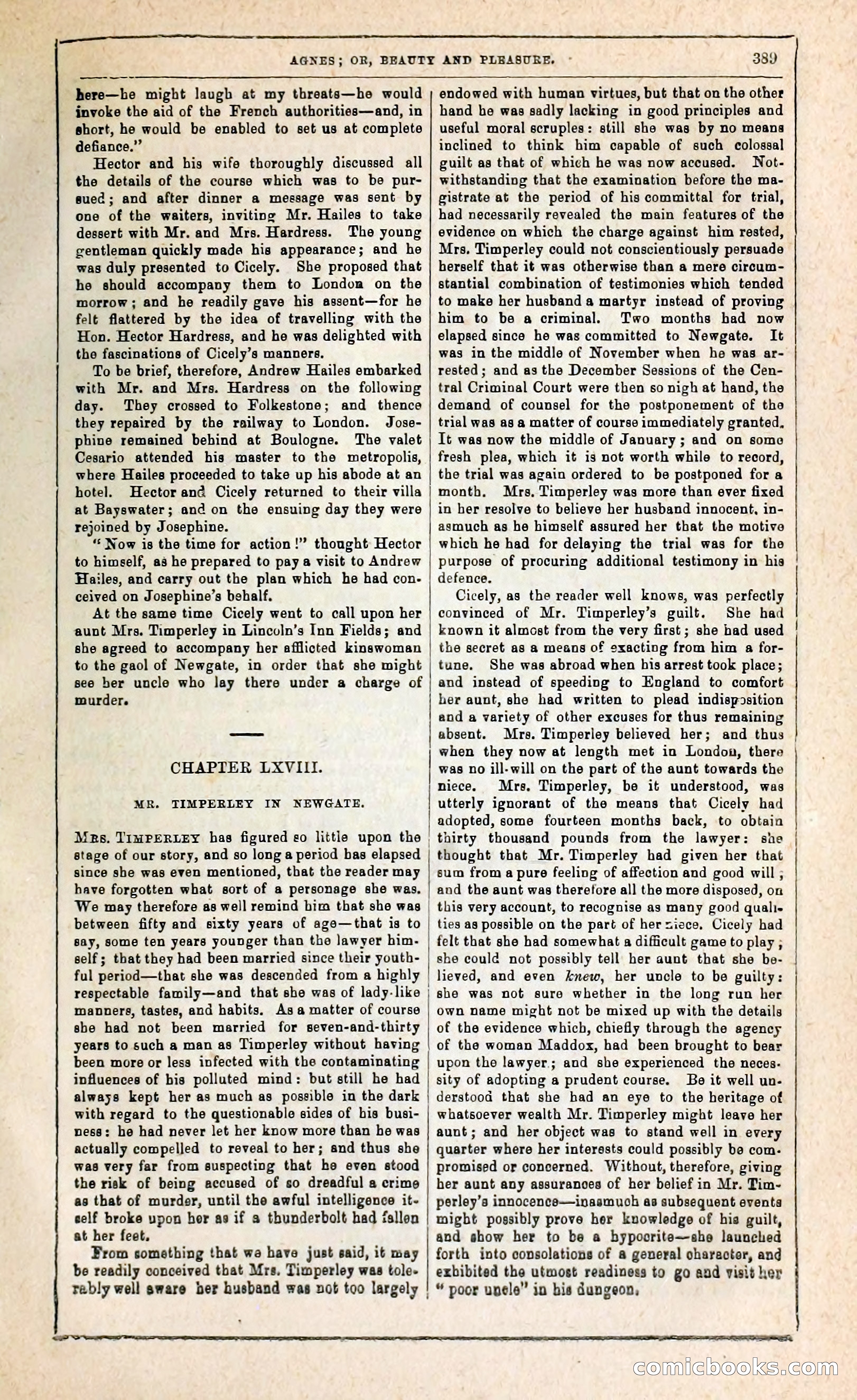
A restored page from Penny Dreadfuls, 1857. Page through the whole issue in the reader above.
📄 Transcribed text from this page (OCR, searchable)
Machine-transcribed from the original scan — historical spelling and the odd misread are preserved.
a AGNES; OR, BEAUTY AND PLEASURE, here—he might laugh at my threats—he would invoke the aid of the French authorities—and, in short, he would be enabled to set us at complete defiance.” Hector and his wife thoroughly discussed all the details of the course which was to be pur- sued; and after dinner a message was sent by one of the waiters, inviting Mr. Hailes to take dessert with Mr. and Mrs. Hardress. The young gentleman quickly made his appearance; and he was duly presented to Cicely. She proposed that he should accompany them to London on the morrow; and he readily gave his assent—for he felt flattered by the idea of travelling with the Hon. Hector Hardress, and he was delighted with the fascinations of Cicely’s manners. To be brief, therefore, Andrew Hailes embarked with Mr. and Mrs. Hardress on the following day. They crossed to Folkestone; and thence they repaired by the railway to London. Jose- phine remained behind at Boulogne. The valet Cesario attended his master to the metropolis, where Hailes proceeded to take up his abode at an hotel. Hector and Cicely returned to their villa at Bayswater; and on the ensuing day they were rejoined by Josephine. “‘ Now is the time for action!” thought Hector to himself, as he prepared to pay a visit to Andrew Hailes, and carry out the plan which he had con- ceived on Josephine’s behalf. At the same time Cicely went to call upon her aunt Mrs. Timperley in Lincoln’s Inn Fields; and she agreed to accompany her afflicted kinswoman to the gaol of Newgate, in order that she might see her uncle who lay there under a charge of murder. CHAPTER LXVIII. MR. TIMPERLEY IN NEWGATE. Mas. TIMPERLEY has figured so little upon the | stage of our story, and so longa period bas elapsed since she was even mentioned, that the reader may have forgotten what sort of a personage she was, We may therefore as well remind him that she was between fifty and sixty years of age—that is to say, some ten years younger than the lawyer him- self ; that they had been married since their youth- ful period—that she was descended from a highly respectable family—and that she was of lady-like manners, tastes, and habits. Asa matter of course she had not been married for seven-and-thirty years to such a man as Timperley without having been more or less infected with the contaminating influences of his polluted mind: but still he had always kept her as much as possible in the dark with regard to the questionable sides of his busi- ness: he had never let her know more than he was actually compelled to reveal to her; and thus she was very far from suspecting that he even stood the riak of being accused of so dreadful a crime as that of murder, until the awful intelligence it- self broke upon her as if a thunderbolt had fsllon at her feet. From something that we have just said, it may be readily conceived that Mrs. Timperley was tole- tably well sware ber husband was not too largely 380 endowed with human virtues, but that on the other hand be was sadly lacking in good principles and useful moral scruples: still she was by no means inclined to think him capable of such colossal guilt as that of which he was now accused. WNot- withstanding that the examination before the ma- gistrate at the period of his committal for trial, had necessarily revealed the main features of the evidence on which the charge against him rested, Mrs. Timperley could not conscientiously persuade herself that it was otherwise than a mere circum- stantial combination of testimonies which tended to make her husband a martyr instead of proving him to be a criminal. Two months had now elapsed since he was committed to Newgate. It was in the middle of November when he was ar- rested; and as the December Sessions of the Cen- tral Criminal Court were then so nigh at hand, the demand of counsel for the postponement of the trial was as a matter of course immediately granted, It was now the middle of January ; and on some fresh plea, which it is not worth while to record, the trial was again ordered to be postponed for a month. Mrs. Timperley was more than ever fixed in her resolve to believe her husband innocent, in- asmuch as he himself assured her that the motive which he had for delaying the trial was for the purpose of procuring additional testimony in his defence. Cicely, as the reader well knows, was perfectly convinced of Mr. Timperley’s guilt. She had known it almost from the very first; she had used the secret as a means of exacting from him a for- tune. She was abroad when his arrest took place; and instead of speeding to England to comfort her aunt, she had written to plead indisposition and a variety of other excuses for thus remaining absent. Mrs. Timperley believed her; and thus when they now at length met in London, there was no ill-will on the part of the aunt towards the niece. Mrs, Timperley, be it understood, was utterly ignorant of the means that Cicely had adopted, some fourteen months back, to obtain thirty thousand pounds from the lawyer: she thought that Mr. Timperley had given her that sum from a pure feeling of affection and good will ; and the aunt was therefore all the more disposed, on this very account, to recognise as many good quali- ties as possible on the part of her ziece, Cicely had felt that she had somewhat a difficult game to play ; she could not possibly tell her aunt that she be- lieved, and even knew, her uncle to be guilty: she was not sure whether in the long run her own name might not be mixed up with the details of the evidence which, chiefly through the agency of the woman Maddox, had been brought to bear upon the lawyer; and she experienced the neces- sity of adopting a prudent course. Be it well un- derstood that she had an eye to the heritage of whatsoever wealth Mr. Timperley might leave her aunt; and her object was to stand well in every quarter where her interests could possibly be com. promised or concerned. Without, therefore, giving her aunt any assurances of her belief in Mr. Tim- perley’s innocence—inasmuch as subsequent events might possibly prove her knowledge of his guilt, and show her to be a bypocrite—she launched forth into consolations of a general character, and exbibited the utmost readiness to go and visit her |“ poor unele” in his dungeon, INOOLK S|