
Penny Dreadfuls, 1857 · page 82 of 394
Agnes, or, Beauty and Pleasure — page 82: what you’re looking at
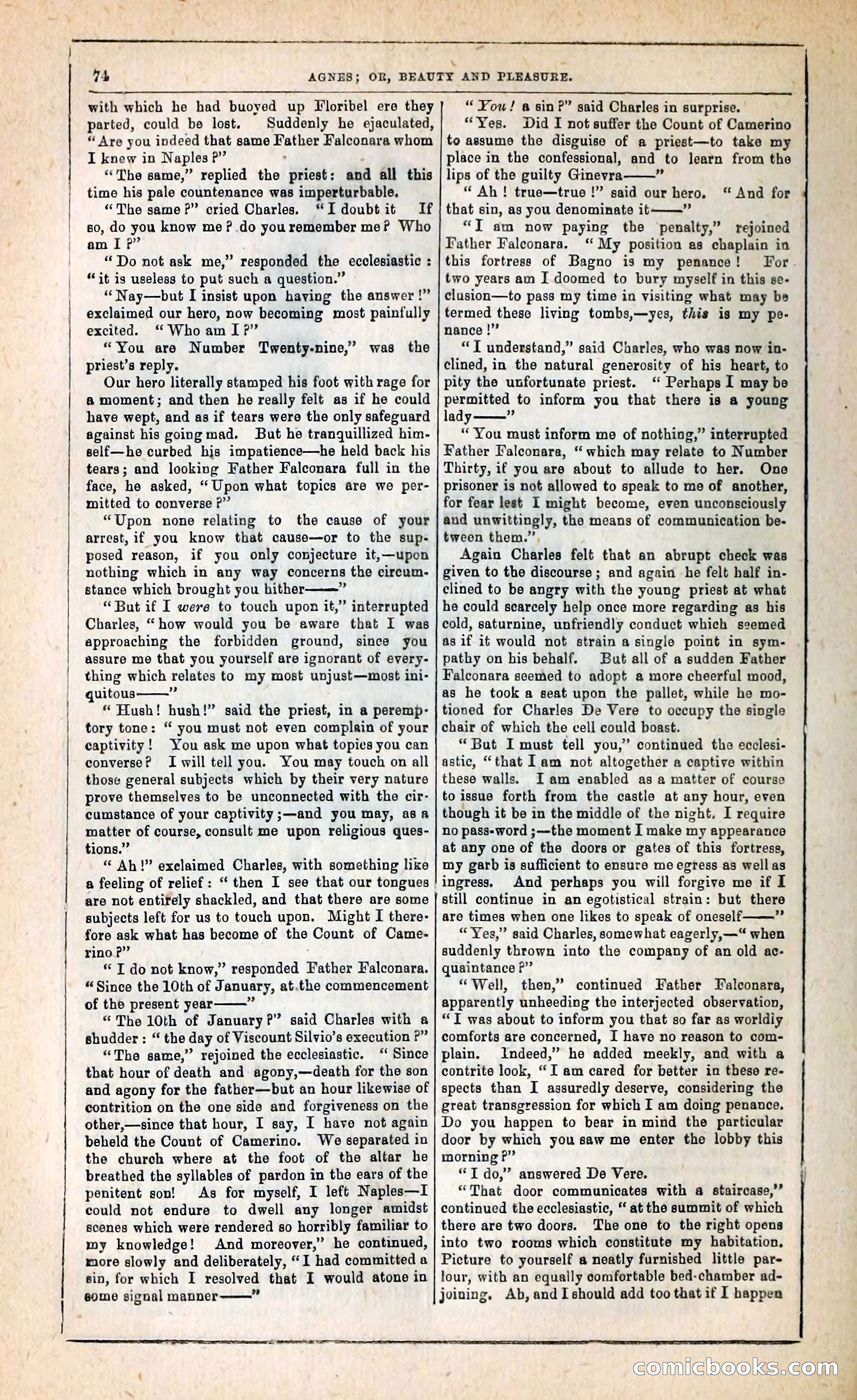
A restored page from Penny Dreadfuls, 1857. Page through the whole issue in the reader above.
📄 Transcribed text from this page (OCR, searchable)
Machine-transcribed from the original scan — historical spelling and the odd misread are preserved.
74 ~__— with which he had buoyed up Floribel ere they parted, could be lost. Suddenly he ejaculated, * Are you indeed that same Father Falconara whom I knew in Naples P” “The same,” replied the priest: and all this time his pale countenance was imperturbable. “The same?” cried Charles. “Idoubtit If so, do you know me? do youremember me? Who am I P” ‘Do not ask me,” responded the ecclesiastic : “it is useless to put such a question.” ‘“‘Nay—but I insist upon haying the answer !” exclaimed our hero, now becoming most painfully excited. “ Whoam I?” “You are Number Twenty-nine,’ was the priest’s reply. Our hero literally stamped his foot with rage for & moment; and then he really felt as if he could have wept, and as if tears were the only safeguard against his goingmad. But he tranquillized him- self—he curbed his impatience—he held back his tears; and looking Father Falconara full in the face, he asked, “ Upon what topics are we per- mitted to converse P” “Upon none relating to the cause of your arrest, if you know that cause—or to the sup- posed reason, if you only conjecture it,—upon nothing which in any way concerns the circum- stance which brought you hither 7 “But if I were to touch upon it,” interrupted Charles, “how would you be aware that I was approaching the forbidden ground, since you assure me that you yourself are ignorant of every- thing which relates to my most unjust—most ini- quitous a “ Hush! hush!” said the priest, in a peremp- tory tone: “ you must not even complain of your captivity! You ask me upon what topics you can converse? Iwill tell you. You may touch on all those general subjects which by their very nature prove themselves to be unconnected with the cir- cumstance of your captivity ;—and you may, asa matter of course, consult me upon religious ques- tions.” «“ Ah!” exclaimed Charles, with something like a feeling of relief: “then I see that our tongues are not entifely shackled, and that there are some subjects left for us to touch upon. Might I there- fore ask what has become of the Count of Came- rino.P” * T do not know,” responded Father Falconara. “Since the 10th of January, at.the commencement of the present year 4 “The 10th of January?” said Charles with a shudder : “ the day of Viscount Silvio’s execution ?” “The same,” rejoined the ecclesiastic. ‘‘ Since that hour of death and agony,—death for the son and agony for the father—but an hour likewise of contrition on the one side and forgiveness on the other,—since that hour, I say, I have nof again beheld the Count of Camerino. We separated in the church where at the foot of the altar he breathed the syllables of pardon in the ears of the penitent son! As for myself, I left Naples—I could not endure to dwell any longer amidst scenes which were rendered so horribly familiar to my knowledge! And moreover,” he continued, more slowly and deliberately, “I had committed a sin, for which I resolved that I would atone in eome signal manner Pe - ‘ AGNES; OR, BEAUTY AND PLEASURE. “You! a sin?” said Charles in surprise. “Yes. Did I not suffer the Count of Camerino to assume the disguise of a priest—to take my place in the confessional, and to learn from the lips of the guilty Ginevra Me “ Ah! true—true !” said our hero, that sin, as you denominate it 4 “T am now paying the penalty,” rejoined Father Faleonara. ‘“ My position as chaplain in this fortress of Bagno is my penance! two years am I doomed to bury myself in this se- clusion—to pass my time in visiting what may be termed these living tombs,—yes, this is my pe- nance !” “T understand,” said Charles, who was now in- clined, in the natural generosity of his heart, to pity the unfortunate priest. ‘ Perhaps I may be permitted to inform you that there is a young lady ie “You must inform me of nothing,” interrupted Father Falconara, “ which may relate to Number Thirty, if you are about to allude to her. Ono prisoner is not allowed to speak to me of another, for fear lest I might become, even unconsciously and unwittingly, the means of communication be- tween them.” Again Charles felt that an abrupt check was given to the discourse; and again he felt half in- clined to be angry with the young priest at what he could searcely help once more regarding as his cold, saturnine, unfriendly conduct which seemed “ And for For. as if if would not strain asinglo point in sym- | pathy on his behalf. But all of a sudden Father Falconara seemed to adopt a more cheerful mood, as he took a seat upon the pallet, while he mo- tioned for Charles De Vere to occupy the single chair of which the cell could boast. * But I must tell you,” continued tha ecclesi- astic, “that Tam not altogether a captive within these walls. I am enabled as a matter of course to issue forth from the castle at any hour, even though it be in the middle of the night. I require no pass-word ;—-the moment I make my appearance at any one of the doors or gates of this fortress, my garb is sufficient to ensure me egress as wellas ingress. And perhaps you will forgive mo if I still continue in an egotistical strain: but there are times when one likes to speak of oneself-——”’ “Yes,” said Charles, somewhat eagerly,—“ when suddenly thrown into the company of an old ac- quaintance P” ‘Well, then,” continued Father Faleonara, apparently unheeding the interjected observation, **T was about to inform you that so far as worldiy comforts are concerned, I have no reason to com- plain. Indeed,” he added meekly, and with a contrite look, “I am cared for better in these re- spects than I assuredly deserve, considering the great transgression for which I am doing penance. Do you happen to bear in mind the particular door by which you saw me enter the lobby this morning P” “IT do,” answered De Vere. “That door communicates with a staircase,” continued the ecclesiastic, at the summit of which there are two doors. ‘The one to the right opens into two rooms which constitute my habitation, Picture to yourself a neatly furnished little par- lour, with an equally comfortable bed-chamber ad- joining. Ab, and I should add too that if I happen Comichook 5*