
Penny Dreadfuls, 1839 · page 143 of 201
Alfred de Rosann — page 143: what you’re looking at
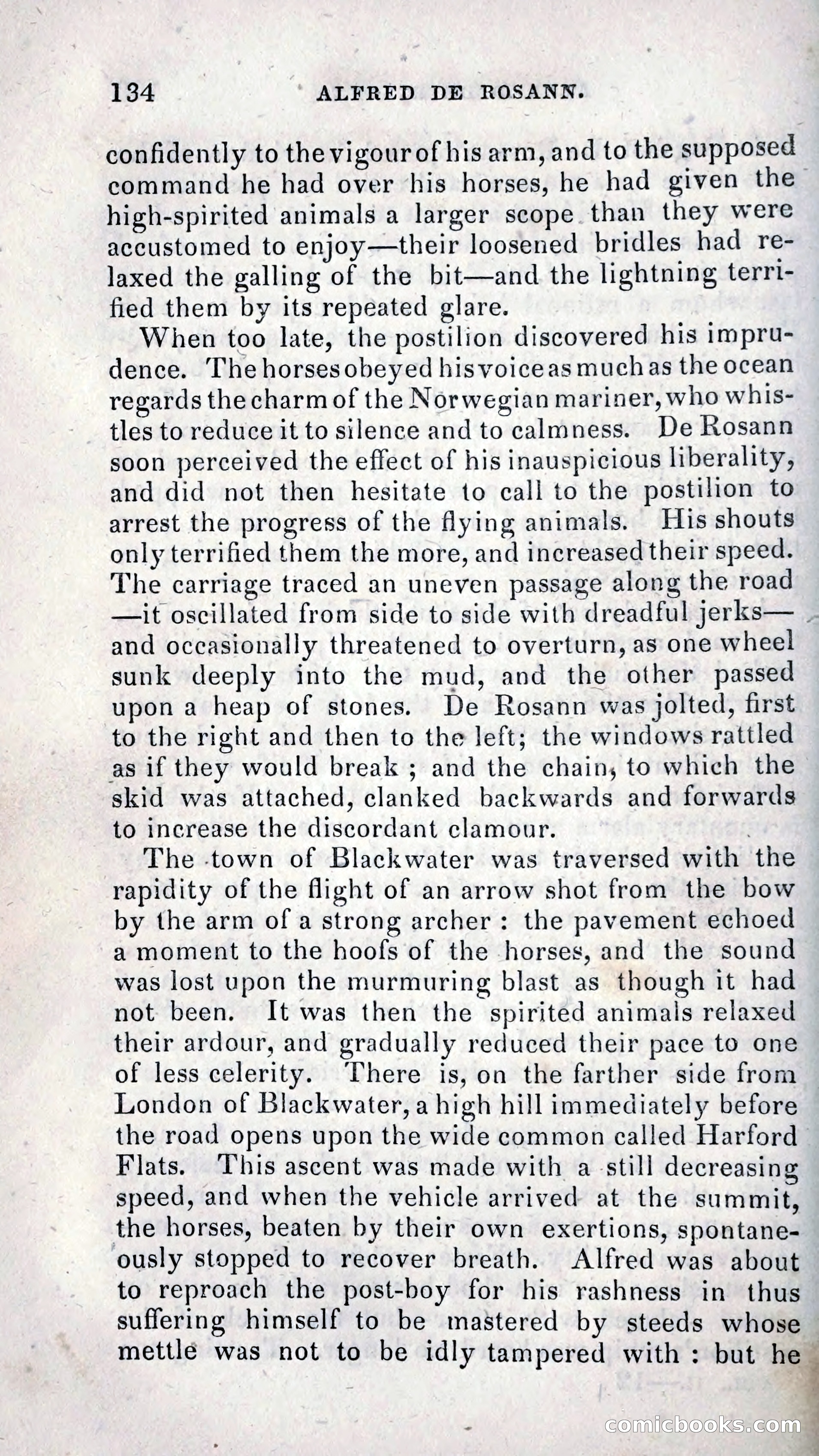
A restored page from Penny Dreadfuls, 1839. Page through the whole issue in the reader above.
📄 Transcribed text from this page (OCR, searchable)
Machine-transcribed from the original scan — historical spelling and the odd misread are preserved.
134 ALFRED DE ROSANN. confidently to the vigour of his arm, and to the supposed command he had over his horses, he had given the high-spirited animals a larger scope than they were accustomed to enjoy—their loosened bridles had re- laxed the galling of the bit—and the lightning terri- fied them by its repeated glare. When too late, the postilion discovered his impru- dence. The horses obeyed his voiceas muchas the ocean regards the charm of the Norwegian mariner, who whis- tles to reduce it to silence and to calmness. De Rosann soon perceived the effect of his inauspicious liberality, and did not then hesitate to call to the postilion to arrest the progress of the flying animals. His shouts only terrified them the more, and increased their speed. The carriage traced an uneven passage along the road —it oscillated from side to side with dreadful jerks— _ and occasionally threatened to overturn, as one wheel sunk deeply into the mud, and the other passed upon a heap of stones. De Rosann was jolted, first to the right and then to the left; the windows rattled as if they would break ; and the chain, to which the skid was attached, clanked backwards and forwards to increase the discordant clamour. | The -town of Blackwater was traversed with the rapidity of the flight of an arrow shot from the bow by the arm of a strong archer: the pavement echoed a moment to the hoofs of the horses, and the sound was lost upon the murmuring blast as though it had not been. It was then the spirited animals relaxed their ardour, and gradually reduced their pace to one of less celerity. ‘There is, on the farther side from London of Blackwater, a high hill immediately before the road opens upon the wide common called Harford Flats. ‘This ascent was made with a still decreasing speed, and when the vehicle arrived at the summit, the horses, beaten by their own exertions, spontane- ously stopped to recover breath. Alfred was about to reproach the post-boy for his rashness in thus suffering himself to be mastered by steeds whose mettle was not to be idly tampered with : but he COMMGEOOOKS AGO im < ‘