
Penny Dreadfuls, 1839 · page 164 of 201
Alfred de Rosann — page 164: what you’re looking at
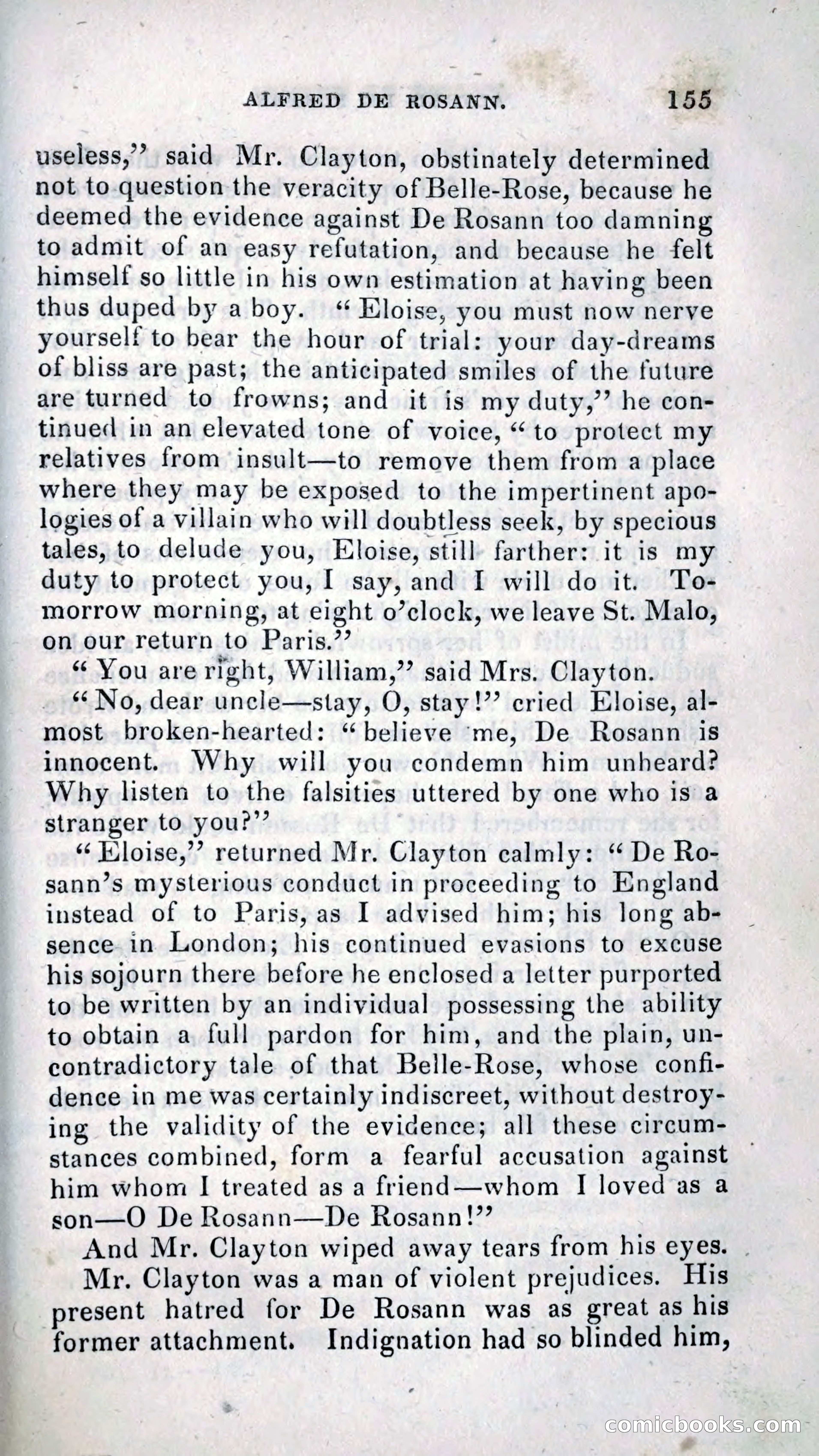
A restored page from Penny Dreadfuls, 1839. Page through the whole issue in the reader above.
📄 Transcribed text from this page (OCR, searchable)
Machine-transcribed from the original scan — historical spelling and the odd misread are preserved.
ALFRED DE ROSANN. 155 useless,’ said Mr. Clayton, obstinately determined not to.question the veracity of Belle-Rose, because he deemed the evidence against De Rosann too damning to admit of an easy refutation, and because he felt himself so little in his own estimation at having been thus duped by a boy. ‘“ Eloise, you must now nerve yourself to bear the hour of trial: your day-dreams of bliss are past; the anticipated smiles of the future are turned to frowns; and it is my duty,’ he con- tinued in an elevated tone of voice, “to protect my relatives from insult—to remove them from a place where they may be exposed to the impertinent apo- logies of a villain who will doubtless seek, by specious tales, to delude you, Eloise, still: farther: it is my duty to protect you, I say, and I will do it. To- morrow morning, at eight o’clock, we leave St. Malo, on our return to Paris.’’ “ You areright, William,” said Mrs. Clayton. ‘No, dear uncle—stay, O, stay!” cried Eloise, al- most broken-hearted: “believe ‘me, De Rosann is innocent. Why will you condemn him unheard? Why listen to the falsities uttered by one who is a stranger to you?” “ Wloise,’”’ returned Mr. Clayton calmly: ‘ De Ro- sann’s mysterious conduct in proceeding to England instead of to Paris, as I advised him; his long ab- sence in London; his continued evasions to excuse his sojourn there before he enclosed a letter purported to be written by an individual possessing the ability to obtain a full pardon for him, and the plain, un- contradictory tale of that Belle-Rose, whose confi- dence in me was certainly indiscreet, without destroy- ing the validity of the evidence; all these circum- stances combined, form a fearful accusation against him whom I treated as a friend—whom I loved as a son—O De Rosann—De Rosann!”’ And Mr. Clayton wiped away tears from his eyes. . Mr. Clayton was a man of violent prejudices. His resent hatred for De Rosann was as great as his former attachment. Indignation had so blinded him, COPMICGLOOOKS (EO)