
Penny Dreadfuls, 1839 · page 186 of 273
Alfred de Rosann by G.W.M. Reynolds — page 186: what you’re looking at
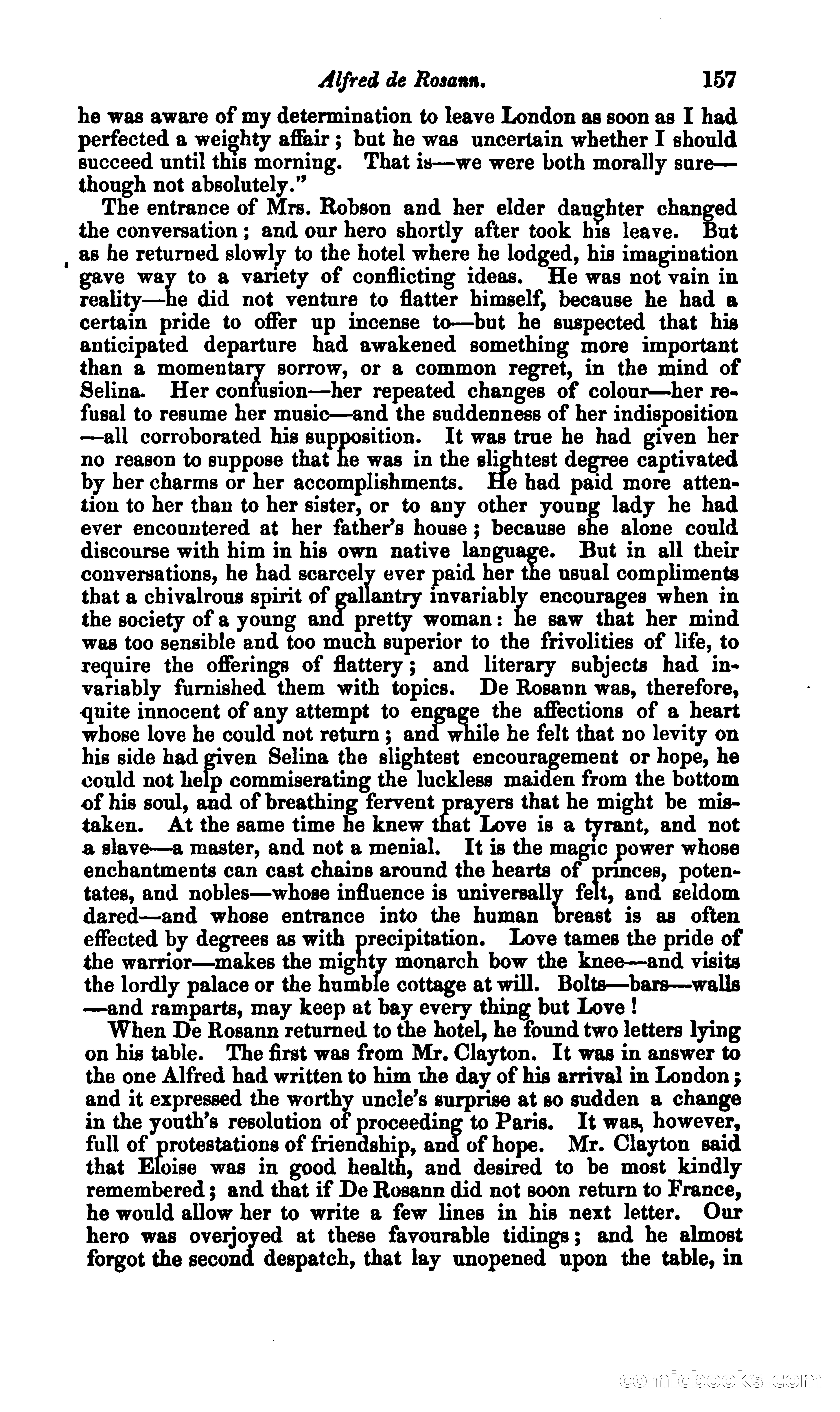
A restored page from Penny Dreadfuls, 1839. Page through the whole issue in the reader above.
📄 Transcribed text from this page (OCR, searchable)
Machine-transcribed from the original scan — historical spelling and the odd misread are preserved.
Alfred de Rosann. 157 he was aware of my determination to leave London as soon as I had perfected a weighty affair; but he was uncertain whether I should succeed until this morning. That is—we were both morally sure— though not absolutely.” The entrance of Mrs. Robson and her elder daughter changed the conversation ; and our hero shortly after took his leave. But _ as he returned slowly to the hotel where he lodged, his imagination gave way to a variety of conflicting ideas. He was not vain in reality—he did not venture to flatter himself, because he had a certain pride to offer up incense to—but he suspected that his anticipated departure had awakened something more important than a momentary sorrow, or a common regret, in the mind of Selina. Her confusion—her repeated changes of colour—her re- fusal to resume her music—and the suddenness of her indisposition —all corroborated his supposition. It was true he had given her no reason to suppose that he was in the slightest degree captivated by her charms or her accomplishments. He had paid more atten- tion to her than to her sister, or to any other young lady he had ever encountered at her father’s house; because she alone could discourse with him in his own native language. But in all their conversations, he had scarcely ever paid her the usual compliments that a chivalrous spirit of gallantry invariably encourages when in the society of a young and pretty woman: he saw that her mind was too sensible and too much superior to the frivolities of life, to require the offerings of flattery; and literary subjects had in- variably furnished them with topics. De Rosann was, therefore, quite innocent of any attempt to engage the affections of a heart whose love he could not return; and while he felt that no levity on his side had given Selina the slightest encouragement or hope, he could not help commiserating the luckless maiden from the bottom of his soul, aud of breathing fervent prayers that he might be mis- taken. At the same time he knew that Love is a tyrant, and not a slave—a master, and not a menial. It is the magic power whose enchantments can cast chains around the hearts of princes, poten- tates, and nobles—whose influence is universally felt, and seldom dared—and whose entrance into the human breast is as often effected by degrees as with precipitation. Love tames the pride of the warrior—makes the mighty monarch bow the knee—and visits the lordly palace or the humble cottage at will. Bolts—bars—walls —and ramparts, may keep at bay every thing but Love ! When De Rosann returned to the hotel, he found two letters lying on his table. The first was from Mr. Clayton. It was in answer to the one Alfred had written to him the day of his arrival in London ; and it expressed the worthy uncle’s surprise at so sudden a change in the youth’s resolution of proceeding to Paris. It was, however, full of protestations of friendship, and of hope. Mr. Clayton said that Eloise was in good health, and desired to be most kindly remembered; and that if De Rosann did not soon return to France, he would allow her to write a few lines in his next letter. Our hero was overjoyed at these favourable tidings; and he almost forgot the second despatch, that lay unopened upon the table, in COnicbooolks (GO)