
Penny Dreadfuls, 1839 · page 236 of 273
Alfred de Rosann by G.W.M. Reynolds — page 236: what you’re looking at
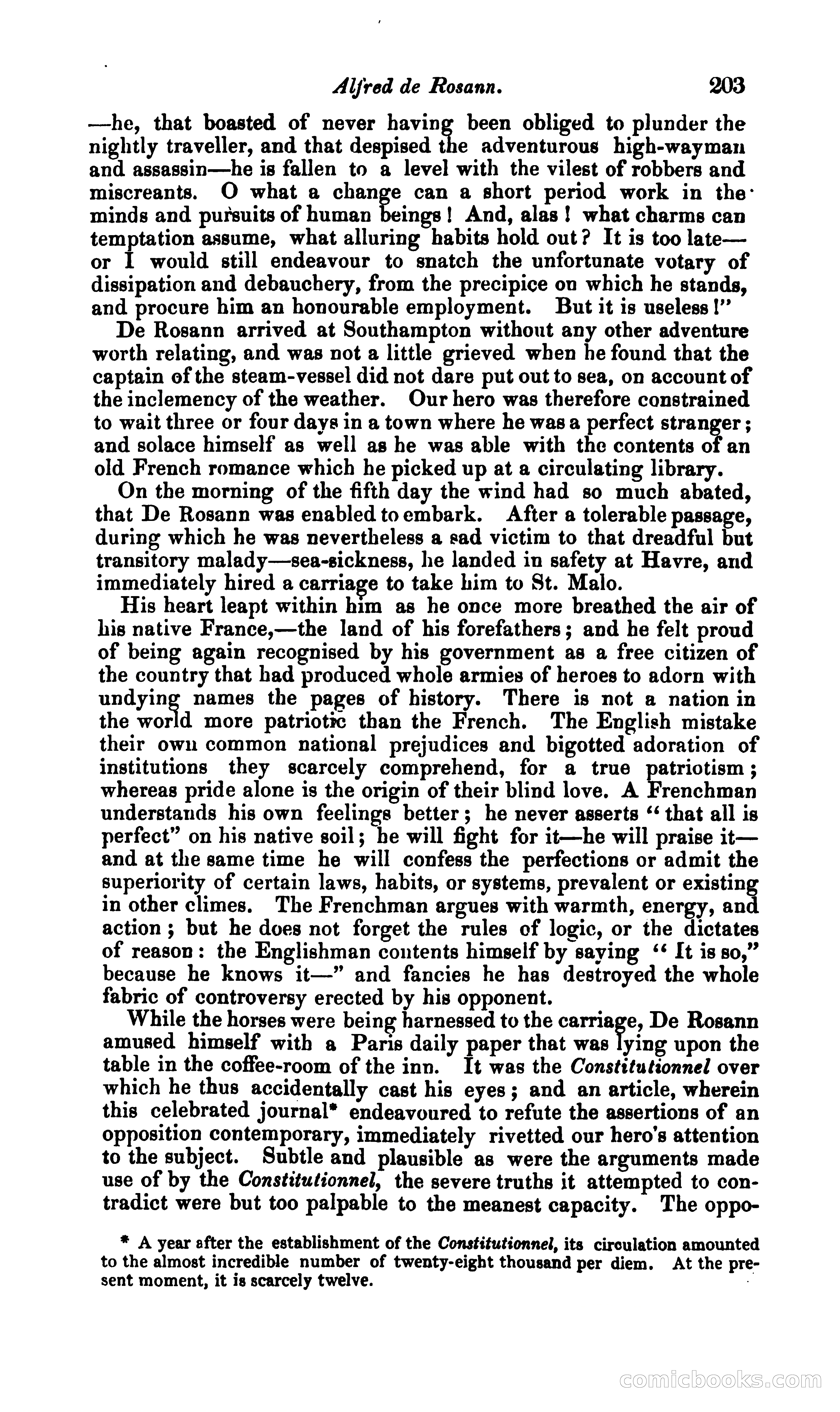
A restored page from Penny Dreadfuls, 1839. Page through the whole issue in the reader above.
📄 Transcribed text from this page (OCR, searchable)
Machine-transcribed from the original scan — historical spelling and the odd misread are preserved.
Alfred de Rosann. 203 —he, that boasted of never having been obliged to plunder the nightly traveller, and that despised the adventurous high-wayman and assassin—he is fallen to a level with the vilest of robbers and miscreants. O what a change can a short period work in the: minds and pursuits of human beings! And, alas! what charms can temptation assume, what alluring habits hold out? It is too late— or I would still endeavour to snatch the unfortunate votary of dissipation and debauchery, from the precipice ou which he stands, and procure him an honourable employment. But it 1s useless !”’ De Rosann arrived at Southampton without any other adventure worth relating, and was not a little grieved when he found that the captain of the steam-vessel did not dare put out to sea, on account of the inclemency of the weather. Our hero was therefore constrained to wait three or four days in a town where he was a perfect stranger ; and solace himself as well as he was able with the contents of an old French romance which he picked up at a circulating library. On the morning of the fifth day the wind had so much abated, that De Rosann was enabledtoembark. After a tolerable passage, during which he was nevertheless a sad victim to that dreadful but transitory malady—sea-sickness, he landed in safety at Havre, and immediately hired a carriage to take him to St. Malo. His heart leapt within him as he once more breathed the air of his native France,—the land of his forefathers; and he felt proud of being again recognised by his government as a free citizen of the country that had produced whole armies of heroes to adorn with undying names the pages of history. There is not a nation in the world more patriotic than the French. The English mistake their own common national prejudices and bigotted adoration of institutions they scarcely comprehend, for a true patriotism ; whereas pride alone is the origin of their blind love. A Frenchman understands his own feelings better; he never asserts “that all is perfect” on his native soil; he will fight for it—he will praise it— and at the same time he will confess the perfections or admit the superiority of certain laws, habits, or systems, prevalent or existing in other climes. The Frenchman argues with warmth, energy, and. action ; but he does not forget the rules of logic, or the dictates of reason: the Englishman contents himself by saying ‘‘ It is so,” because he knows it—” and fancies he has destroyed the whole fabric of controversy erected by his opponent. While the horses were being harnessed to the carriage, De Rosann amused himself with a Paris daily paper that was lying upon the table in the coffee-room of the inn. It was the Constitutionnel over which he thus accidentally cast his eyes; and an article, wherein this celebrated journal* endeavoured to refute the assertions of an opposition contemporary, immediately rivetted our hero’s attention to the subject. Subtle and plausible as were the arguments made use of by the Constitutionnel, the severe truths it attempted to con- tradict were but too palpable to the meanest capacity. The oppo- * A year after the establishment of the Constitutionnel, its circulation amounted to the almost incredible number of twenty-eight thousand per diem. At the pre- sent moment, it is scarcely twelve. : COnicbooolks (GO)