
Penny Dreadfuls, 1844 · page 164 of 278
Alfred; or, The Adventures of a French Gentleman — page 164: what you’re looking at
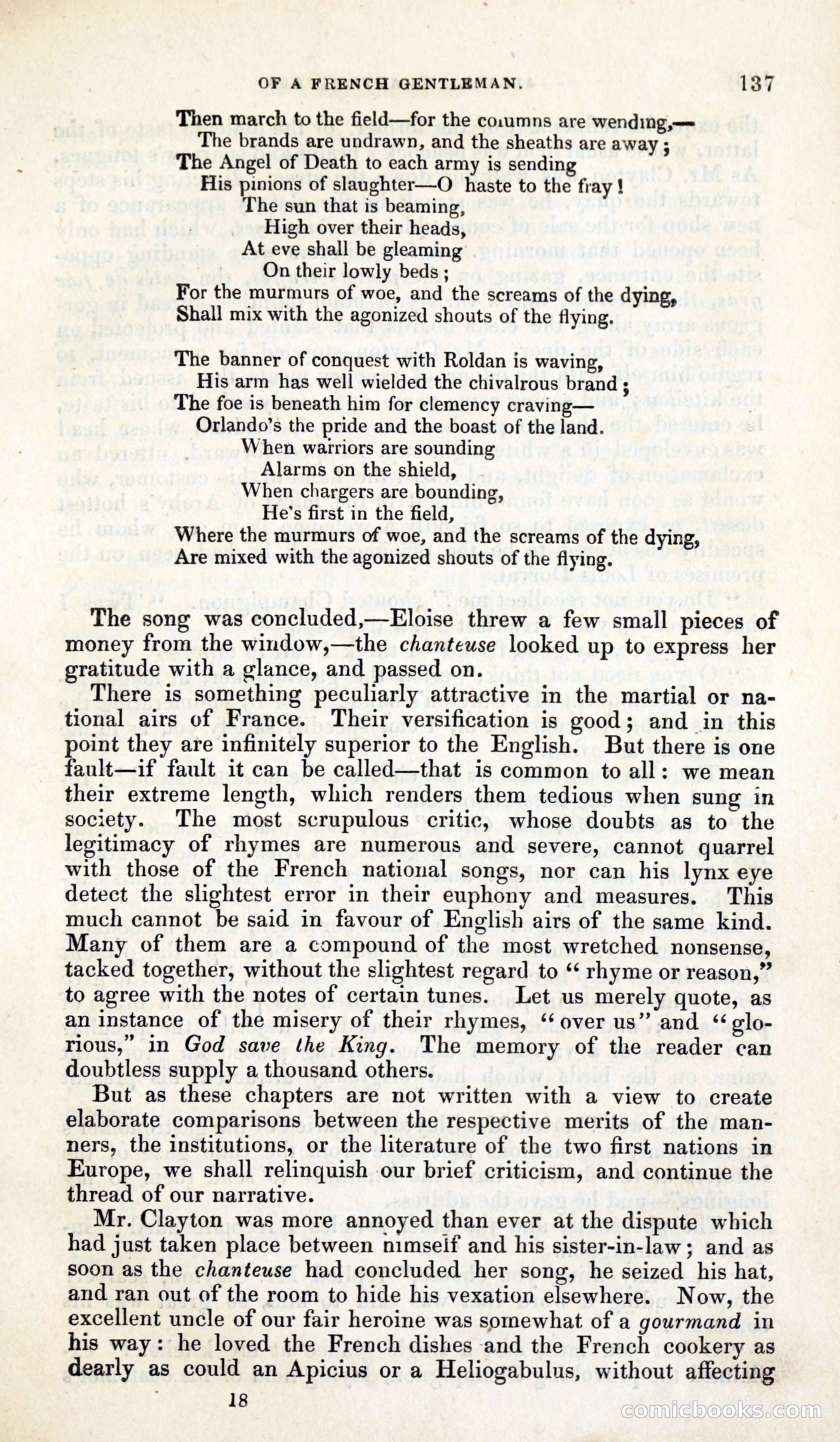
A restored page from Penny Dreadfuls, 1844. Page through the whole issue in the reader above.
📄 Transcribed text from this page (OCR, searchable)
Machine-transcribed from the original scan — historical spelling and the odd misread are preserved.
OF A FRENCH GENTLEMAN. 137 Then march to the field—for the couumns are wending,—= The brands are undrawn, and the sheaths are away ; The Angel of Death to each army is sending Fiis pinions of slaughter—O haste to the fray } The sun that is beaming, High over their heads, At eve shall be gleaming On their lowly beds ; For the murmurs of woe, and the screams of the dying, Shall mix with the agonized shouts of the flying. The banner of conquest with Roldan is waving, His arm has well wielded the chivalrous brand ; The foe is beneath him for clemency craving— Orlando’s the pride and the boast of the land. When warriors are sounding Alarms on the shield, When chargers are bounding, He's first in the field, Where the murmurs of woe, and the screams of the dying, Are mixed with the agonized shouts of the fiying. The song was concluded,—Eloise threw a few small pieces of money from the window,—the chanteuse looked up to express her gratitude with a glance, and passed on. There is something peculiarly attractive in the martial or na- tional airs of France. Their versification is good; and in this point they are infinitely superior to the English. But there is one fault—if fault it can be called—that is common to all: we mean their extreme length, which renders them tedious when sung in society. The most scrupulous critic, whose doubts as to the legitimacy of rhymes are numerous and severe, cannot quarrel with those of the French national songs, nor can his lynx eye detect the slightest error in their euphony and measures. This much cannot be said in favour of English airs of the same kind. Many of them are a compound of the most wretched nonsense, tacked together, without the slightest regard to ‘‘ rhyme or reason,” to agree with the notes of certain tunes. Let us merely quote, as an instance of the misery of their rhymes, ‘over us” and “glo- rious, in God save the King. The memory of the reader can doubtless supply a thousand others. But as these chapters are not written with a view to create elaborate comparisons between the respective merits of the man- ners, the institutions, or the literature of the two first nations in Europe, we shall relinquish our brief criticism, and continue the thread of our narrative. Mr. Clayton was more annoyed than ever at the dispute which had just taken place between nimseif and his sister-in-law; and as soon as the chanteuse had concluded her song, he seized his hat, and ran out of the room to hide his vexation elsewhere. Now, the excellent uncle of our fair heroine was somewhat of a gourmand in his way: he loved the French dishes and the French cookery as dearly as could an Apicius or a Heliogabulus, without affecting 18 CORNICLOOKS»CO