
Penny Dreadfuls, 1881 · page 19 of 38
Alice Bridge of Norwich — page 19: what you’re looking at
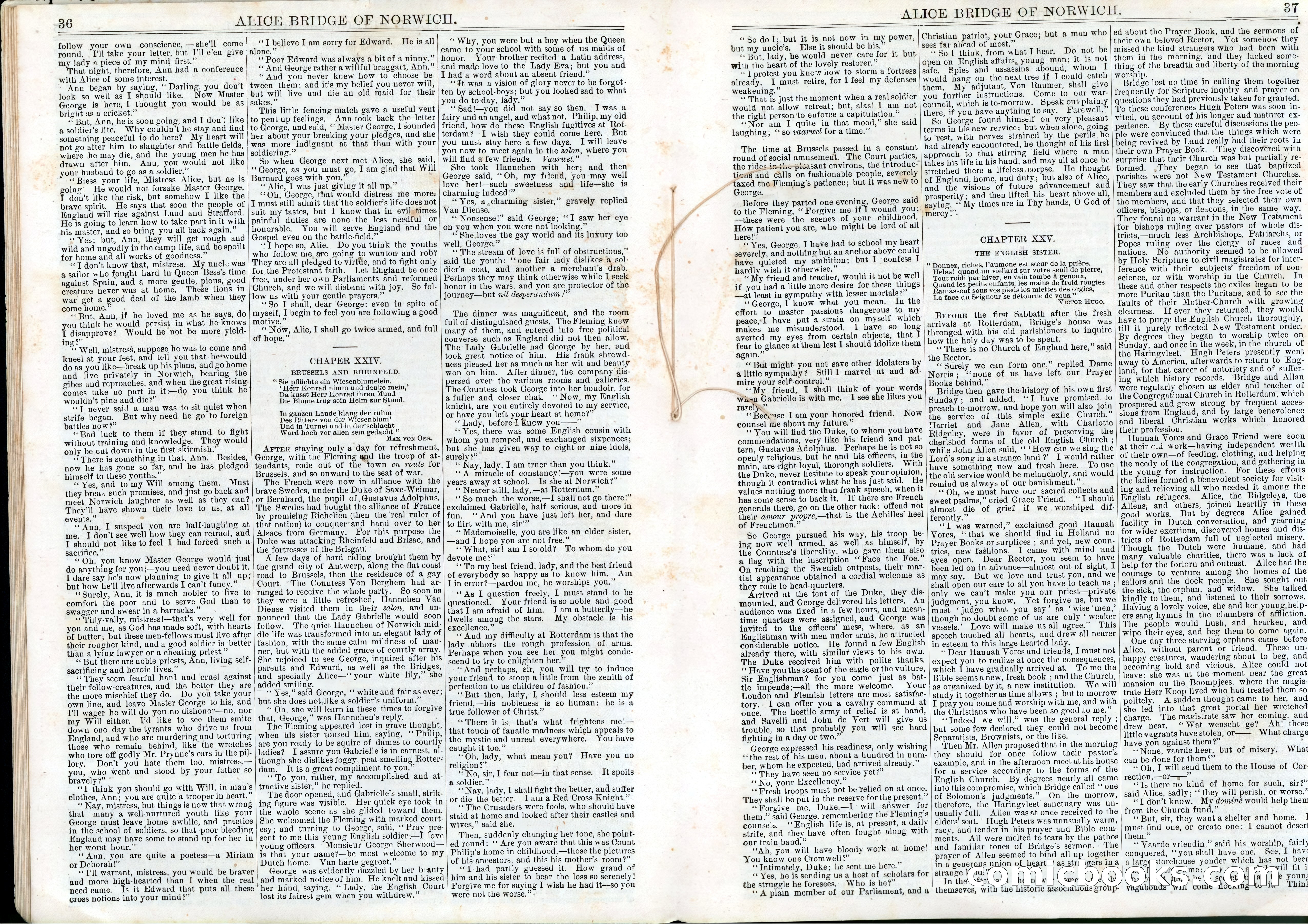
A restored page from Penny Dreadfuls, 1881. Page through the whole issue in the reader above.
📄 Transcribed text from this page (OCR, searchable)
Machine-transcribed from the original scan — historical spelling and the odd misread are preserved.
36 ALICE BRIDGE OF NORWICH. _ follow your own conscience, —she’ll come round. my lady a piece of my mind first.” That night, therefore, Ann had a conference with Alice of some interest. : Ann began by saying, ‘‘ Darling, you don’t look so well as I should like. Now Master George, is here, I thought you would be as bright as a cricket,” “But, Ann, he is soon going, and I don’( like a soldier’s life. Why couldn’t he stay and find something peaceful to do here? My heart will not go after him to slaughter and battle-fields, where he may die, and the young men he has drawn after him, Ann, you would not like your husband to go as a soldier.” “‘Bless your life, Mistress Alice, but fe is oing! He would not forsake Master George, : f don’t like the risk, but somehow I like the brave spirit. He says that soon the people of England will rise against Laud and Strafford. He is going to learn how to take part init with his master, and so bring you all back again.” “Yes: but, Ann, they will get rough and wild and ungodly in the camp life, and be spoilt for home and all works of goodness.” ‘‘T don’t know that, mistress. My uncle was a sailor who fought hard in Queen Bess’s time against Spain, and a more gentle, pious, good creature never was at home, These lions in war get a good deal of the lamb when they come home.” » “But, Ann, if he loved me as he says, do ou think he would persist in what he knows disapprove? Would he not be more yield- ing?” ‘« Well, mistress, suppose he was to come and kneel at your feet, and tell you that hewould do as you like—break up his plans, and go home and live privately in Norwich, bearing the gibes and reproaches, and when the great rising comes take no part in it:—dg you think he wouldn't pine and die?” “T never said a man was to sit quiet when strife began. But why need he go to foreign battles now?” “Bad luck to them if they stand to fight without training and knowledge. They would only be cut down in the first skirmish.’ “There is something in that, Ann. Besides, now he has gone so far, and he has pledged himself to these youths.” “Yes, and tomy Will among them. Must they breax such promises, and just go back and meet Norwich laughter as well as they can? They’ll have shown their love to us, at all events.” “Ann, I suspect you are half-laugling at me, I don’t see well how they can retract, and T should not like to feel I had forced such a sacrifice,” “Oh, you know Master George would just do anything for you;—you need never doubt it. J dare say he’s now planning to give it all up; but how he'll live afterwards I can’t fancy.” ‘Surely, Ann, it is much nobler to live to comfort the poor and to serve God than to emegeer and swear in a barracks,” « Tilly-vally, mistress!—that’s very well for you and me, as God has made soft, with hearts of butter; but these men-fellows must live after their rougher kind, and a good soldier is better than a lying lawyer or a cheating priest.” «But there are noble priests, Ann, living self- sacrificing and heroic lives.” «They seem fearful hard and cruel against their fellow-creatures, and the better they are the more mischief they do. Do you take your own line, and leave Master George to his, and Tl wager he will do you no dishonor—no, nor my Will either. Id like to see them smite down one.day the tyrants who drive us from England, and who are murdering and torturing those who remain behind, like the wretches who tore off godly Mr. Prynne’s ears in the pil- lory. Don’t you hate them too, mistress, — you, who went and stood by your father so bravely?” ° “JT think you should go with Will, in man’s clothes, Ann; you are quite a trooper in heart.” ‘Nay, mistress, but things is now that wrong that many a well-nurtured youth like your George must leave home awhile, and practice in the school of soldiers, so that poor bleeding England may have some to stand up for her in her worst hour.” “‘Ann, you are quite a poetess—a Miriam or Deborah!” “[’]1 warrant, mistress, you would be braver and more high-hearted than I when the real need came. cross notions into your mind?” “‘T believe I am sorry for Edward. He is all I'll take your letter, but I'll e’en give alone.” “Poor Edward was always a bit of a ninny.” “ And George rather a willful braggart, Ann.” * And you never knew how to choose be- tween them; and it’s my belief you never will, but will live and die an old maid for their sakes.” This little fencing-match gave a useful vent to pent-up feelings. Ann took back the letter to George, and said, ‘ Master George, I sounded her about your breaking your pledges, and she !was more indignant at that than with your soldiering.” So when George next met Alice, she said, “ George, as you must go, I am glad that Will Barnard goes with you.” “« Alie, I was just giving it all up.” ‘Oh, George, that would distress me mores I must still admit that the soldier’s life does not suit my tastes, but I know that in evil times painful duties are none the less needful or honorable. You will serve England and the Gospel even on the battle-field.” ‘“T hope so, Alie.. Do you think the youths who follow me are going to wantom and rob? They are all pledged to virtue, and to fight only for the Protestant faith. Let England be once free, under her own Parliaments and reformed Church, and we will disband with joy. So fol- low us with your gentle prayers.” “So I shall, dear George: even in spite of myself, I begin to feel -you are following a good motive.” ‘* Now, Alie, I shall go twice armed, and full of hope.” ' CHAPER XXIV. BRUSSELS AND RHEINFELD. “Sie pfitichte ein Wiesenblumelein, ‘Herr Konrad nimm und denke mein,’ Da kusst Herr Zonrad ihren Mund Die Blume trug sein Helm zur Stund. In ganzen Lande klang der ruhm Des Ritters von der Wiesenblum’ Und in Turnei und in derschlacht Ward hoch vor allen sein gedacht.” Max Von OER, ArtvEr staying only a day for refreshment, George, with the Fleming gnd the troop of at- tendants, rode out of the town en route for Brussels, and so onward to the seat of war. The French were now in alliance with the brave Swedes, under the Duke of Saxe-Weimar, or Bernhard, the pupil of, Gustavus Adolphus. The Swedes had bought the alliance of France by promising Richelieu (then the real ruler of tbat nation) to conquer*and hand over to her Alsace from Germany. For this purpose the Duke was attacking Rheinfeld and Brisac, and the fortresses of the Brisgau. A few days of hard riding brought them by the grand city of Antwerp, along the flat coast road to Brussels, then the residence of a gay Court. “The Countess Von Berghem had ar- ranged to receive the whole party. So soon as they were a little refreshed, Hannchen Van Diense visited them in their salon, and an- nounced that the Lady Gabrielle would soon follow. The quiet Hannchen of Norwich mid- dle life was transformed into an elegant lady of fashion, with the same calm mildness of man- ber, but with the added grace of courtly array. She rejoiced to see George, inquired after his parents and Edward, as well as the Bridges, and specially Alice—‘‘ your white lily,” she added smiling. “Yes,” said George, ‘‘ white and fair as ever; but she does notylike a soldier’s uniform.” “Oh, she will learn in these times to forgive that, George,” was Hannchen's reply. The Fleming appeared lost in grave thought, when his sister roused him, saying, ‘‘ Philip, are you ready to be squire of dames to courtly ladies? J assure you Gabrielle is in earnest, al- though she dislikes foggy, peat-smelling Rotter: dam. It isa great compliment to you.” ‘To you, rather, my accomplished and at- tractive sister,” he replied. The door opened, and Gabrielle’s small, strik- ing figure was visible. Her quick eye took in the whole scene as she glided toward them. She welcomed the Fleming with marked court- esy; and turning to George, said, ‘‘Pray pre- sent to me this young English fbiciter love oung officers, Monsieur George Sherwood— is that your name?—be most welcome to my Dutch home. Van harte gegroet.” George was evidently dazzled by her beauty and marked notice of him. He knelt and kissed 3 it Edward that puts all these her hand, saying, ‘‘ Lady, the English Court lost its fairest gem when you withdrew.” “Why, you were but a boy when the Queen came to your school with some of us maids of honor. Your brother recited a Latin address, and made love to the Lady Eva; but you and I had a word about an absent friend.” “Ft was a vision of glory never to be forgot- ten by school-boys; but you looked sad to what you do to-day, lady.” ‘Sad!—you did not say so then. Iwas a fairy and an angel, and what not. Philip, my old friend, how do these English fugitives at Rot- terdam? I wish they could come here. But you must stay here afew days. I will leave you now to meet again ip the salon, where you will find afew friends. Vaarwel.” ~ She took Hannchen with her; and then George said, ‘‘Oh, my friend, you may well love her!—such sweetness ak life—she is charming indeed!” “Yes, a.charming sister,” gravely replied Van Diense. “Nonsense!” said George; ‘‘I saw her eye on you when you were not looking.” “*Sheloves the gay world and its luxury too well, George.” ‘‘The stream of love is full of obstructions,” said the youth: ‘‘one fair lady dislikes a sol- dier’s coat, and another a merchant's drab. Perhaps they may think otherwise while I seek honor in the wars, and you are protector of the journey—but ndél desperandum !” The dinner was magnificent, and the room full of distinguished guests, The Fleming knew many of them, and entered into free political converse such as England did not then allow. The Lady Gabrielle had George by her, and took great notice of him. His frank shrewd- ness pleased her as muchas her wit and beauty won on him. After dinner, the company dis- persed over the various rooms and galleries. The Countess took George into her boudoir, for a fuller and closer chat. ‘‘ Now, my English knight, are you entirely devoted to my service, or have you left your heart at home?” “Lady, before I Kaew you——” ‘‘Yes, there was some English cousin with whom you romped, and exchanged sixpences; but she has given way to eight or nine idols, surely?” «Nay, lady, I am truer than you think.” ‘* A miracle of constancy !|—you were some years away at school. Is she at Norwich?” “ Nearer still, lady, —at Rotterdam.” ‘©So much the worse,—I shall not go there!” exclaimed Gabrielle, half serious, and more in fun. ‘And you have just left her, and dare to flirt with me, sir!” “‘ Mademoiselle, you are like an elder sister, —and I hope you are not free.” “What, sir! am Iso old? To whom do you devote me?” “To my best friend, lady, and the best friend of everybody so happy as to know him. Am I in error?—pardon me, he worships you.” ‘‘As I question freely, I must stand to be questioned. Your friend is so noble and good that Iam afraid of him. Iam a butterfly—he dwells among the stars. My obstacle is his excellence.” ‘“And my difficulty at Rotterdam is that the lady abhors the rough profession of arms. Perhaps when you see her you might conde- scend to try to enlighten her,” “And perhaps, s:r, you will try to induce your friend to stoop a little from the zenith of perfection to us children of fashion.” “* But then, lady, I, should less esteem my friend,—his nobleness is so human: he is a true follower of Christ,” “There it is—that’s what frightens me!— that touch of fanatic madness which appeals to the mystic and unreal everywhere. You have caught it too.” “Oh, lady, what mean you? Have you no religion?” “No, sir, I fear not—in that sense. a soldier.” ‘Nay, lady, I shall fight the better, and suffer or die the better. Iam a Red Cross Knight.” “<The Crusaders were fools, who should have staid at home and looked after their castles and wives,” said she. r’ Then, suddenly changing her tone, she point- ed round: ‘' Are you aware that this was Count Philip’s home in childhood,—those the pictures of his ancestors, and this his mother’s room?” “T had partly guessed it. How grand of him and his sister to bear the loss so serenely! Tt spoils | Forgive me for saying I wish he had it—so you were not the worse,” ~ oT ALICE BRIDGE OF NORWICH. “So dol; but it is not now iu my power, but my uncle’s, Else it should be his.” “ But, lady, he would never care for it but wiih the heart of the lovely restorer.” Christian patriot, your Grace; but a man who sees far abead of most.” “ 89 [ think, from what J hear. Do not be open on English affairs, young man; it is not ‘“] protest you knew uow to storm a fortress |safe. Spies and assassins abound, whom I already. weakening.” “That is just the moment when a real soldier | you further instructions. would not allow retreat; but, alas! I am not the right person to enforce a capitulation.” “Nor am I quite in that mood,” she said laughing; ‘'so vaarwel for a time.” The time at Brussels passed in a constant round of social amusement. The Court parties, the rides in-ttre-preasant environs, the introduc- ticts and calls on fashionable people, severely taxed the Fleming’s patience; but it was new to George. Before they parted one evening, George said to the Fleming, ‘‘ Forgive me if I wound you; —these were the scenes of your childhood. How patient you are, who might be lord of all here!” “Yes, George, I have had to school my heart severely, and nothing but an anchor above could have quieted my ambition; but I confess I hardly wish it otherwise.” “My friend and teacher, would it not be well if you had a little more desire for these things —al, least in sympathy with lesser mortals?” “‘George, 1 know what you mean. makes averted my eyes from certain objects, that fear to glance at them lest I should idolize them again.” «But might you not save other idolaters b a little sympathy? | Still I marvel at and ad- mire your self-control.” “My friend, I shall think of wien Gabrielle is with me. rarelyy” *«Beceuse Iam your honored friend. Now counsel me about my future.” “You will find the Duke, to whom you have commendations, very like his friend and pat tern, Gustavus Adolphus. Perhaps he is not so openly religious, but he and his officers, in the main, are right loyal, thorough soldiers, With the Duke, never hesitate to speak your opinion, though it contradict what he has just said. He values nothing more than frank speech, when it has some sense to back it. If there are French generals there, go on the other tack: offend not their amour propre,—that is the Achilles’ heel of Frenchmen.” So George pursued his way, his troop be I must retire, for I feel my defenses In the effort to master passions dangerous to my peace,"I have put a strain on myself which me misunderstood. I have so long our words I see she likes you would hang on the next tree if I could catch them. My adjutant, Von Raumer, shall give Come to our war- council, which is to-morrow. Speak out plainly there, if you have anything to say. Farewell.” So George found himself on very pleasant terms in his new rervice; but when alone, going to rest, with nerves strained by the perils he had already encountered, be thought of his first approach to that stirring field where a man takes his life in his hand, and may all at once be stretched there a lifeless,corpse. He thought of England, home, and duty; but also of Alice, and the visions of future advancement and prosperity; and then lifted his heart above all, saying, ‘‘ My times are in Thy hands, O God of mercy |”. CHAPTER XXV. THE ENGLISH SISTER. “ Donnez, riches, )’aumone est sceur de Ja priére. Helas! quand un viellard sur votre seuil de pierre, Tout roidi par hiver, en vain tombe @ genoux, Quand les pa enfants, les mains de froid rougies Ramassent sous vos pieds les miettes des orgies, La face du Seigneur se détourne de vous.” Victor Huao. Brrore the first Sabbath after the fresh arrivals at Rotterdam, Bridge’s house was thronged with his old parishioners to inquire how the holy day was to be spent. “ There is no Church of England here,” said the Rector. ‘Surely we can form one,” replied Dame Norris; ‘‘none of us have left our Prayer Books behind.” Bridge then gave the-history of his own first Sunday; and added, ‘‘I have promised. to preach to-morrow, and hope you will also join Yarriet and Jane Allen, with Charlotte Ridgeley, were in favor of preserving the cherished forms of the old English Church ; while Jolin Allen said, ‘‘ ‘How can we sing the Lord’s song in astrange land?’ I would rather have something new and fresh here. To use the old service would be melancholy, and would remind us always of our banishment.” . “©Oh, we must have our sacred collects and sweet psalms,” cried Grace Friend. “1 should almost die of grief if we worshiped dif- ferently.” ‘‘] was warned,” exclaimed good Hannah -| Vores, ‘‘that we should find in Holland no ing now well armed, as well as himself, by | Prayer Books or surplices ; and yet, new coun- the Countess’s liberality, who gave them also a flag with the inscription ‘Face the Foe.’ On reaching the Swedish outposts, their mar tial appearance obtained a cordial welcome as they rode to head-quarters. Arrived at the tent of the Duke, they dis tries, new fashions. I came with mind ‘and eyes open. Dear Rector, you seem to have -| been led on in advance—almost out of sight, I may say. But we love and trust you, and we shall open our ears to all you have to teach us ; -|only we can’t make you our priest—private > mounted, and George delivered his letters, An | judgment, you know. Yet forgive us, but we audience was fixed in a few hours, and mean -|must ‘judge what you say’ as ‘wise ‘men,’ time quarters were assigned, and George was though no doubt some of us are only ‘ weaker invited to the officers’ mess, where, as an Englishman with men under arms, he attracted He found a few English | in esteem to this large-hearted lady. considerable notice. ; 1 already there, with similar views to his own The Duke received him with polite thanks. “Have you the scent of the eagle or the vulture Sir Englishman? for you come just as bat tle impends;—all the more welcome. London and Flemish letters are most satisfac tory. I can offer you a cavalry command at once. The hostile army of relief is at hand and Savelli and John de Vert will give us Your vessels,’ Love will make us all agree.” This speech touched all hearts, and drew all nearer . “Dear Hannah Vores and friends, I must not expect you to realize at once the consequences, , | which I have gradually arrived at. To me the - | Bible seems a new, fresh book ; and the Church, as organized by it, a new institution. We will - | study it together as time allows ; but to morrow I pray you comeand worship with me, and with , |the Ghristians who have been so good to me.” “Indeed we will,” was the general reply ; trouble, so that probably you will see hard] put some few declared they could not become fighting in a day or two.” George expressed his readiness, only wishing é‘the rest of his men, about a hundred in num- ber, whom he expected, had arrived already.” ‘They have seen no service yet?” “No, your Excellency.” “Fresh troops must not be relied ov at once They shall be put in the reserve for the present.’ ‘Forgive me, them,” said George, remembering the Fleming’s counsels. ‘‘ English life is, at present, a daily Separatists, Brownists, or the like. Then Mr. Allen proposed that in the morning they should for once follow their pastor's example, and in the afternoon meet at his house for a service according to the forms of the English Church. By degrees nearly all came . | into this compromise, which Bridge called ‘‘ one ’|of Solomon’s judgments.” On the morrow, Duke,—I will answer for|therefore, the Haringvieet sanctuary was un- usually full. Allen was at once received to the elders’ seat. Hugh Peters was unusually warm, strife, and they have often fought along with | racy, and tender in his prayer and Bible com- our train-band.” “Ah, you will have bloody work at home You know one Cromwell?” “‘Intimately, Duke; he sent me