
Penny Dreadfuls, 1881 · page 21 of 38
Alice Bridge of Norwich — page 21: what you’re looking at
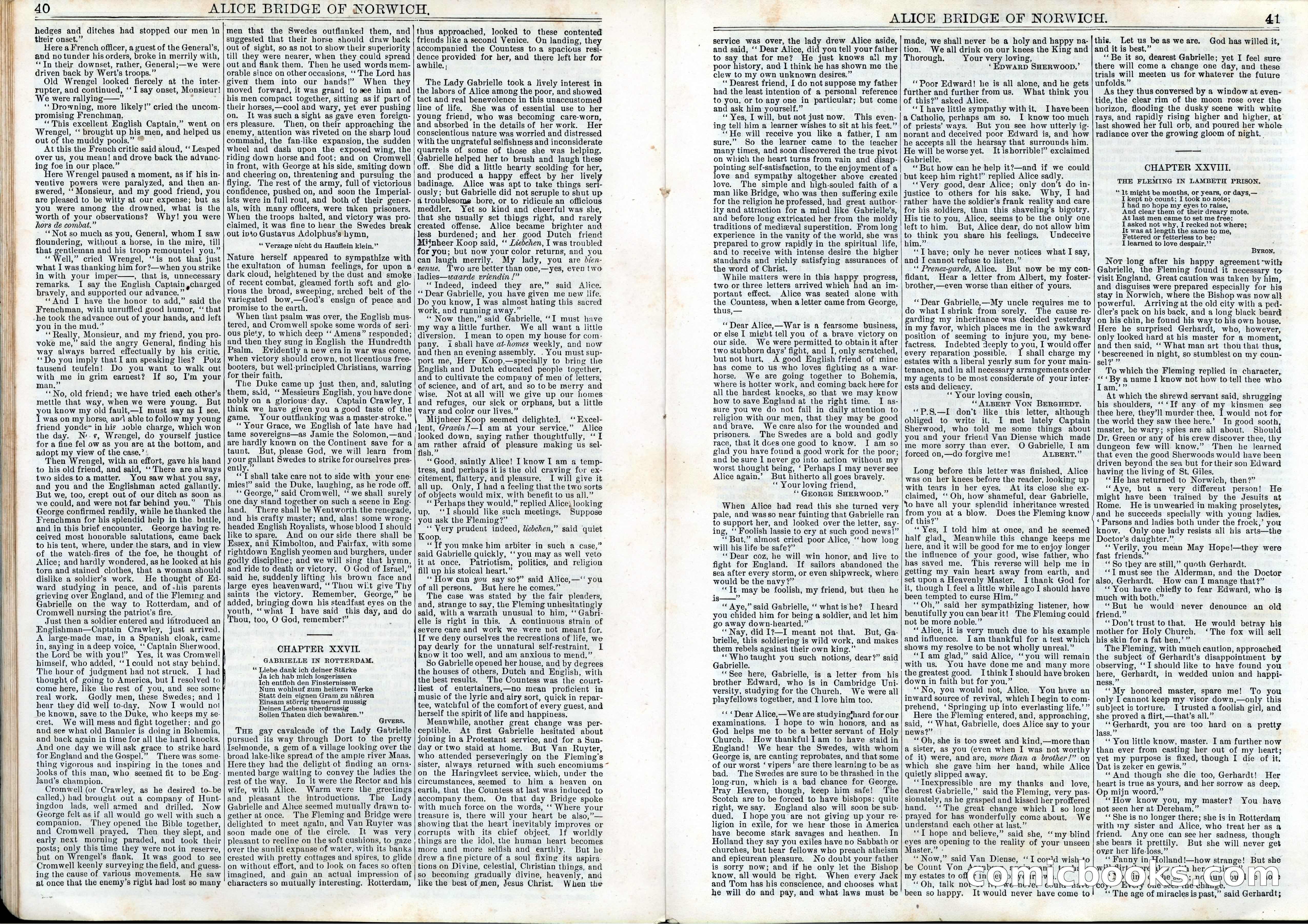
A restored page from Penny Dreadfuls, 1881. Page through the whole issue in the reader above.
📄 Transcribed text from this page (OCR, searchable)
Machine-transcribed from the original scan — historical spelling and the odd misread are preserved.
hedges and ditches had stopped our men in their onset.” Here a French officer, a guest of the General’s, and no tunder his orders, broke in merrily with, “In their downset, rather, General;—we were driven back by Wert’s troops.” Old Wrengel looked fiercely at the inter- rupter, and continued, ‘‘I say onset, Monsieur! We were rallying——” ‘‘ Drowning, more likely!” cried the uncom- promising Frenchman, “This excellent English Captain,” went on Wrengel, ‘‘ brought up his men, and helped us out of the muddy pools.” @ At this the French critic said aloud, ‘‘ Leaped over us, you mean! and drove back the advanc- ing foe in our place.” Here Wrengel paused a moment, as if his in- ventive powers were paralyzed, and then an- swered, ‘‘ Monsieur, and my good friend, you are pleased to be witty at our expense; but as you were among the drowned, what is the worth of your observations? Why! you were hors de combat.” “Not so much as you, General, whom I saw floundering, without a horse, in the mire, till that gentleman and his troop remountel you.” “Well,” cried Wrengel, ‘‘is not that just what I was thanking him for?—when you strike in with your imper——, that is, unnecessary remarks, I say the English Captain charged bravely, and supported our advance.” *‘And I have the honor to add,” said the Frenchman, with unruffled good humor, “that he took the advance out of your hands, and Jeft you in the mud.” ‘*Really, Monsieur, and my friend, you pro- voke me,” said the angry General, finding his way always barred effectually by his critic, ‘‘Do you imply that I am speaking lies? Potz tausend teufeln! Do you want to walk out with me in grim earnest? If so, ’m your man,” ‘«No, old friend; we have tried each other’s mettle that way, when we were young, But ou know my old fault,—I must say as I see. ee on my horse, apf able to follow my young friend yonder” in his aoble charge, which won the day. N’.¢7, Wrengel, do yourself justice for a fine fel ow as you are at the bottom, and adopt my view of the case.’ ’ Then Wrengel, with an effort, gave his hand to his old friend, and said, ‘‘ There are always two sides to a matter. You saw what you say, and you and the Englishman acted gallantly. But we, too, crept out of our ditch as soon as we could, and were not far behind yeu.” This George confirmed readily, while he thanked the Frenchman for his splendid help in the. battle, and in this brief encounter. George having re- ceived most hovorable salutations, came back to his tent, where, under the stars, and in view of the watch-fires of the foe, he thought of Alice; and hardly wondered, as he looked at his torn and stained clothes, that a woman should dislike a soldier's work. He thought of Kd- ward studying in peace, and of-his parents grieving over England, and of the Flemirg and Gabrielle on the way to Rotterdam, and of Cromwell nursing the patriot’s fire. Just then a soldier entered and introduced an Englishman—Captain Crawley, just arrived. A large-made map, in a Spanish cloak, came in, saying in adeep voice, ‘‘ Captain Sherwood, the Lord be with you!” Yes, it was Cromwell himself, who added, ‘I could not stay behind. The hour of judgment had not struck, I had thought, of going to America, but I resolved to come here, like the rest of you, and sec some real work. Godly men, these Swedes; and | hear they did well to-day. Now I would not be known, save to the Duke, who keeps my se- cret. We will mess and fight together; and go and see what old Bannier is doing in Bohemia, and back again in time for all the hard knocks. And one day we will ask grace to strike hard for England and the Gospel.” There was some- thing vigorous aud inspiring in the tones and jooks of this man, who seemed fit to be Eng- Jand’s champion. Cromwell (or Crawley, as he desired to—be called,) had brought out a company of Hunt- ingdon lads, well armed and drilled. Now George felt as if all would go well with such a companion. They opened the Bible together, and Cromwell prayed. Then, they slept, and early next morning paraded, and took their posts; only this time they were not in reserve, but on Wrengel’s flank, It was good to see Cromwell keenly surveying the field, and guess- ing the cause of various movements. He saw at once that the enemy’s right had lost so many 40 ALICE BRIDGE OF NORWICH. ‘men that the Swedes outflanked them, and suggested that their horse should draw back out of sight, so as not to show their superiority till they were nearer, when they could spread out and flank them. Then he used words mem- orable since on other occasions, '‘The Lord has given them into our hands!’ When they moved forward, it was grand to see him and his men compact together, sitting asif part of their horses,—cool and wary, yet ever pushing on. - It was such a sight as gave even foreign- ers pleasure. Then, on their approaching the enemy, attention was riveted on the sharp loud command, the fan-like expansion, the sudden wheel and dash upon the exposed wing, the riding down horse and foot; and on Cromwell | in front, with George at his side, smiting down and cheering on, threatening and pursuing the flying. The rest of the army, full of victorious confidence, pushed on, and soon the Imperial- ists were in full rout, and both of their gener- als, with many officers, were taken prisoners, When the troops halted, and victory was pro- claimed, it was fine to hear the Swedes break out into Gustavus Adolphus’s hymn, “ Verzage nicht du Hauflein klein.” Nature herself appeared to sympathize with the exultation of human feelings, for upon a dark cloud, heightened by the dust and smoke } of recent combat, gleamed forth soft and glo- rious the broad, sweeping, arched belt of the variegated bow,—God’s ensign of peace and promise to the earth. When that psalm was over, the English mus- tered, and Cromwell spoke some words of seri- ous piety, to which deep ‘‘ Amens” responded; and then they sung in English the Hundredth Psalm. Evidently a new erain war was come, when victory should crown, not licentious free- booters, but wel!-principled Christians, warring for their faith, The Duke came up just then, and, saluting them, ssid, ‘‘ Messieurs English, you have done nobly on a glorious’day. Captain Crawley, I think we have given you a good taste of the game. Your outflunking was a master-stroke.” “Your Grace, we English of late have had tame sovereigns—as Jamie the Solomon,—and are hardly known on the Continent save for a taunt. But, please God, we will learn from your gallant Swedes to strike for ourselves pres- ently.” : “T shall take care not to side with your ene. mies!” said the Duke, laughing, as he rode off. “George,” said Cromwell, ‘‘ we shall surely one day stand together on such a scene in Eng- land. There shall be Wentworth the renegade, and his crafty master; and, alas! some wrong- headed English Royalists, whose blood I should like to spare. And on our side there shall be Essex, and Kimbolton, and Fairfax, with some rightdown English yeomen and burghers, under godly discipline; and we will sing that hymn, and ride to death or victory. O God of Israel,” said he, suddenly lifting his brown face and large eyes heavenward, ‘‘ Thou wi-t give Thy saints the victory. Remember, George,” he added, bringing down his steadfast eyes on the youth, ‘““what I have said this day, and do Thou, too, O God, remember!” CHAPTER XXVII. GABRIELLE IN ROTTERDAM. “Liebe dank ich deiner Starke Ja ich hab mich losgerissen Ich entfloh den Finsternissen Num wohlauf zum heitern Werke Statt dein eignen Gram zu néhren Einsam stérrig trauernd mussig Deines Lebens uberdrussig Sollen Thaten dich bewahren.” GIVERS. Tue gay cavalcade of the Lady Gabrielle pursued its way through Dort to the pretty Iselmonde, a gem of a village looking over the broad lake-like spread of the ample river Maas, Here they had the delight of finding an orna- mented barge waiting to convey the ladies the rest of the way. In it were the Rector and his wife, with Alice. Warm were the greetings and pleasant the introductions, The Lady Gabrielle and Alive seemed mutually drawn to- gether at once. The Fleming and Bridge were delighted to meet again, and Van Ruyter was soon made one of the circle. It was very pleasant to recline on the soft cushions, to gaze over the sunlit expanse of water, with its banks crested with pretty cottages and spires, to glide on without effort, and to look on faces so often imagined, and gain an actual impression of characters so mutually interesting. Rotterdam, thus approached, looked to these contented friends like a second Venice. On landing, they accompanied the Countess to a spacious resi- dence provided for her, and there left her for awhile. ; The Lady Gabrielle took a lively interest in the labors of Alice among the poor, and showed tact and real benevolence in this unaccustomed line of life, She was of essential use to her young friend, who was becoming care-worn, and absorbed in the details of her work. Her conscientious nature was worried and distressed with the ungrateful selfishness and inconsiderate quarrels of some of those she was helping. Gabrielle helped her to brush and laugh these off. She did a little hearty scolding for her, and produced a happy effect by her lively badinage. Alice was apt to take things seri- ously; but Gabrielle did not scruple to shut up a troublesome bore, or to ridicule an officious meddler, Yet so kind and cheerful wag she, that she usually set things right, and rarely created offense. Alice became brighter and less burdened; and her good Dutch friend Mijinheer Koop said, ‘‘ Liebchen, I was troubled for you; but now your color returns, and you can laugh merrily. My lady, you are dien- venue, Two are better than one,—yes, even two | ladies—waarde vriendin |” ‘“Indeed, indeed they are,” said Alice. ‘* Dear Gabrielle, you have given me new life. Do you know, I was almost hating this sacred work, and running away.” “ Now then,” said Gabrielle, ‘I must have my way alittle further. We all want a little diversion. I mean to open my house for com- pany. Isball have at-homes weekly, and now and then an evening assembly. . You must sup- port me, Herr Koop,—specially to bring the English and Dutch educated people together, and to cultivate the company of men of letters, of science, and of art, and so tobe merry and wise. Not at all will we give up our homes and refuges, our sick or orphans, but a little vary and color our lives.” Mijnheer Koop seemed delighted. ‘ Excel- {lent, Gravin/—I am at your service.” Alice jlooked down, saying rather thoughtfully, “I (am rather afraid of pleasure making us sel- fish.” “Good, saintly Alice! I know I am a temp- tress, and perhaps it is the old craving for ex- citément, flattery, and pleasure. I will give it allup. Only, I had a feeling that the two sorts of objects would mix, with benefit to us all.” ** Perhaps they would,” replied Alice) looking up. ‘‘I should like such meetings, Suppose you ask the Fleming?” ‘* Very prudent indeed, lWebchen,” said ‘quiet Koop. “Tf you make him arbiter in such a case,” said Gabrielle quickly, ‘‘ you may as well veto it at once. Patriotism, politics, and religion fill up his stoical heart.” ‘* How can you say so?” said Alice,—‘‘ you of all persons. But here he comes.” The case was stated by the fair pleaders, and, strange to say, the Fleming unhesitatingly said, wilh a warmth unusual to him, ‘‘ Gabri- elle is right in this. A continuous strain of severe care and work we-were not meant for, If we deny ourselves the recreations of life, we pay dearly for the unnatural self-restraint. I know it too well, and am anxious to mend.” So Gabrielle opened her house, and by degrees the houses of others, Dutch and English, with the best results. The Countess was the court- liest of entertainers,—no mean proficient in music of the lyric and airy sort, quick in repar- tee, watchful of the comfort of every guest, and herself the spirit of life and happiness, Meanwhile, another great change was per- ceptible. At first Gabrielle hesitated about joining in a Protestant service, and for a Sun- day or two staid at home. But Van Ruyter, who attended perseveringly on the Fleming's sister, always returned with such encomiums~ on the Haringvleet service, which, under the circumstances, seemed to him a heaven on earth, that the Countess at last was induced to accompany them. On that day Bridge spoke with much force on the words, ‘‘ Where your treasure is, there will your heart be also,”— showing that the heart inevitably improves or corrupts with its chief object. If worldly things are the idol, the human heart becomes more and more selfish and earthly, But he drew a fine picture of a soul fixing its aspira- tions on Divine, celestial, Christian things, and so becoming gradually divine, heavenly, and like the best of men, Jesus Christ. When the ALICE BRIDGE OF NORWICH. : 41 service was over, the lady drew Alice aside, | made, we shall never be a holy and happy na- and said, ‘‘ Dear Alice, did you tell your father | tion. We all drink on our knees the King and to say that for me? He just knows ail my poor history, and I think he has shown me the clew to my own unknown desires.” “ Dearest friend, I do not suppose my father had the least intention of a personal reference to you, or to any one in particular; but come and ask him yourself.” «Yes, I will, but not just now. This even- ing tell him a learner wishes fo sit at his feet.” ‘‘He will receive you like a father, I am sure.” So the learner came to the teacher many times, and soon discovered the true pivot on which the heart turns from vain and disap- pointing self-satisfaction, to the enjoyment of a love and sympathy altogether above created love. The simple and high-souled faith of a man like Bridge, who was then suffering exile for the religion he professed, had great author- ity and attraction for a mind like Gabrielle’s, and before long extricated her from the moldy traditions of medieval superstition. From long experience in the vanity of the world, she was prepared to grow rapidly in the spiritual life, and to receive with intense desire the higher standards and richly satisfying assurances of the word of Christ. While matters were in this happy progress, two or three letters arrived which had an im- portant effect. Alice was seated alone with the Countess, when a letter came from George, thus,— “Dear Alice,—War is a fearsome business, or else I migbt tell you of a brave victory on our side. We were permitted to obtainit after two stubborn days’ fight, and I, only scratched, but not hurt. A good English friend of mine has come to us-who loves fighting as a war- horse. We are going together to Bohemia, where is hotter work, and coming back here for all the hardest knocks, so that we may know how to save England at the right time. I as- sure you we do not fail in daily attention to religion with our men, that they may be good and brave. We care also for the wounded and prisoners. The Swedes are a bold and godly race, that it dces one good to know. I am so glad you have found a good work for the poor; and be sure I never go into action without my worst thought being, ‘ Perhaps I may never see Alice again.’ But. hitherto all goes bravely. “ Your loving friend, ‘‘@EORGH SHERWOOD.” When Alice had read this she turned very pale, and wasso near fainting that Gabrielle ran to support her, and looked over the letter, say- ing, ‘‘ Foolish lassie to ery at such good news!” ‘* But,” almost cried poor Alice, ‘‘ how long will his life be safe?” : “‘Dear coz, he will win honor, and live to fight for England. If sailors abandoned the sea after every storm, or even shipwreck, where would be the navy?” : “‘It may be foolish, my friend, but then he ih “Aye,” said Gabrielle, ‘‘ whatishe? Iheard you chided him for being a soldier, and let him go away down-hearted.” ‘“Nay, did I1?—I meant not that. But, Ga- brielle, this soldiering is wild work, and makes them rebels against their own king.” ‘“Who taught you such notions, dear?” said Gabrielle. ‘‘See here, Gabrielle, is a letter from his brother Edward, who is in Cambridge Uni- versity, studying for the Church. We were all playfellows together, and I love him too. ‘«« «Dear Alice,—We are studying*hard for our examinations. I hope to win honors, and as God helps me to be a better servant of Holy Church. How thankfulIam to have staid in England! We hear the Swedes, with whom George is, are canting reprobates, and that some of our worst ‘vipers’ are there learning to be as bad. The Swedes are sure to be thrashed in the long-run, which is a bad chance for George. Pray Heaven, though, keep him safe! The Scotch are to be forced to have bishops: quite right, we say. England also will soon be sub. dued. I hope you are not giving up your re- ligion in exile, for we hear those in America have become stark savages and heathen. In Holland they say you exiles have no Sabbath or churches, but hear fellows who preach atheism and epicurean pleasure. No doubt your father is sorry now; and if he only let the Bishop know, all would be right. When every Jack and Tom has his conscience, and chooses what he will do and pay, and what laws must be Thorough. Your ae loving, ‘Ep WARD SHERWOOD.’ ‘Poor Edward! he is all alone, and he gets further and further from us. What think you of this?” asked Alice. “T have little sympathy withit. Ihave been a Catholic, perhaps am so. I know too much of priests’ ways. But you see how utterly ig- norant and deceived poor Edward is, and how he accepts all the hearsay that surrounds him. He will be worse yet. It ishorrible!” exclaimed Gabrielle. “But how can he help it?—and if we could but keep him right!” replied Alice sadly. “‘Very good, dear Alice; only don’t do in- justice to others for his sake. Why, I had rather have the soldier’s frank reality and care for his soldiers, than this shaveling’s bigotry. His tie to you, Alice, seems to be the only one left to him. But, Alice dear, do not allow him to think you share his feelings. Undeceive him,” ‘“‘T have; only he never notices what I say, and I cannot refuse to listen.” ‘* Prenez-garde, Alice. But now be my con- fidant, Hear a letter from Albert, my foster- brother,—even worse than either of yours. “Dear Gabrielle.—My uncle requires me to do what I shrink from:sorely. The cause re- garding my inheritance was decided yesterday in my favor, which places me in the awkward position of seeming to injure you, my bene- factress. Indebted deeply to you, I would offer every reparation possible. shall charge my estates with a liberal yearly sum for your main- tenance, and in all necessary arrangements order my agents to be most considerate of your inter- ests and delicacy. “Your loving cousin, ‘‘ ALBERT VON BERGHEDT. ‘““P.S8.—I don't like this letter, although obliged to write it. I met lately Captain Sherwood, who told me some things about you and your friend Van Diense which made me more sorry than ever. O Gabrielle, I am forced on,—do forgive me! ALBERT.” Long before this letter was finished, Alice was on her knees before the reader, looking up with tears in her eyes. At its close she ex- claimed, ‘‘Oh, how shameful, dear Gabrielle, Yo have all your splendid inheritance wrested from you at a blow. Does the Fleming know of this?” “Yes, I told him at once, and he seemed half glad. Meanwhile this change keeps me here, and it will be good for me to enjoy longer the influence of your good, wise father, who has saved me. ‘This reverse will help me in getting my vain heart away from earth, and set upon a Heavenly Master, I thank God for it, though L feel a little whileago I should have been tempted to curse Him.” ‘*Oh,” said her sympathizing listener, how beautifully you can bear it! The Fleming could not be more noble.” ‘ Alice, it is very much due to his example and influence. Iam thankful for a test which shows my resolve to be not wholly unreal.” “JT am glad,” said Alice, ‘you will remain with us. You hav