
Penny Dreadfuls, 1881 · page 23 of 38
Alice Bridge of Norwich — page 23: what you’re looking at
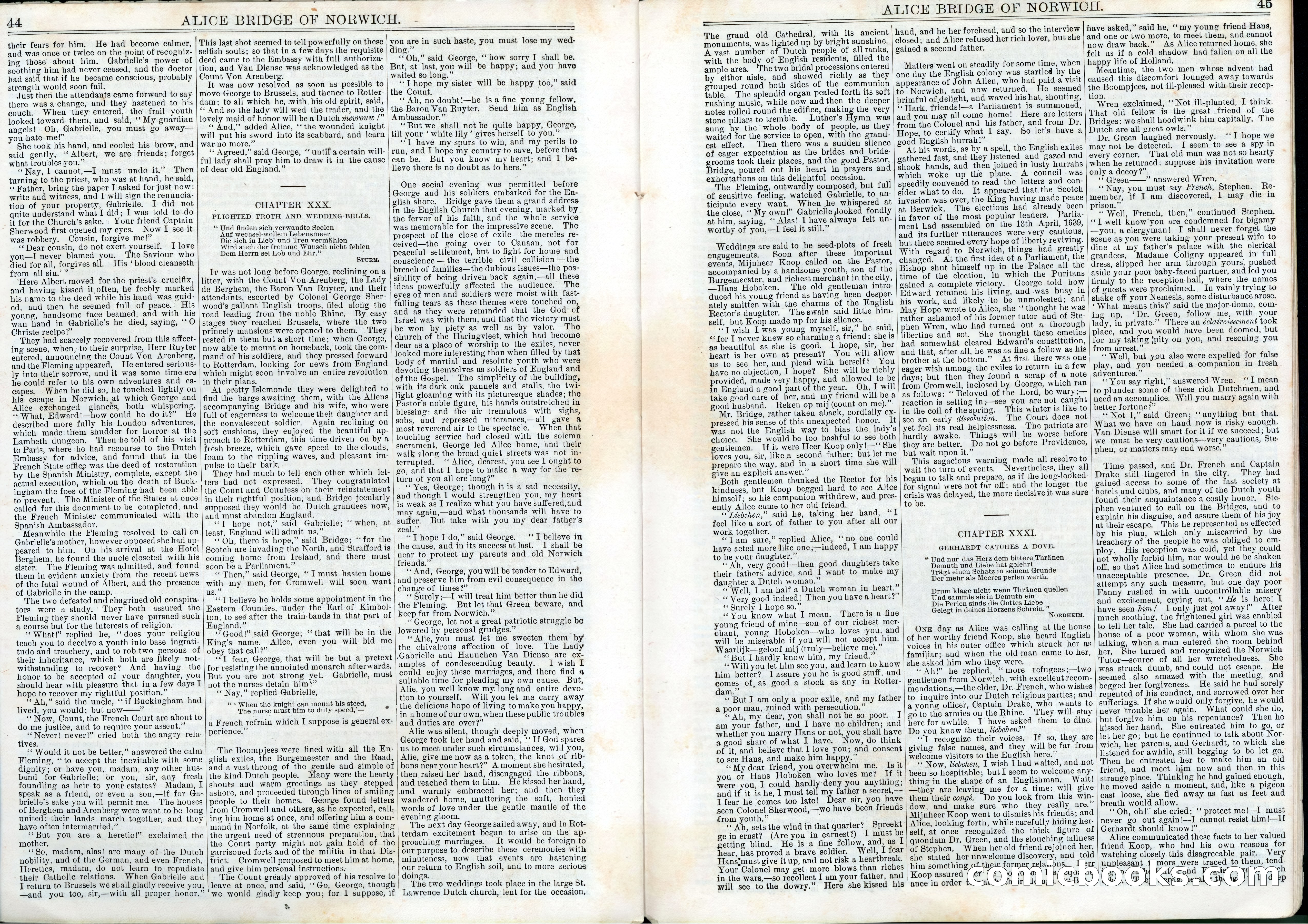
A restored page from Penny Dreadfuls, 1881. Page through the whole issue in the reader above.
📄 Transcribed text from this page (OCR, searchable)
Machine-transcribed from the original scan — historical spelling and the odd misread are preserved.
ALICE BRIDGE OF NORWICH. - their fears for him. He had become calmer, and was once or twice on the point of recogniz- ing those about him. Gabrielle’s power of soothing him had never ceased, and the doctor had said that if he became conscious, probably strength would soon fail. Just then the attendants came forward to say there was a change, and they hastened to his couch. When they entered, the frail youth looked toward them, and said, ‘‘ My guardian angels! Oh, Gabrielle, you must go away— ou hate me!” She took his hand, and cooled his brow, and said gently, ‘‘ Albert, we are friends; forget what troubles you.” “Nay, I cannot,—I must undo it,” Then turning to the priest, who was at hand, he said, “Father, bring the paper I asked for just now: write and witness, and I will sign the renuncia- tion of your property, Gabrielle. I did not quite understand what I did; I was told to do it for the Church’s sake. | Your friend Captain Sherwood first opened my eyes. Now I see it wastobbery. Cousin, forgive me!” “Dear cousin, do not exert yourself. I love ou—lI never blamed you. The Saviour who died for all, forgives all. His ‘blood cleanseth from all sin.’ ” Here Albert moved for the priest’s crucifix, and having kissed it often, he feebly marked his name to the deed while his hand was guid- ed, and then he seemed full of peace. His young, handsome face beamed, and with his wan hand in Gabrielle’s he died, saying, ‘tO Christe recipe!” They had scarcely recovered from this affect- ing scene, when, to their surprise, Herr Ruyter entered, announcing the Count Von Arenberg, and the Fleming appeared. He entered serious- ly into their sorrow, and it was some time ere he could refer to his owv adventures and es- capes. When he did so, he touched lightly on his escape in Norwich; at which George and Alice exchanged glances, both whispering, ‘© What, Edward!—how could he doit?” He described more fully his London adventures, which. made.them shudder for horror at the Lambeth dungeon. Then he told of his visit to Paris, where he had recourse to the Dutch Embassy for advice, and found that in the French State office was the deed of restoration by the Spanish Ministry, complete, except the actual execution, which on the death of Buck- ingham the foes of the Fleming had been able to prevent.. The Minister of the States at once called for this document to be completed, and the French Minister communicated with the Spanish Ambassador. Meanwhile the Fleming resolved to call on Gabrielle’s mother, however opposed she had ap- peared to him. On his arrival at the Hotel Berghem, he found the uncle closeted with his sister. The Fleming was admitted, and found them in evident anxiety from the recent news of the fatal wound of Albert, and the presence of Gabrielle in the camp. The two defeated and chagrined old conspira- tors were a study. They both assured the Fleming they should never have pursued such a course but for the interests of religion. “What!” replied he, ‘‘does your religion teach you to deceive a youth into base ingrati- tude and treachery, and to rob two persons of their inheritance, which both are likely not- withstanding to recover? And having the honor to be accepted of your daughter, you should hear with pleasure that in a few days I hope to recover my rightful position.” “ Ah,” said the uncle, ‘if Buckingham had lived, you would; but now——” “‘Now, Count, the French Court are about to do me justice, and to require your assent.” “Never! never!” cried both the angry rela- tives. se Would it not be better,” answered the calm Fleming, ‘‘to accept the inevitable with some dignity; or have you, madam, any other hus- band for Gabrielle; or you, sir, any fresh foundling as heir to your estates? Madam, I speak as a friend, or even a son,—if for Ga- brielle’s sake you will permit me. The houses of Berghem and Arenberg were wont to be long united: their lands march together, and they have often intermarried.” ‘““But you are a heretic!” exclaimed the mother. “So, madam, alas! are many of the Dutch nobility, and of the German, and even French. Heretics, madam, do not learn to repudiate their Catholic relations. When Gabrielle and I return to Brussels we shall gladly receive you, —and you too, sir,—with all proper honor.” This last shot seemed to tell powerfully on these selfish souls; so that in a few days the requisite deed came to the Embassy with full authoriza- tion, and Van Diense was acknowledged as the | Count Von Arenberg, It was now resolved as soon as possible to move George to Brussels, and thence to Rotter- dam; to all which he, with, his old spirit, said, “And so the lady will wed the trader, and the lovely maid of honor will be a Dutch mevrouw /” “And,” added Alice, ‘‘the wounded knight will put his sword into its seabbard, and learn war no more.” “ Aoreed,” said George, ‘ untif'a certain will- ful lady shall pray him to draw it in the cause of dear old England.” : CHAPTER XXX. PLIGHTED TROTH AND WEDDING-BELLS. ‘Und finden sich verwandte Seelen Auf wechsel-wollem Lebensmeer Die sich in Lieb’ und Treu verméhlen Wird auch der fromme Wunsch nicht fehlen Dem Herrn sei Lob und Ehr.” s StTuRM. Ir was not long before George, reclining on a litter, with the Count Von Arenberg, the Lady de Berghem, the Baron Van Ruyter, and their attendants, escorted by Colonel George Sher- wood’s gallant English troops, filed along the road leading from the noble Rhine. By easy stages they reached Brussels, where the two princely mansions were opened to them. They rested in them but a short time; when George, now able to mount on horseback, took the com- mand of his soldiers, and they pressed forward to Rotterdam, looking for news from England which might soon involve an entire revolution in their plans. At pretty Islemonde they were delighted to find the barge awaiting them, with the Allens accompanying Bridge and his wife, who were full of eagerness to welcome their daughter and the convalescent soldier, Again reclining on soft cushions, they enjoyed the beautiful ap- proach to Rotterdam, this time driven on by a fresh breeze, which gave speed to the clouds, foam to the rippling waves, and pleasant im- pulse to their bark. They had much to tell each other which let- ters had not expressed. They congratulated the Count and Countess on their reinstatement in their rightful position, and Bridge jecularly supposed they would be Dutch grandees now, and must abandon England. “T hope not,” said Gabrielle; ‘‘ when, at least, England willadmit us.” “Oh, there is hope,” said Bridge; ‘‘for the Scotch are invading the North, and ‘Strafford is coming home from Ireland, and there must soon be a Parliament.” “Then,” said George, ‘‘I must hasten home with my men, for Cromwell will soon want “«T believe he holds some appointment in the Eastern Counties, under the Earl of Kimbol- ton, to seé after the train-bands in that part of England.” “Good!” said George; ‘that will be in the King’s name. Alice, even you will bid me obey that call?” «T fear, George, that will be but a pretext for resisting the annointed monarch afterwards. But you are not strong yet. Gabrielle, must not the nurses detain him?” ‘‘Nay,” replied Gabrielle, “ «When the knight can mount his steed, The nurse must him to duty speed,’— si a French refrain which I suppose is general ex- perience.” The Boompjees were lined with all the En- glish exiles, the Burgemeester and the Raad, and a vast throng of the gentle and simple of the kind Dutch people. Many were the hearty shouts and warm greetings as they stepped ashore, and proceeded through lines of smiling people to their homes. George found letters from Cromwell and others, as he expected, call ing him home at once, and offering him a com- mand in Norfolk, at the same time explaining the urgent need of strenuous preparation, that the Court party might not gain hold of the garrisoned forts and of the militia in that Dis- trict. Cromwell proposed to meet him at home, and give him personal instructions. The Count greatly approved of his resolve to leave at once, and said, ‘‘Go, George, though ‘we would gladly keep you; for I suppose, if bs ‘you are in such haste, you must lose my wed- ding.” ‘©Oh,” said George, ‘‘ how sorry I shall be, But, at last, you will be happy; and you have waited so long.” ‘‘T hope my sister will be happy too,” said the Count. : “¢ Ah, no doubt!—he is a fine young fellow, the Baron Van Ruyter. Send him as English Ambassador,” _ But we shall not be quite happy, George, till your ‘ white lily’ gives herself to you.” “‘T have my spurs to win, and my perils to run, and I hope my country to save, before that can be. But you know my heart; and I be- lieve there is no doubt as to hers.” One socia) evening was permitted before George and his soldiers embarked for the En- glish shore. Bridge gave them a grand address in the English Church that evening, marked by the fervor of his faith, and the whole service was memorable for the impressive scene. The prospect of the close of exile—the mercies re- ceived—the going over to Canaan, not for peaceful settlement, but to fight for home and conscience — the terrible civil collision — the breach of families—the dubious issues—the pos- sibility of being driven back again,—all these ideas powerfully affected the audience. The eyes of men and soldiers were moist with fast- falling tears as these themes were touched on, and as they were reminded that the God of Tsrael was with them, and that the victory must be won by piety as well as by valor. The church of the Haringvleet, which had become dear as a place of worship to the exiles, never looked more interesting than when filled by that body of martial and resolute youth who were devoting themselves as soldiers of England and of the Gospel. The simplicity of the building, with its dark oak pannels and stalls, the twi- light gloaming with its picturesque shades; the Pastor’s noble figure, his hands outstretched in blessing; and the air tremulous with sighs, sobs, and repressed ulterances,—all gave a most reverend air to the spectacle. When that touching service had closed with the solemn sacrament, George Jed Alice home, and their walk slong the broad quiet streets was not in- terrupted. ‘‘ Alice, dearest, you see I ought to go, and that I hope to make a way for the re- turn of you all ere long?” . “Yes, George; though it is a sad necessity, and though I would strengthen you, my heart is weak as I realize what you have suffered,and may again,—and what thousands will have to ety But take with you my dear father’s zeal.” g “T hope I do,” said George. ‘‘I believe in the cause, and in its success at last. I shall be near to protect my parents and old Norwich friends.” “ And, George, you will be tender to Edward, and preserve him from evil consequence in the chanye of times?” “ Surely ;—I will treat him better than he did the Fleming. But let that Green beware, and keep far from Norwich.” George, let not a great patriotic struggle be lowered by personal grudges.” “ Alie, you must let me sweeten them by the chivalrous affection of love. The Lady /Gabrielle and Hannchen Van Diense are ex- amples of condescending beauty. I wish I could enjoy these marriages, and there find a suitable time for pleading my own cause. But, Alie, you well know my. long and entire devo- tion to yourself. Will you let me carry away the delicious hope of living to make you happy, in ahome of our own, when these public troubles and duties are over?” Alie was silent, though deeply moved, when George took her hand and said, ‘‘ If God spares us to meet under such eircumstances, will you, Alie, give me now as a token, the knot of rib- bons near your heart?” A moment she hesitated, then raised her hand, disengaged the ribbons, and reached them to him. He kissed her hand, and warmly embraced her; and then they wandered home, muttering the soft, honied words of love under the gentle mantle of the evening gloom. The next day George sailed away, and in Rot- terdam excitement began to arise on the ap- proaching marriages. It would be foreign to our purpose to describe these ceremonies with minuteness, now that events are hastening our return to English soil, and to more serious doings, The two weddings took place in the large St. Lawrence Dutch church, lent for the occasion. N\e ALICE BRIDGE OF NORWICH. The grand old Cathedral, with its ancient monuments, was lighted up by bright sunshine. ‘A vast number of Dutch people of all ranks, with the body of English residents, filled the ample area. Thetwo bridal processions entered by either aisle, and showed richly as they grouped round both sides of the communion table. The splendid organ pealed forth its soft rushing music, while now and then the deeper notes rolled round the edifice, making the very stone pillars to tremble. _ Luther’s Hymn was sung by the whole body of people, as they waited for the service to open, with the grand- est effect. Then there was a sudden silence of eager expectation as the brides and bride- grooms took their places, and the good Pastor, Bridge, poured out his heart in prayers and exhortations on this delightful occasion. The Fleming, outwardly composed, but full of sensitive feeling, watched Gabrielle, to an- ticipate every want. When ,he whispered at the close, ‘My own!” Gabrielle looked fondly at him, saying, ‘‘ Alas! I have always felt un- worthy of you,—l feel it still.” Weddings are said to be seed-plots of fresh engagements, Soon after these important events, Mijnheer Koop called on the Pastor, accompanied by a handsome youth, son of the Burgemeester, and richest merchant in the city, —Hans Hoboken. The old gentleman intro- duced his young friend as having been desper- ately smitten with the charms of the English Rector’s daughter. The swain said little him- self, but Koop made up for his silence, “wish I was young myself, sir,” he said, “for I never knew so charming a friend: she is as beautiful as she is good. I hope, sir, her heart is her own at present? You will allow us 1o see her, and plead with herself? You have no objection, I hope? She will be richly provided, made very happy, and allowed to be in England a good part of the year. Qh, I will take good care of her, and my friend will be a good husband. Reken op mij (count on me).” Mr. Bridge, rather taken aback, cordially ex- pressed his sense of this unexpected honor. It was not the English way to bias the lady’s choice, She would be too bashful to see both gentlemen, If it were Heer Koop only !—‘‘ She loves you, sir, like a second father; but let me prepare the way, and in a short time she will give an explicit answer.” Both gentlemen thanked the Rector for his kindness, but Koop begged hard to see Alice himself; so his companion withdrew, and pres- ently Alice came to her old friend. ““Tiebchen,” said he, taking her hand, “I feel like a sort of father to you after all our work together. “Tam sure,” replied Alice, ‘‘no one could have acted more like one;—indeed, I am happy to be your daughter.” “ Ah, very good!—then good daughters take their fathers’ advice, and 1 want to make my daughter a Dutch woman.” «Well, Lam half a Dutch woman in heart.” “Very good indeed! Then you havea heart?” “ Surely I hope so.” “You know what I mean. There is a fine young friend of mine—son of our richest mer- chant, young Hoboken—who loves you, and will be miserable if you will not accept him. Waarlijk—geloof mij (truly—believe me).” ‘But L hardly know him, my friend.” ‘Will you let him see you, and learn to know him better? I assure you he is good stuff, and comes of,as good a stock as any in Rotter- dam.” ‘But I am only a poor exile, and my father @ poor man, ruined with persecution.” “Ah, my dear, you shall not be so poor. I am your father, and I have no children; and whether you marry Hans or not, you shall have a good share of what I have. Now, do think of it, and believe that I love you; and consent to see Hans, and make him happy.” “My dear friend, you overwhelm me. Is it you or Hans Hoboken who loves me? If it were you, I could hardly deny you anything; and if it is he, 1 must tell my father a secret,—— I fear he comes too late! Dear sir, you have seen Colonel Sherwood,—we have been friends from youth.” } ‘« Mh, sets the wind in that quarter? Spreekt geinernst? (Are you in earnest?) I must be getting blind. He is a fine fellow, and, as I hear, has proved a brave soldier. Well, I fear Hans‘must give it up, and not risk a heartbreak. Your Colonel may get more blows than riches in the wars,—so recollect I am your father, and will see to the dowry.” Here she kissed his hand, and he her forehead, and so the interview closed; and Alice refused her rich lover, but she gained a second father. Matters went on steadily for some time, when one day the English colony was startled by the appearance of John Allen, who had paid a visit to Norwich, and now returned. He seemed brimful of delight, and waved his hat, shouting, “ Hark, friends!—a Parliament_is summoned, and you may all come home! Here are letters from the Colonel and his father, and from Dr. Hope, to certify what I say. So let’s have a good English hurrah!” At his words, as by a spell, the English exiles gathered fast, and they listened and gazed and shook hands, and then joined in lusty hurrahs which woke up the place. A council was speedily convened to read the letters and con- sider what to do. It appeared that the Scotch invasion was over, the King having made peace at Berwick. The elections had already been in favor of the most popular leaders. Parlia- ment had assembled on the 18th April, 1689, and its further utterances were very cautious, but there seemed every hope of liberty reviving. With regard to Norwich, things had greatly changed. At the first idea of a Parliament, the Bishop shut himself up in the, Palace all the time of the election, in which the Puritans gained a complete viclory. George told how Edward retained his living, and was busy in his work, and likely to be unmolested; and May Hope wrote to Alice, she ‘‘ thought he was rather ashamed of his former tutor and of Ste- phen Wren, who had turned out a thorough libertine and sot. She thought these emetics had somewhat cleared Edward’s constitution, and that, after all, he was as fine a fellow as his brother at the bottom.” At first there was one eager wish among the exiles to return in a few days; but then they found a scrap of a note from Cromwell, inclosed by George, which ran as follows: ‘‘ Beloved of the Lord, be wary ;— reaction is setting in;—see you are not caught in the coil of thespring. This winter is like to gee an early dissolution. The Oourt does not yet feel its real helplessness. The patriots are hardly awake. Things will be worse before they are better. Do not go before Providence, but wait upon it.” This sagacious warning made all resolve to wait the turn of events. Nevertheless, they all began to talk and prepare, as if the long-looked- for signal were not far off; and the longer the crisis was delayed, the more decisive it was sure to be. : CHAPTER XXXI. GERHARDT CATCHES A DOVE. “ Und nur das Herz dem bittere Thriinen Demuth und Liebe hat gelehrt Triigt einen Schatz in seinem Grunde Der mehr als Meeres perlen werth. Drum klage nicht wenn Thriinen quellen Und sammie sie in Demuth ein Die Perlen sinds die Gottes Liebe Gelegt in deines Horzens Schrein.” NoRDHEIM. One day as Alice was calling at the house |of her worthy friend Koop, she heard English voices in his outer office which struck her as familiar; and when the old man came to her, she asked him who they were. “Ah” he replied, ‘‘more refugees;—two gentlemen from Norwich, with excellent recom- mendations,—the elder, Dr. French, who wishes to inquire into our Dutch religious parties; and a young officer, Captain Drake, who wants to go to the armies on the Rhine. They will stay here for awhile. I have asked them to dine. Do you know them, lebchen?” “T recognize their voices.