
Penny Dreadfuls, 1881 · page 31 of 38
Alice Bridge of Norwich — page 31: what you’re looking at
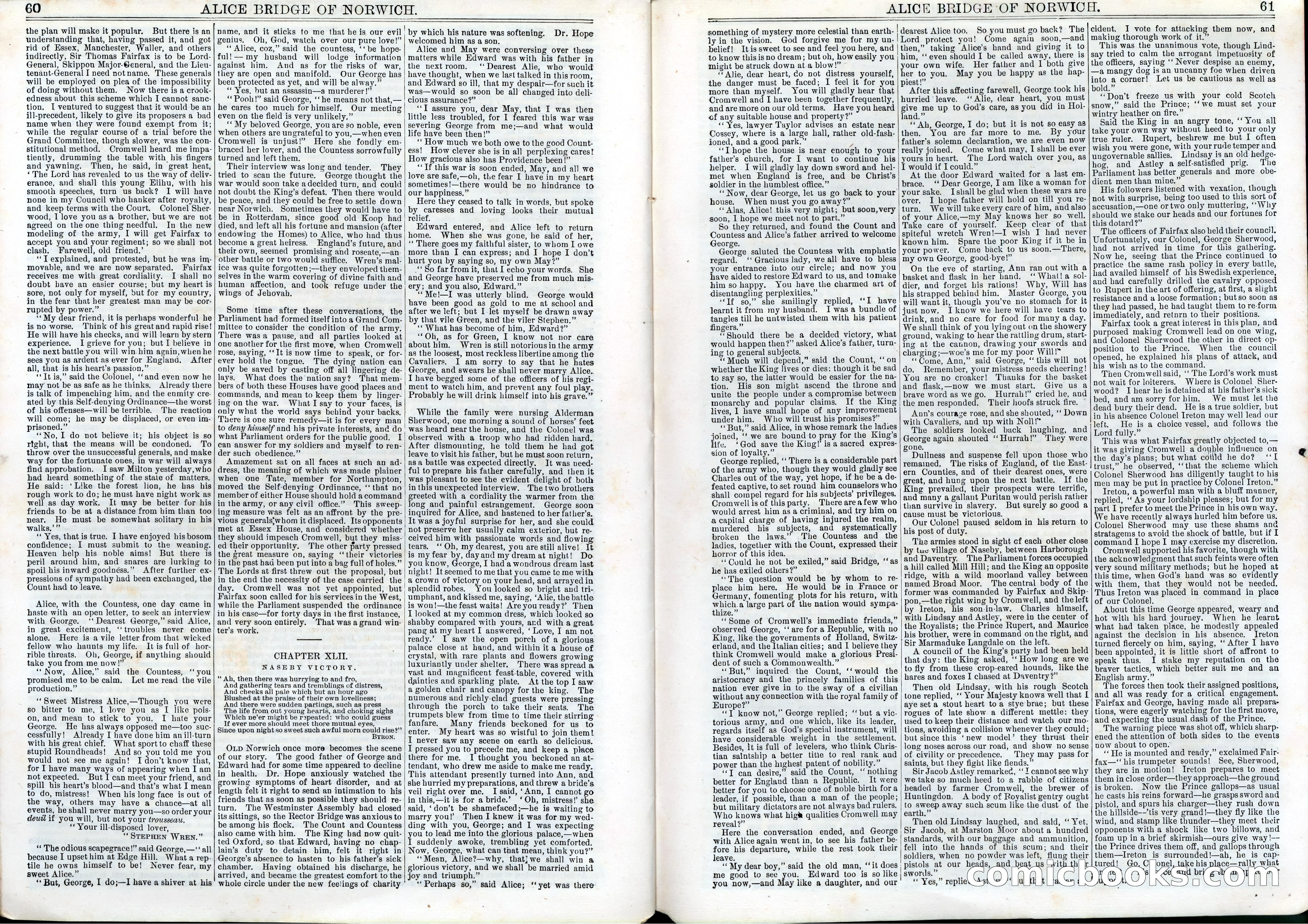
A restored page from Penny Dreadfuls, 1881. Page through the whole issue in the reader above.
📄 Transcribed text from this page (OCR, searchable)
Machine-transcribed from the original scan — historical spelling and the odd misread are preserved.
60 ALICE BRIDGE OF NORWICH. the plan will make it popular. understanding that, having passed it, and got rid of Essex, Manchester, Waller, and others indirectly, Sir Thomas Fairfax is to be Lord- General, Skippon Major-General, and the Lieu- tenant-General I need notname. These generals will be employed on plea of the impossibility of doing without them. Now there is a crook- edness about this scheme which I cannot sanc- tion. I ventured to suggest that it would be an ill-precedent, likely to give its proposers a bad name when they were found exempt from it; while the regular course of a trial before the Grand Committee, though slower, was the con- stitutional method. Cromwell heard me impa- tiently, drumming the table with his fingers and yawning. Then, he said, in great heat, ‘The Lord has revealed to us the way of deliv- erance, and shaJl this young Elihu, with his smooth speeches, turn us back? I will have none in my Council who hanker after royalty, and keep terms with the Court. Colonel Sher: wood, I love you asa brother, but we are uot agreed on the one thing needful. In the new modeling of the army, I will get Fairfax to accept you and your regiment; so we shall not clash.: Farewell, old friend.’ “T explained, and protested, but he was im- movable, and we are now separated. Fairfax receives me with great cordiality. I shall no doubt have an easier course; but my heart is sore, not only for myself, but for my country, in the fear that her greatest man may be cor- rupted by power.” ‘«My dear friend, it is perhaps wonderful he is no worse. Think of his great and rapid rise! He will have his checks, and will learn by stern experience. I grieve for you; but I believe in the next battle you will win. him again, when he sees you as ardent as ever for England. After all, that is his heart’s passion,” ‘Tt is,” said the Colonel, ‘‘and even now he may not be as safe as he thinks. Already there is talk of impeaching him, and the enmity cre- ated by this Self-denying Ordinance—the worst of his offenses—will be terrible. The reaction will come; he may be displaced, or even im- prisoned.” ‘“No, I do not believe it; his object is so tight, that the means will be condoned. To throw over the unsuccessful generals, and make way for the fortunate ones, in war will always find approbation. I saw Milton yesterday,who had heard something of the state of matters. He said: ‘ Like the forest lion, he has his rough work to do; he must have night work as well as day work. It may be better for his friends to be at a distance from him than too near. He must be somewhat solitary in his walks,’” “ Yes, that is true. I have enjoyed his bosom confidence; I must submit to the weaning. Heaven help his noble aims! But there is peril around him, and snares are lurking to spoil his inward goodness,” After further ex- pressions of sympathy had been exchanged, the Count had to leave. Alice, with the Countess, one day came in haste with an open letter, to seek an interview with George. ‘‘ Dearest George,” said Alice, in great excitement, ‘troubles never come alone. Here is a vile letter from that wicked fellow who haunts my life. It is full of hor- rible threats. Oh, George, if anything should take you from me now!” “ Now, Alice,” said the Countess, ‘‘ you promised me to be calm. Let me read the vile production.” ‘‘Sweet Mistress Alice,—Though you were s0 bitter to me, I love you as I like pois- on, and mean to stick to you. I hate your George. He has always opposed me—too suc- cessfully! Already I have done him anill-turn with his great chief. What sport to chaff these stupid Roundheads! And so you told me you would not see me again! I don’t know that, for I have many ways of appearing when I am not expected. But I can meet your friend, and spill his heart’s blood—and that’s what I mean to do, mistress! When his long face is out of the way, others may have a chance—at all events, he shall never marry you—so order your dewil if you will, but not your trousseau, ‘Your ill-disposed lover, “STEPHEN WREN,” “ The odious scapegrace!” said George,—'‘ all because I upset him at Edge Hill. What a rep- tile he owns himself to be! Never fear, my But there js an [ name, and it sticks to me that he is our evil genius, Oh, God, watch over our pure love!” “ Alice, coz,” said the countess, ‘‘ be hope- ful!— my husband will lodge information against him. And as for the risks of war, they are open and manifold. Our George has been protected as yet, and will be alway.” “ Yes, but an assassin—a murderer!” “Pooh!” said George, ‘‘he means not that,— he cares too much for himself. Our meeting even on the field is very unlikely,” ‘« My beloved George, you are so noble, even when others are ungrateful to you,—when even Cromwell is unjust!” Here she fondly em- braced her lover, and the Countess sorrowfully turned and left them. Their interview was long and tender. They tried to scan the future. George thought the war would soon take a decided turn, and could not doubt the King’s defeat. Then there would be peace, and they could be free to settle down near Norwich. Sometimes they would have to be in Rotterdam, since good old Koop had died, and left all his fortune and mansion (after endowing the Homes) to Alice, who had thus become a great heiress. England’s future, and their own, seemed promising and roseate,—an- other battle or two would suffice. Wren’s mal- ice was quite forgotten ;—they enveloped them- selves in the warm covering of divine faith and human affection, and took refuge under the wings of Jehovah. Some time after these conversations, the Parliament had formed itself into a Grand Com- mittee to vonsider the condition of the army. There was a pause, and all parties looked at one another for the first move, when Cromwell rose, saying, ‘‘It is now time to speak, or for- ever hold the tongue. The dying nation can only be saved by casting off all lingering de- lays, What does the nation say? That mem- bers of both these Houses have good places and commands, and mean to keep them by linger- ing on the war. What I say to your faces, is only what the world says behind your backs. There is one sure remedy—it is for every man to deny himself and his private interests, and do what Parliament orders for the public good. I can answer for my soldiers and myself to ren- der such obedience.” Amazement sat on all faces at such an ad- dress, the meaning of which was made plainer when one Tate, member for Northampton, moved the Self-denying Ordinance, ‘that no member of either House should hold acommand in the army, or any civil office.” This sweep- ing measure was felt as an affront by the pre- vious generals;whom it displaced. Its opponents met at Essex House, and considered whether they should impeach Cromwell, but they miss- ed their opportunity. The other party pressed the great measure on, saying ‘‘their victories in the past haa been put into a bag full of holes.” The Lords at first threw out the proposal, but in the end the necessity of the case carried the day. Cromwell was not vet appointed, but Fairfax soon called for his services inthe West, while the Parliament suspended the ordinance in his case—for forty days in the first instance, and very soon entirely. That was a grand win- ter’s work. CHAPTER XLII. NASEBY VICTORY. sweet Alice.” ‘But, George, I do;—I have a shiver at his ‘“ Ah, then there was hurrying to and fro, And gathering tears and tremblings of distress, And cheeks all pale which but an hour ago Blushed at the praise of their own loveliness; And there were sudden partings, such as press The life from out young hearts, and choking sighs Which ne’er might be r2peated: who could guess If ever more should meet thore mutual eyes, Since upon night so sweet such awful morn omne rise?” RON, Oxp Norwich once more becomes the scene of our story. The good father of George and Edward had for some time appeared to decline in health. Dr. Hope anxiously watched the growing symptoms of heart disorder, and at length felt it right to send an intimation to his friends that as soon as possible they should re- turn. The Westminster Assembly had closed its sittings, so the Rector Bridge was anxious to be among his flock. The Count and Countess also came with him. The King bad now quit- ted Oxford, so that Edward, having no chap- lain’s duty to detain him, felt it right in George’s absence to hasten to his father’s sick chamber. Having obtained his discharge, he arrived, and became the greatest comfort to the whole circle under the new feelings of charity by which his nature was softening. Dr. Hope welcomed him as a son, Alice and May were conversing over these matters while Edward was with his father in the next room. ‘‘ Dearest Alie, who would have thought, when we last talked in this room, was—would so soon be all] changed into deli- cious assurance?” “T assure you, dear May, that I was then little less troubled, for I feared this war was severing George from me;—and what would life have been then!” “ How much we both owe to the good Count- ess! How clever she is in all perplexing cares! How gracious also has Providence been!” “Tf this war is soon ended, May, and all we love are safe,—oh, the fear I have in my heart sometimes!—there would be no hindrance to our happiness,” Here they ceased to talk in words, but spoke by caresses and loving looks their mutual relief. Edward entered, and Alice left to return home. When she was gone, he said of her, ‘‘ There goes my faithful sister, to whom I owe more than I can express; and I hope I don’t hurt you by saying so, my own May?” ‘So far from it, that I echo your words. She and George have preserved me from much mis- ery; and you also, Edward.” ““Me!—I was utterly blind. George would have been good as gold to me at school and after we left; but I-let myself be drawn away by that vile Green, and the viler Stephen.” ‘« What has become of him, Edward?” “*Oh, as for Green, I know not nor care about him. Wren is still notorious in the army as the loosest, most reckless libertine among the Cavaliers. I am sorry to say that he hates George, and swears he shall never marry Alice. T have begged some of the officers of his regi- ment to watch him, and prevent any foul play. Probably he will drink himself into his grave.” While the family were nursing Alderman Sherwood, one morning a sound of horses’ feet was heard near the house, and the Colonel was observed with a troop who had ridden hard. After dismounting, he told them he had got leave to visit his father, but he must soon return, asa battle was expected directly. It was need- ful to prepare his father carefully, and then it was pleasant to see the evident delight of both in this unexpected interview. . The two brothers greeted with a cordiality the warmer from the Jong and painful estrangement. George soon inquired for Alice, and hastened to her father’s. It was a joyful surprise for her, and she could not preserve her usually calm exterior, but re- ceived him with passionate words and flowing tears. ‘Oh, my dearest, you are still alive! It is el fear by, dayand my dream at night! Do you know, George, I had a wondrous dream last night! It seemed to me that you came te me with a crown of victory on your head, and arrayed in splendid robes. You looked so bright and tri- umphant, and kissed me, saying, ‘Alie, the battle is won|—the feast waits! Are youready?’ Then I looked at my common dress, which looked so shabby compared with yours, ard with a great pang at my heart I answered, ‘ Love, I am not ready.” I saw the open porch of a glorious palace close at hand, and within it a house of crystal, with rare plants and flowers growing luxuriantly under shelter, There was spread a vast and magnificent feast-table, covered with dainties and sparkling plate, At the top I saw a golden chair and canopy for the king. The numerous and richly-clad guests were pressing through the porch to take their seats. The trumpets blew from time to time their stirring fanfare. Many friends beckoned for us to enter. My heart was so wistful to join them! I never saw any scene on earth so delicious. I pressed you to precede me, and keep a place there for me. I thought you beckoned an at- tendant, who drew me aside to make me ready. This attendant presently turned into Ann, and she hurried my preparations, and threw a bride's veil right over me. I said, ‘Ann, I cannot go in this,—it is for a bride.’ ‘Oh, mistress! she said, ‘don’t be shamefaced;—he is waiting to marry you!’ Then I knew it was for my wed- ding with you, George; and I was expecting you to lead me into the glorious palace,—when I suddenly awoke, trembling yet comforted. Now, George, what can that mean, think you?” “Mean, Alice?—why, that} we shall win a glorious victory, and we shall be married amid joy and triumph.” “Perhaps so,” said Alice; “yet was there and Edward so ill, that my despair—for such it. ALICE BRIDGE OF NORWICH. something of mystery more celestial than earth- ly in the vision. God forgive me for my un- belief! Itis sweet to see and feel you here, and to know this isno dream; but oh, howeasily you might be struck down at a blow!” “ Alie, dear heart, Go not distress yourself, the danger must be faced; I feel it for you more than myself. You will gladly hear that Cromwell and I have been together frequently, and are more on our old terms. Have you heard of any suitable house and property?” “< Yes, lawyer Taylor advises an estate near Cossey, where is a large hall, rather old-fash- ioned, and a good park.” , “‘T hope the house is near enough to your father’s church, for I want to continue his helper. . I will gladly lay down sword and hel- met when England is free, and be Christ’s soldier in the humblest office.” ‘Now, dear George, let us go back to your house. When must you go away?” ‘Alas, Alice! this very night; but soon,very soon, I hope we meet not to part.” So they returned, and found the Count and Countess and Alice’s father arrived to welcome George. : George saluted the Countess with emphatic regard. ‘‘ Gracious lady, we all have to bless your entrance into our circle; and now you ave aided to restore Edward to us, and tomake him so happy. You have the charmed art of disentangling perplexities,” “If go,” she smilingly replied, ‘“‘I have learnt it from my husband. I was a bundle of tangles till he untwisted them with his patient fingers.” “Should there be a decided victory, what would happen then?” asked Alice’s father, turn- ing to general subjects. ‘ “Much will depend,” said the Count, ‘‘on whether the King lives or dies: though it be sad to say so, the latter would be easier for the na- tion. His son might ascend the throne and unite the people under a compromise between monarchy and popular claims. If the King lives, I have small hope of any improvement under him. Who will trust his promises?” “But,” said Alice, in whose remark the ladies joined, ‘‘ we are bound to pray for the King’s life. ‘God save the King! is a sacred expres- sion of loyalty.” : George replied, ‘‘ There is a considerable part of the army who, though they would gladly see Charles out of the way, yet hope, if he be a de- feated captive, to set round him counselors who shall compel regard for his subjects’ privileges. Cromwell is of this party. There areafew who would arrest him as a criminal, and try him on acapital charge of having injured the realm, murdered _ his subjects, and systematically broken the laws.” .The Countess and the ladies, together with the Count, expressed their horror of this idea. “Could he not be exiled,” said Bridge, ‘‘as he has exiled others?” “The question would be by whom to re- place him here, He would be in France or Germany, fomenting plots for his return, with which.a large part of the nation would sympa- thize.” “Some of Cromwell's immediate friends,” observed George, ‘‘ are for a Republic, with no King, like the governments of Holland, Switz- erland, and the Italian cities; and I believe they think Cromwell would make a glorious Presi- dent of such a Commonwealth.” “But,” inquired: the Count, ‘‘ would the aristocracy and the. princely families of this nation ever give in to the sway of a civilian without any connection with the royal family of Europe?” “T know not,’’ George replied; ‘‘ but a vic- torious army, and one which, like its leader, regards itself as God's special instrument, will have considerable weight in the settlement. Besides, it is full of levelers, who think Chris- tian saintship a better title to real rank and power than the highest patent of nobility.” — “T can desire,” said the Count, ‘nothing better for England than a Republic. It were better for you to choose one of noble birth fora leader, if possible, than a man of the people; but military dictators are not always bad rulers. Who knows what higa qualities Cromwell may reveal?” Here the conversation ended, and George with Alice again went in, to see his father be- fore his departure, while the rest took their leave. : ‘‘ My dear boy,” said the old man, ‘‘it does me good to see you. Edward too is so like you now,—and May like a daughter, and our i | pistols at our heads, and tus With th) |r swords.” “ Yes,” replie (0), fa hi G dearest Alice too. So you must go back? The Lord protect you! Come again soon,—and then,” taking Alice’s hand and giving it to him, ‘‘even should I be called away, there is your own wife. Her father and I both give her to you. May you be happy as the hap- iest!” ; : After this affecting farewell, George took his hurried leave. ‘‘Alie, dear heart, you must give me up to God’s care, as you did in Hol- land.” “Ah, George, I do; but it is not so easy as then, You are far more to me. By your father’s solemn declaration, we are even now really joined. Come what may, I shall be ever yours in heart. The Lord watch over you, as I would if I could.” At the door Edward waited for a last em- brace. ‘‘ Dear George, I am like a woman for your sake. Ishall be glad when these wars are over. I hope father will hold on till you re- turn, We will take every care of him, and also of your Alice,—my May knows her so well. Take care of yourself. Keep clear of that spiteful wretch Wren!—I wish I had never known him. Spare the poor King if it be in your power. Come back to us soon.—There, my own George, good-bye!” On the eve of starting, Ann ran out with a basket and flask in her hand. ‘‘ What! a sol- dier, and forget his rations! Why, Will has his strapped behind him. Master George, you will want it, though you’ve no stomach for it just now. I know we here will have tears to drink, and no care for food for many a day. We shall think of you lying out on the showery ground, waking to hear the rattling drum, start- ing at the cannon, drawing your swords and charging ;—woe’s me for my poor Will!” “Come, Ann,” said George, ‘ this will not do. Remember, your mistress needs cheering! You are no croaker! Thanks for the basket and flask,—now we must start. Give us a brave word as we go. Hurrah!” cried he, and the men responded, Their hoofs struck fire, Ann’s courage rose, and she shouted, ‘‘ Down with Cavaliers, and up with Noll!” The soldiers looked back laughing, and George again shouted ‘‘Hurrah!” They were one, & Dullness and suspense fell upon those who remained. The risks of England, of the East- ern Counties, and of their dearest ones, were great, and hung upon the next battle. If the King prevailed, their prospects were terrific, and many a gallant Puritan would perish rather than survive in slavery. But surely so good a cause must be victorious. Our Colonel paused seldom in his return to his post of duty. The armies stood in sight cf each other close by tue village of Naseby, between Harborough and Daventry. The Parliament forces occupied a hill called Mill Hill; and the King an opposite ridge, with a wild moorland valley between named Broad Moor. The central body of the former was commanded by Fairfax and Skip- pon,—the right wing by Cromwell, and the lef