
Penny Dreadfuls, 1881 · page 33 of 38
Alice Bridge of Norwich — page 33: what you’re looking at
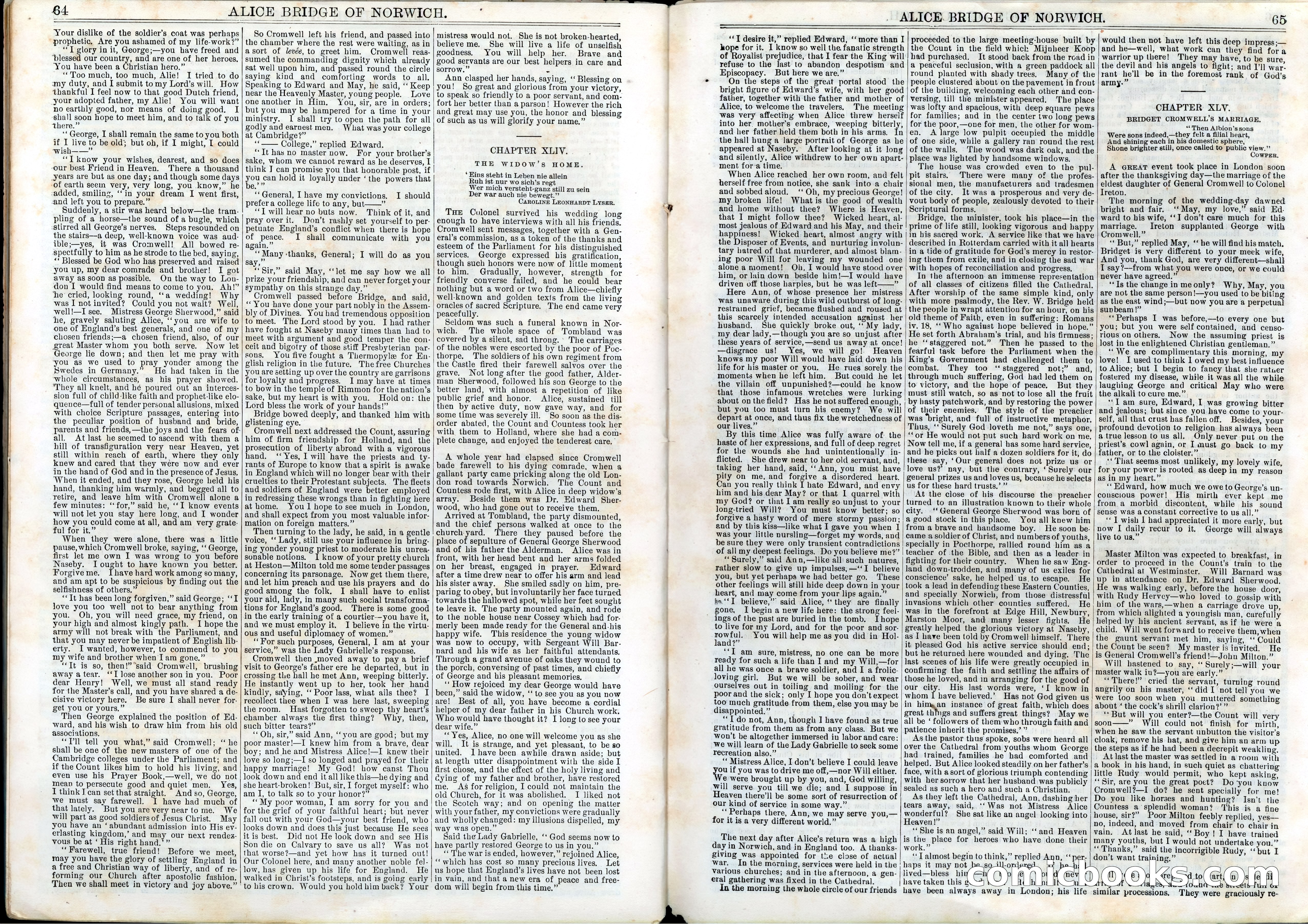
A restored page from Penny Dreadfuls, 1881. Page through the whole issue in the reader above.
📄 Transcribed text from this page (OCR, searchable)
Machine-transcribed from the original scan — historical spelling and the odd misread are preserved.
64. | ALICE BRIDGE OF NORWICH. ° Your dislike of the soldier’s coat was perhaps prophetic, Are you ashamed of my life-work?” “T glory in it, George;—you have freed and ‘blessed our country, and are one of her heroes, ‘You have been a Christian hero.” “Too much, too much, Alie! I tried to do ‘my duty, and I submit to my Lord’s will. How thankful I feel now to that good Dutch friend, your adopted father, my Alie! You will want no earthly good, nor means of doing good. I shall soon hope to meet him, and to talk of you there.” ‘* George, I shall remain the same to you both if I live to be old; but oh, if I might, L could ~wish——” “I know your wishes, dearest, and so does our best Friend in Heaven. There a thousand _years are but as one day; and though some days ‘of earth seem very, very long, you know,” he added, smiling, ‘“‘in your dream I went first, and left you to prepare.” Suddenly, a stir was heard below—the tram- pling of a horse—the sound of a bugle, which stirred all George’s nerves. Steps resounded on the stairs—a deep, well-known voice was aud- ible;—yes, it was Cromwell! All bowed re- spectfully to him as he strode to the bed, saying, “«‘ Blessed be God who has preserved and raised you up, my dear comrade and brother! I got away as soon as possible, On the way to Lon- don I would find means to come to you. Ah!” ‘he cried, looking round, ‘‘a wedding! Why was I not invited? Could you not wait? Well, well!—I see. Mistress George Sherwood,” said he, gravely saluting Alice, ‘“‘you are wife to one of England’s best generals, and one of my chosen friends;—a chosen friend, also, of our great Master whom you both serve. Now let George lie down; and then let me pray with you as we used to pray yonder among the Swedes in Germany.” He had taken in the whole circumstances, as his prayer showed. ‘They all knelt, and hé poured out an interces- sion full of child-like faith and prophet-like elo- quence—full of tender personal allusions, mixed with choice Scripture passages, entering into- the peculiar position of husband and bride, parents and friends,—the joys and the fears of all. At last he seemed to ascend with them a hill of transfiguration very near Heaven, yet still within reach of earth, where they only knew and cared that they were now and ever in the hand of God and in the presence of Jesus, ‘When it ended, and they rose, George held his hand, thanking him warmly, and begged all to retire, and leave him with Cromwell alone a few minutes: ‘‘for,” said he, ‘‘I know events will not let you stay here long, and I wonder how you could come at all, and am very grate. ful for it.” : ‘When they were alone, there was a little pause, which Cromwell broke, saying, ‘‘ George, first let me own I was wrong to you before Naseby. I ought to have known you better. Forgiveme. Ihave hard work among so many, and am apt to be suspicious by finding out the selfishness of others,” “«Tt has been long forgiven,” said George; ‘‘I love you too well not to bear anything from you. Oh, you will need grace, my friend, on your high and almost kingly path. I hope the army will not break with the Parliament, and that you may never be impatient of English lib- erty. I wanted, however, to commend to you my wife and brother when I am gone.” “It is so, then!” said Cromwell, brushing away atear. ‘I lose another son in you. Poor dear Henry! Well, we must all stand ready for the Master’s call, and you have shared a de- cisive victory here. Be sure I shall never for- get you or yours,” Then George explained the position of Ed- ward, and his wish to draw him from his old associations. “Tl tell you what,” said Cromwell; ‘he shall be one of the new masters of one of the Cambridge colleges under the Parliament; and if the Count likes him to hold his living, and even use his Prayer Book,—well, we do not mean to persecute good and quiet men, Yes, I think I can set that straight. And so, George, we must say farewell. I have had much of that lately, But you are very neartome. We will part as good soldiers of Jesus Christ. May you have an ‘abundant admission into His ey- erlasting kingdom,’ and may our next rendez- vous be at ‘ His right hand.’ ” ‘Farewell, true friend! Before we meet, may you have the glory of settling England in a free and Christian way of liberty, and of re- forming our Church after apostolic fashion. Then we shall meet in victory and joy above.” So Cromwell left his friend, and passed into the chamber where the rest were wailing, as in asort of levée, to greet him. Cromwell reas- sumed the commanding dignity which already sat well upon him, and passed round the circle saying kind and comforting words to all. Speaking to Edward and May, he said, ‘‘ Keep near the Heavenly Master, young people. Love one another in Him. You, sir, are in orders; but you may be hampered for a time in your ministry. I shall try to open the path for all godly and earnest men. What was your college at Cambridge?” ‘*__ College,” replied Edward. “Tt has no master now. For your brother’s sake, whom we cannot reward as he deserves, I think J can promise you that honorable post, if you can hold it loyally under ‘the powers that be.’ ”? ‘General, I have my convictions. I should prefer a college life to any, but——” “T will hear no buts now. Think of it, and pray over it. Don’t rashly set yourself to per- petuate England’s conflict when there is hope of peace. I shall communicate with you again.” ‘* Many ‘thanks, General; I will do as you say,” “Sir,” said May, ‘‘let me say how we all prize your friendship, and can never forget your sympathy on this strange day.” Cromwell passed before Bridge, and said, ‘* You have done your part nobly in the Assem- bly of Divines. You had tremendous opposition to meet. The Lord stood by you. I had rather have fought at Naseby many times than had to meet with argument and good temper the con- ceit and bigotry of those stiff Presbyterian par- sons, You five fought a Thermopyle for En- glish religion in the future, The free Churches you are setting up over the country are garrisons for loyalty and progress. I may have at times to bow in the temple of Rimmon for the nation’s sake, but my heart is with you. Hold on: the Lord bless the work of your hands!” Bridge bowed deeply, and thanked him with glistening eye. Cromwell next addressed the Count, assuring him of firm friendship for Holland, and the prosecution of liberty abroad with a vigorous hand, ‘‘ Yes, I will have the priests and ty- rants of Europe to know that a spirit is awake in England which will no longer bear with their cruelties to their Protestant subjects, The fleets and soldiers of England were better employed in redressing these wrongs than in fighting here at home. You I hope to see much in London, and shall expect from you most valuable infor- mation on foreign matters.” Then turning to the lady, he said, in a gentle voice, ‘‘ Lady, still use your influence in bring- ing yonder young priest to moderate his unrea- sonable notions. I know of your pretty church at Heston—Milton told me some tender passages concerning its parsonage. Now get them there, and let him preach and use his prayers and do good among the folk. I shall have to enlist your aid, lady, in many such social transforma- tions for England’s good. There is some good in the early training of a courtier—you have it, and we must employ it. I believe in the virtu- ous and useful diplomacy of women.” ‘For such purposes, General, I am at your service,” was the Lady Gabrielle’s response. Cromwell then moved away to pay a brief visit to George’s father ere he departed, but in crossing the hall he met Ann, weeping bitterly. He instantly went up to her, took her hand kindly, saying, ‘‘ Poor lass, what ails thee? I recollect thee when I was here last, sweeping the room. Hast forgotten to sweep thy heart’s chamber always the first thing? Why, then, such bitter tears?” “Oh, sir,” said Ann, “you are good; but my poor master!—I knew him from a brave, dear boy; and he and Mistress Alice!—I knew their love so long;—I so longed and prayed for their happy marriage! My God! how canst Thou look down and end it all like this—he dying and she heart-broken! But, sir, I forget myself: who am I, to talk so to your honor?” **My poor woman, I am sorry for you and for the grief of your faithful heart; but never fall out with your God—your best friend, who looks down and does this just because He sces it is best. Did not He look down and see His Son die on Calvary to save us all? Was not that worse?—and yet how has it turned out! Our Colonel here, and many another noble fel- low, has givén up his life for England. He walked in Christ’s footsteps, and is going early to his crown. Would you hold him back? Your mistress would not, She is not broken-hearted, believe me. She will live a life of unselfish goodness, You will help her. Brave and good servants are our best helpers in care and sorrow.” - Ann clasped her hands, saying, ‘‘ Blessing on you! So great and glorious from your victory, to speak so friendly to a poor servant, and com- fort her better than a parson! However the rich and great may use you, the honor and blessing of such as us will glorify your name,” CHAPTER XLIV. THE WIDOW’S HOME. ‘Eins steht in Leben nie allein Ruh ist nur wo sich's regt Wer mich versteht-ganz still zu sein Der war auch nie bewegt.” CaroLinE LEoNHARDT LYSER, Toe Colonel survived his wedding long enough to have interviews with all his friends. Cromwell sent messages, together with a Gen- eral’s commission, as a token of the thanks and esteem of the Parliament for his distinguished services. George expressed his gratification, though such honors were now of little moment to him. Gradually, however, strength for friendly converse failed, and he could bear nothing but a word or two from Alice—chiefly well-known and golden texts from the living oracles of sacred Scripture. The end came very peacefully. Seldom was such a funeral known in Nor- wich. The whole space of Tombland was covered by a silent, sad throng.‘ The carriages of the nobles were escorted by the poor of Poc- thorpe, The soldiers of his own regiment from the Castle fired their farewell salvos over the grave. Not long after the good father, Alder- man Sherwood, followed his son George to the better land, with almost a repetition of like public grief and honor. Alice, sustained till then by active duty, now gave way, and for some time was severely ill. So soon as the dis- order abated, the Count and Countess took her with them to Holland, where she had a com- plete change, and enjoyed the tenderest care.” A whole year had elapsed since Cromwell bade farewell to his dying comrade, when a gallant party came pricking along the old Lon- don road towards Norwich. The Count and Countess rode first, with Alice in deep widow’s array. Beside them was Dr. Edward Sher- wood, who had gone out to receive them. Arrived at Tombland, the party dismounted, and the chief persons walked at once to the church:yard. There they paused before the place of sepulture of General George Sherwood and of his father the Alderman. Alice was in front, with her head bent and her arms folded on her breast, engaged jn prayer. Edward after a time drew near to offer his arm and lead his sister away. She smiled sadly on him, pre- paring to obey, but involuntarily her face turned towards the hallowed spot, while her feet sought to leave it. The party mounted again, and rode to the noble house near Cossey which had for- merly been made ready for the General and-his happy wife. This residence the young widow was now to occupy, with Sergeant Will Bar- nard and his wife as her faithful attendants, Through a grand avenue of oaks they wound to the porch, conversing of past times, and chiefly of George and his pleasant memories, ‘‘ How rejoiced my dear George would have been,” said the widow, ‘' to see you as you now are! Best of all, you have become a cordial helper of my dear father in his Church work. Who would have thought it? I long to see your dear wife.” ; ‘Yes, Alice, no one will welcome you as she will. It is strange, and yet pleasant, to be so united. Ihave been awhile drawn aside; but at length utter disappointment with the side I first chose, and the effect of the holy living and Cying of my father and brother, have restored me, As for religion, I could not maintain the old Church, for it was abolished. I liked not the Scotch way; and on opening the matter with your father, my convictions were gradually and wholly changed: my illusions dispelled, my way was open.” Said the Lady Gabrielle, ‘‘ God seems now to have partly restored George to us in you.” “The war is ended, however,” rejoined Alice, “which has cost so many precious lives, Let us hope that England’s lives have not been lost in vain, and that a new era of peace and free- dom will begin from this time.” “4 ene ALICE. BRIDGE OF NORWICH. 65 “‘T desire it,” replied Edward, ‘‘ more than I hope for it. I know so well the fanatic strength of Royalist eh leone that I fear the King will: refuse to the last'to abandon despotism and Episcopacy. But here we are.” On the steps of the great portal stood the bright figure of Edward’s wife, with her good father, together with the father and mother of Alice, to welcome the travelers, The meeting was very affecting when Alice threw herself into her. mother’s embrace, weeping bitterly, and her father held them both in his arms. In the hall hung a large portrait of George as he appeared at Naseby. After looking at it long and silently, Alice withdrew to her own apart- ment fora time. ‘When Alice reached her own room, and felt herself free from notice, she sank into a chair and sobbed aloud. ‘‘ Oh, my precious George! my broken life! Whatis the good of wealth and home without thee? Where is Heaven, that I might follow thee? Wicked heart, al- most jealous of Edward and his May, and their happiness! Wicked: heart, almost angry with the Disposer of Events, and nurturing involun- tary hatred of that murderer, and almost blam- ing poor Will for leaving my wounded one alone a moment! Oh, I would have stood over him, or Jain down beside him!—I would have driven off those harpies, but he was left——” Here Ann, of whose presence her mistress was unaware during this wild outburst of long- restrained grief, became flushed and roused at this scarcely intended accusation against. her husband. She quickly broke out, ‘‘ My lady, my dear lady,—though you are so unjust after these years of service,—send us away at once! —disgrace us! Yes, we will go! Heaven knows my poor Will would have laid down his life for his master or you. He rues sorely the moments when he left him, But could he let the villain off unpunished?—could he know that those infamous wretches were lurking about on the field? Has he not suffered enough, but you too must turn his enemy? We will depart at once, and thus fix the wretchedness of our lives,” By this time Alice was fully aware of. the haste of her expressions, and full of deep regret for the wounds she had unintentionally in- flicted. She drew near to her old servant, and, taking her hand, said, ‘Ann, you must have pity on me, and forgive a disordered heart. Can you really think I hate Edward, and envy him and his dear May? or that I quarrel with my God? or that I am really so unjust to your long-tried Will? You must know better; so forgive a hasty word of mere stormy passion; end by this kiss—like what I gave you when I was your little nursling—forget my words, and be sure they were only transient contradictions of all my deepest feelings. Do you believe me?” Surely,” said Ann,—like all! such natures, rather slow to give up impulses, —‘‘I believe you, but yet perhaps we had better go, These other feelings will still hide deep down in your heart, and may come from your lips again.” ba‘‘I believe,” said Alice, ‘they are finally _ gone, I begin a new life here: the strong feel- ings of the past are buried in the tomb. Ihope to live for my Lord, and for the poor and sor- rowful. You will help me as you did in Hol- land?” ‘*T am sure, mistress, no one can be more ready for such a life than I and my Will,—for all he was once a brave soldier, and I a frolic- loving girl. But we will be sober, and wear ourselves out in toiling and moiling for the poor and the sick; only I hope you don't expect too much gratitude from them, else you may be disappointed.” ; “T do not, Ann, though I have found as true gratitude from them as from any class. But we Won't be altogether immersed in labor and care: We will learn of the Lady Gabrielle to seek some Tecreation also.” “ Mistress Alice, I don’t believe I could leave eo if you was to drive me off,—nor Will either. e were brought up by you, and, God willing, will serve. you till we die; and I suppose in Heaven there’ll be some sort of resurrection of our kind of service in some way.” ‘* Perhaps there, Ann, we may serve you,— for it is a very different world.” The next day after Alice’s return was a high day in Norwich, and in England too. A thanks- giving was appointed for the close of actual war. In the morning, services were held in the | various churches; and in the afternoon, a gen- eral gathering was fixed in the Cathedral. In the morning the whole circle of our friends proceeded to the large meeting-house built by the Ccunt in the field whick Mijnheer Koop had purchased. It stood back from the road in a peaceful seclusion, with a green paddock all round planted with shady trees, Many of the people clustered about on the pavement in front of the building, welcoming each other and con- versing, till the minister appeared. The place was lofty and spacious, with deep square pews for families; and in the center two long pews for the poor,—one for men, the other for wom- en. A large low pulpit occupied the middle of one side, while a gallery ran round the rest of the walls. The wood was dark oak, and the place was lighted by handsome windows. The house was crowded even to the pul- pit stairs, There were many of the profes- sional men, the manufacturers and tradesmen of the city. It was a prosperous and very de- vout body of people, zealously devoted to their Scriptural forms. Bridge, the minister, took his place—in the prime of life still, looking vigorous and happy in his sacred work. A service like that we have described in Rotterdam carried with it all hearts in a tide of gratitude for God’s mercy in restor- ing them from exile, and in closing the sad war with hopes of reconciliation and progress, In the afternoon an immense representation of all classes of citizens filled the Cathedral. After worship of the same simple kind, only with more psalmody, the Rev. W. Bridge held the people in wrapt attention for an hour, on his old theme of Faith, even in suffering: Romans iv. 18, “‘ Who against hope believed in hope.” He set forth Abraham's trial, and his firmness; he ‘‘staggered not.”. Then he passed to the fearful task before the Parliament when the King’s Government had challenged them to combat. They too ‘‘ staggered not;” and, through much suffering, God had led them on to’ victory, and the hope of peace. But they must still watch, so as not to lose all the fruit by hasty patchwork, and by restoring the power of their enemies. The style of the preacher was bright, and full of instructive metaphor, Thus, ‘‘ Surely God Joveth me not,” says one, ‘Cor He would not put such hard work on me, Now tell me, if a general has some hard service, and he picks out half a dozen soldiers for it; do these say, ‘Our genera] does not prize us or love us? nay, but the contrary, ‘ Surely: our general prizes us and loves us, because he selects us for these hard trusts.’ ” At the close of his discourse the preacher turned to an illustration known to their whole city. ‘‘General George Sherwood was born of a good stock in this place. You all knew him from a brave and handsome boy. He soon be- came a soldier of Christ, and numbers of y