
Penny Dreadfuls, 1881 · page 8 of 38
Alice Bridge of Norwich — page 8: what you’re looking at
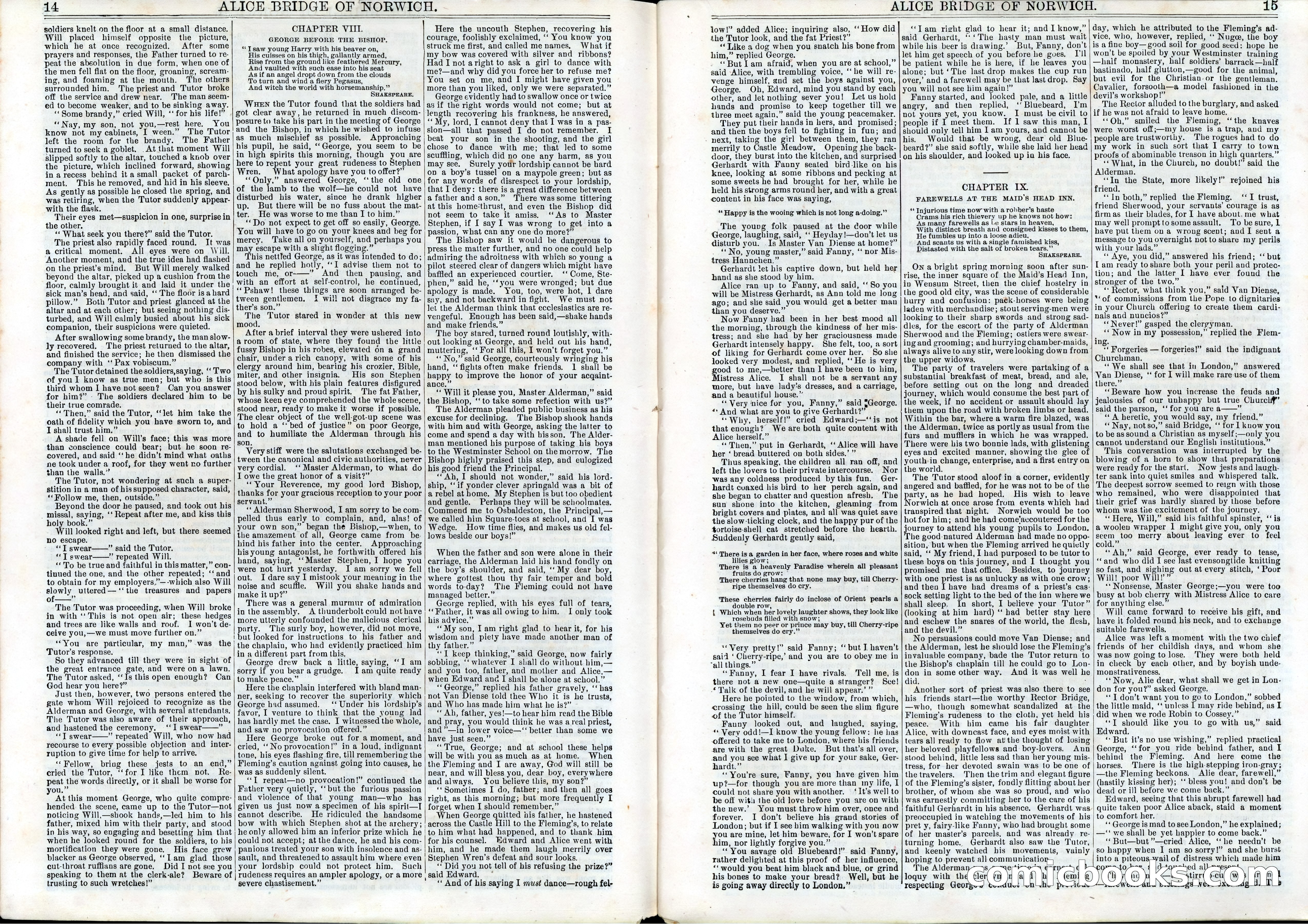
A restored page from Penny Dreadfuls, 1881. Page through the whole issue in the reader above.
📄 Transcribed text from this page (OCR, searchable)
Machine-transcribed from the original scan — historical spelling and the odd misread are preserved.
14 ALICE BRIDGE OF NORWICH. soldiers knelt on the floor at a small distance. Will placed himself opposite the picture, which he at once recognized. After some prayers and responses, the Father turned to re- peat the absolution in due form, when one of the men fell flat on the floor, groaning, scream- ing, and foaming at the mouth. The others surrounded him. The priest and Tutor broke off the service and drew near. The man seem- ed to become weaker, and to be sinking away. ‘‘ Some brandy,” cried Will, ‘‘ for his life!” “Nay, my son, not you,—rest here, You know not my cabinets, I ween.” The Tutor left the room for the brandy. The Father turned to seek a goblet. .At that moment Will slipped softly to the altar, touched a knob over the picture, which inclined forward, showing in a recess behind it a small packet of parch- ment. This he removed, and hid in his sleeve. As gently as possible he closed the spring, and was retiring, when the Tutor suddenly appear- with the flask. Their eyes met—suspicion in one, surprise in the other. ‘¢ What seek you there?” said the Tutor. The priest also rapidly faced round. It was a critical moment. All eyes were on Will. Another moment, and the true idea had flashed on the priest’s mind, But Will merely walked beyond the altar, picked up a cushion from the floor, calmly brought it and laid it under the sick man’s head, and said, ‘‘ The floor is a hard pillow.” Both Tutor and priest glanced at the altar and at each other; but seeing nothing dis- turbed, and Will calmly busied about his sick companion, their suspicions were quieted. After swallowing some brandy, the man slow- ly recovered. The priest returned to the altar, and finished the service; he then dismissed the company with ‘‘ Pax vobiscum.” The Tutor detained thesoldiers,saying, ‘‘ Two of you I know as true men; but who is this third whom I have not seen? Oan you answer for him?” - The soldiers declared him to be their true comrade. ««Then,” said the Tutor, ‘‘let him take the oath of fidelity which you have sworn to, and I sha)] trust him,” A shade fell on Will’s face; this was more than conscience could bear; but he soon re- covered, and said ‘‘he didn’t mind what oaths ne took under a roof, for they went ro further than the walls.” The Tutor, not wondering at such a super- stition in a man of his supposed character, said, *‘Follow me, then, outside.” Beyond the door he paused, and took out his _ missal, saying, ‘‘ Repeat after me, and kiss this holy book.” Will looked right and left, but there seemed no escape. “T swear——” said the Tutor. « T swear ”’ repeated Will. “To be true and faithful in this matter,” con- tinued the one, and the other repeated; ‘‘ and to obtain for my employers,”—-which also Will slowly uttered—‘‘the treasures and papers of) The Tutor was proceeding, when Will broke in with “ This is not open air; these hedges and trees are like walls and roof. I won't de- ceive you,—we must move further on.” “You are particular, my man,” Tutor’s response. So they advanced till they were in sight of the great entrance gate, and were on a lawn. The Tutor asked, ‘‘Is this open enough? Can God hear you here?” : Just then, however, two persons entered the gate whom Will rejoiced to recognize as the Alderman and George, with several attendants. The Tutor was also aware of their approach, and hastened the ceremony, ‘I swear wee “T swear——”" repeated Will, who now had recourse to every possible objection and inter- ruption to give time for help to arrive. “Fellow, briag these jests to an end,” cried the Tutor, ‘‘for I like them not. Re- peat the words directly, or it shall be worse for ou.” fi At this moment George, who quite compre- hended the scene, came up to the Tutor—not noticing Will,—shook hands,—led him to his father, mixed him with their party, and stood in his way, so engaging and besetting him that when he looked round for the soldiers, to his mortification they were gone, His face grew blacker as George observed, ‘‘I.am glad those cut-throat ruffians are gone, Did I not sve you speaking to them at the clerk-ale? Beware of trusting to such wretches!” was the} CHAPTER VIII. GEORGE BEFORE THE BISHOP. “Tsaw young Harry with his beaver on, His cuisses on his thigh, gallantly armed, Rise from the ground like feathered Mercury, And vaulted with such ease into his seat Asif an angel dropt down from the clouds To turn and wind a fiery Pegasus, And witch the world with horsemanship.” SHAKSPEARE, WHEN the Tutor found that the soldiers had got clear away, he returned in much discom- posure to take his part in the meeting of George and the Bishop, in which he wished to infuse as much mischief as possible. Approaching his pupil, he said, ‘George, you seem to be in high spirits this morning, though you are here to repent your great rudeness to Stephen Wren. What apology have you to offer?” “Only,” answered George, ‘‘the old one of the lamb to the wolf—he could not have disturbed his water, since he drank higher up. But there will be no fuss about the mat- ter. He was worse to me than I to him.” “Do not expect to get off so easily, George. You will have to go on your knees and beg for mercy. Take all on yourself, and perhaps you may escape with a slight flogging.” This nettfed George, as it was intended to do; and he replied hotly, “I advise them not to touch me, or ” And then pausing, and with an effort at self-control, he continued, “Pshaw! these things are soon arranged be- tween gentlemen, 1 will not disgrace my fa- ther’s son.” The Tutor stared in wonder at this new mood. After a brief interval they were ushered into aroom of state, where they found the little fussy Bishop in his robes, elevated on a grand chair, under a rich canopy, with some of his clergy around him, bearing his crozier, Bible, miter, and other insignia. His son Stephen stood below, with his plain features disfigured by his sulky and proud spirit. The fat Father, whose keen eye comprehended the whole scene, stood near, ready to make it worse if possible. The clear object of the well-got-up scene was to hold a ‘bed of justice” on poor George, and to humiliate the Alderman through his son. Very stiff were the salutations exchanged be- tween the canonical and civic authorities, never very cordial. ‘‘ Master Alderman, to what do I owe the great honor of a visit?” ‘Your Reverence, my good lord Bishop, thanks for your gracious reception to your poor servant.” “Alderman Sherwood, I am sorry to be com- pelled thus early to complain, and, alas! of your own son,” began the Bishop,—when, to the amazement of all, George came from be. hind his father into the center. Approaching his young antagonist, he forthwith offered his hand, saying, ‘‘Master Stephen, I hope you were not hurt yesterday. I am sorry we fell out. I dare say I mistook your meaning in the noise and scuffle. Will you shake hands and make it up?” There was a general murmur of admiration in the assembly. A thunderbolt could not have more utterly confounded the malicious clerical party. The surly boy, however, did not move, but looked for instructions to his father and the chaplain, who had evidently practiced him in a different part from this, George drew back a little, saying, “‘I am sorry if you beara grudge. Iam quite ready to make peace.” Here the chaplain interfered with bland man- ner, seeking to recover the superiority which George had assumed. ‘‘ Under his lordship’s favor, I venture to think that the young lad has hardly met the case. I witnessed the whole, and saw no provocation offered.” Here George broke out for a moment, and cried, ‘‘No provocation!” in a loud, indignant tone, his eyes flashing fire, till remembering the Fleming’s caution against going into causes, he was as suddenly silent. “I repeat—no provocation!” continued the Father very quietly, ‘‘but the furious passion and violence of that young man—who has given us just now a specimen of his spirit—I cannot describe. He ridiculed the handsome bow with which Stephen shot at the archery; he only allowed him an inferior prize which he could not accept; at the dance, he and his com- panions treated your son with insolence and as- sault, and threatened to assault him where even your lordsbip could not protect him, Such rudeness requires an ampler apology, or a more severe chastisement.” Here the uncouth Stephen, recovering his courage, foolishly exclaimed, ‘‘ You know you struck me first, and called me names, What if my bow was covered with silver and ribbons? Had I not aright to ask a girl to dance with me?—and why did you force her to refuse me? You set on me, and I might have given you more than you liked, only we were separated.” George evidently had to swallow once or twice as if the right words would not come; but at length recovering his frankness, he answered, “«My, lord, I cannot deny that I was in a pas- sion—all that passed I do not remember. I |beat your son in the shooting, and the girl chose to dance with me; that led to some scuffling, which did no one any harm, as you may see. Surely your lordship cannot be hard op a boy’s tussel on a maypole green; but as for any words of disrespect to your lordship, that I deny: there is a great difference between a father and ason.” There was some tittering at this homethrust, and even the Bishop did not seem to take it amiss. ‘‘As to Master Stephen, if I say I was wrong to get into a passion, what can any one do more?” The Bishop saw it would be dangerous to press the matter further, and no one could help admiring the adroitness with which so young a pilot steered clear of dangers which might have baffled an experienced courtier. ‘‘ Come, Ste- phen,” said he, ‘‘you were wronged; but due apology is made. You, too, were hot, 1 dare say, and not backward in fight. We must not let the Alderman think that ecclesiastics are re- vengeful. Enough has been said,—shake hands and make friends.” The boy stared, turned round loutishly, with- out looking at George, and held out his hand, muttering, ‘‘ For all this, I won’t forget you.” “No,” said George, courteously wringing his hand, ‘‘ fights often make friends, 1 shall be happy to improve the honor of your acqaint- ance.” “Will it please you, Master Alderman,” said the Bishop, ‘‘to take some refection with us?” The Alderman pleaded public business as his excuse for declining. The Bishop shook hands with him and with George, asking the latter to come and spend a day with hisson, The Alder- man mentioned his purpose of taking his boys to the Westminster School on the morrow. The Bishop highly praised this step, and eulogized his good friend the Principal. “Ah, I should not wonder,” said his lord- ship, ‘‘if yonder clever springald was a bit of a rebel at home. My Stephen is but too obedient and gentle. Perhaps they will be schoolmates. Commend me to Osbaldeston, the Principal, — we called him Square-toes at school, and I was Wedge. How time flies, and makes us old fel- lows beside our boys!” When the father and son were alone in their carriage, the Alderman laid his hand fondly on the boy’s shoulder, and said, ‘‘My dear boy, where gottest thou thy fair temper and bold words to-day? The Fleming could not have managed better.” George replied, with his eyes full of tears, ‘Father, it was all owing to him. I only took his advice.” “My son, Iam right glad to hear it, for his wisdom and piety have made another man of thy father.” “I keep thinking,” said George, now fairly sobbing, ‘‘ whatever I shall do without him,— and you too, father, and mother and Alice,— when Edward ana I shall be alone at school.” “George,” replied his father gravely, ‘‘ has not Van Diense told thee Who it is he trusts, and Who has made him what he is?” “Ah, father, yes!—to hear him read the Bible and pray, you would think he was areal priest, and ’’—in lower voice—‘‘ better than some we have just seen.” “True, George; and at school these helps will be with you as much as at home. When the Fleming and I are away, God will still be near, and will bless you, dear boy, everywhere and always. You believe this, my son?” ‘‘Sometimes I do, father; and then all goes right, as this morning; but more frequently I forget when I should remember.” When George qtitted his father, he hastened across the Castle Hill to the Fleming’s, to relate to him what had happened, and to thank him for his counsel. Edward and Alice went with him, and he made them laugh merrily over Stephen Wren’s defeat and sour looks, ‘Did you not tell of his refusing the prize?” , said Edward, “‘ And of his saying I must dance—rough fel- ALICE BRIDGE OF NORWICH. low!” added Alice; inquiring also, ‘‘How did the Tutor look, and the fat Priest?” ; “Like a dog when you snatch his bone from him,” replied George. “But Lam afraid, when you are at school,” said ‘Alice, with trembling voice, ‘‘he will re- venge himself, and set the boys against you, George. Ob, Edward, mind you stand by each other, and let nothing sever you! Let us hold lands and promise to keep together till we three meet again,” said the young peacemaker. They put their hands in hers, and promised; and then the boys fell to fighting in fun; and . next, taking the girl between them, they ran merrily to Castle Meadow. Opening the back- door, they burst into the kitchen, and surprised Gerhardt with Fanny seated bird-like on his Knee, looking at some ribbons and pecking at some sweets he had brought for her, while he held his strong arms round her, and with a great content in his face was saying, “ Happy is the wooing which is not long a-doing.”” The youvg folk paused at the door while George, laughing, said, ‘‘ Heyday!—don’t let us disturb you. .Is Master Van Diense at home?” . No, young master,” said Fanny, ‘‘ nor Mis- tress Hannochen,” Gerhardt let his captive down, but held her hand as she stood by him. Alice ran up to Fanny, and said, ‘‘ So you will be Mistress Gerhardt, as Ann told me long ago; and she said you would get a better man than you deserve.” Now Fanny had been in her best mood all the morning, through the kindness of her mis- tress; and she had by her graciousness made Gerhardt intensely happy. She felt, too, a sort of liking for Gerhardt come over her. So she looked very modest, and replied, ‘‘He is very good to me,—better than I have been to him, Mistress Alice. I shall not be a servant any more, but have lady's dresses, and a carriage, and a beautiful house.” “ Very ‘nice for you, Fanny,” said (George. «And what are you to give Gerhardt?” “Why, herself!’ cried Edward;—‘‘is not that enough? Weare both quite content with Alice herself.” “Then,” put in Gerhardt, ‘‘ Alice will have her ‘ bread buttered on both sides.’ ” Thus speaking, the children all ran off, and left the lovers to their private intercourse. Nor ‘was any coldness produced by this fun. Ger- hardt cvaxed his bird to her perch again, and she began to chatter and question afresh, The sun shone into the kitchen, gleaming from bright covers and plates, and all was quiet save the slow-licking clock, and the happy pur of the tortoise-she]l cat stretched before the hearth. Suddenly Gerhardt gently said, “( There isa garden in her face, where roses and white lilies glow; There is a heavenly Paradise wherein all pleasant fruits do grow: ~ There cherries hang that none may buy, till Cherry- ripe themselves do cry. These cherries fairly do inclose of Orient pearls a double row, { Which when her lovely laughter shows, they look like rosebuds filled with snow; Yet them no peer or prince may buy, till Cherry-ripe themselves do ery.” “Very pretty!” said Fanny; “but J. haven’t said ‘Cherry-ripe,’ and you are to obey me in “all things.” “Fanny, I fear I have rivals. Tell me, is there not a new one—quite a stranger? Sce! -* Talk of the devil, and he will appear.’ ” Here he pointed to the window, from which, crossing the hill, could be seen the slim figure of the Tutor himself. Fanny looked out, and laughed, saying, “* Very odd!—I know the young fellow: he has offered to take me to London, where his friends are with the great Duke. But that’s all over, and you see what I give up for your sake, Ger- hardt.” “You're sure, Fanny, you have given him up?—for though you are more than my life, I could not share you with another. ‘It’s well to be off with the old love before you are on with the new.’ You must throw him over, once and forever. I don’t believe his grand stories of London; but if I see him walking with you now you are mine, let him beware, for I won’t spare him, nor lightly forgive you.” ““You savage old Bluebeard!” said Fanny, rather delighted at this proof of her influence, **would you beat him black and blue, or grind his bones to make your bread? Well, but he is going away directly to London,” “Tam right glad to hear it; and I know,” said Gerhardt, ‘‘The hasty man must wait while his beer is drawing.’ But, Fanny, don’t let him get speech of you before he goes, I'll be patient while he is here, if he leaves you alone; but ‘The last drop makes the cup run over,’ and a farewell may be that last drop. Say you will not see him again!” Fanny started, and looked pale, and a little angry, and then replied, ‘‘ Bluebeard, I’m not yours yet, you know. I must be civil to people if I meet them. If 1 saw this man, I should only tell him I am yours, and cannot be his. Would that be wrong, dear old Blue- beard?” she said softly, while she laid her head on his shoulder, and looked up ia his face. CHAPTER IX. FAREWELLS AT THE MAID'S HEAD INN. “ Injurious time now with a robber’s haste Crams his rich thievery up he knows not how: As many farewells as Le stars in heaven, With distinct breath and consigned kisses to them, He fumbles up into a loose adieu, And scants us with a single famished kiss, Distasted with the salt of broken tears,” SHAKSPEARE, On a bright spring morning soon after sun- rise, the inner square of the Maid’s Head Inn, in Wensum Street, then the chief hostelry in the good old city, was the scene of considerable hurry and confusion: paek-horses were being laden with merchandise; stout serving-men were looking to their sharp swords and strong sad- dles, for the escort of the party of Alderman Sherwood and the Fleming; ostlers were swear- ing and grooming; and hurrying chamber-maids, always alive to any stir, were looking down from | the upper widows. The party of travelers were partaking of a substantial breakfast of meat, bread, and ale, before setting out on the long and dreaded journey, which would consume the best part of the week, if no accident or assault should lay them upon the road with broken limbs or head. Within the bar, where a warm fire blazed, was the Alderman, twice as portly as usual from the furs and mufflers in which he was wrapped. There were his two bonnie lads, with glistening eyes and excited manner, showing the glee of youth-in change, enterprise, and a first entry on the world. The Tutor stood aloof in a corner, evidently angered and baffled, for he was not to be of the party, as he bad hoped. His wish to leave Norwich at once arose from events which had transpired that night. Norwich would be too hot for him; and he had come’accoutered for the journey to attend his young pupils to London. The good-natured Alderman had made no oppo- sition, but when the Fleming arrived he quietly said, ‘‘ My friend, I had purposed to be tutor to these boys on this journey, and I thought you promised me that office. Besides, to journey with one priest is as unlucky as with one crow; and then I have had dreams of a priest’s cas- sock setting light to the bed of the inn where we shall sleep, In short, I believe your Tutor” (looking at him hard) ‘‘ had better stay here and eschew the snares of the world, the flesh, and the devil.” No persuasions could move Van Diense; and the Alderman, lest he should lose the Fleming’s invaluable company, bade the Tutor return to the Bishop’s chaplain till he could go to Lon- don in some other way. And it was well h did. ; Another sort of priest was also th