
Penny Dreadfuls, 1867 · page 197 of 390
The Boy Soldier; Or, Garibaldi's Young Captain — page 197: what you’re looking at
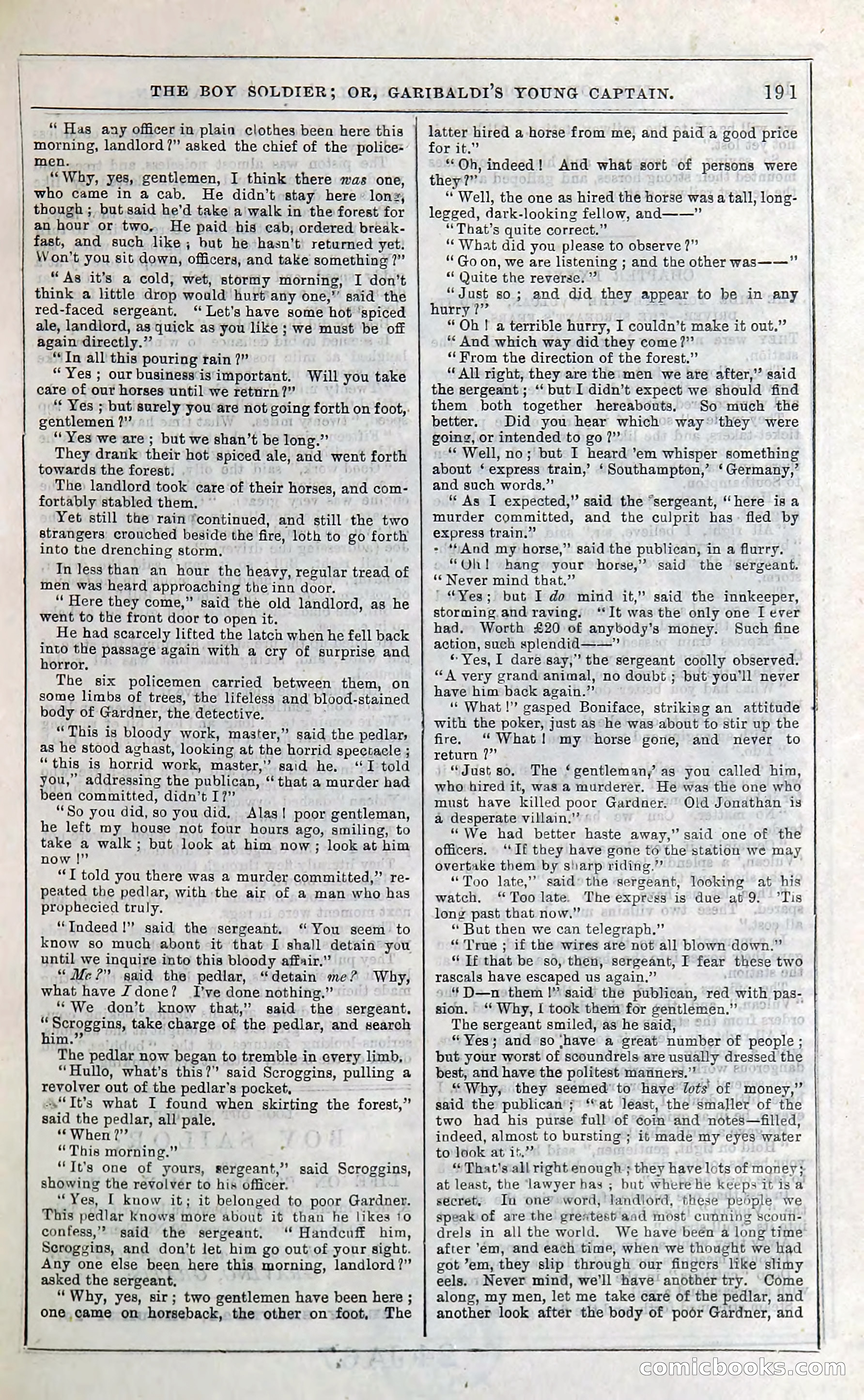
A restored page from Penny Dreadfuls, 1867. Page through the whole issue in the reader above.
📄 Transcribed text from this page (OCR, searchable)
Machine-transcribed from the original scan — historical spelling and the odd misread are preserved.
‘“ Has any officer in plain clothes been here this morning, landlord?” asked the chief of the police= men... bin ““Why, yes, gentlemen, I think there was one, who came in a cab. He didn’t stay here’ lon2, though ; but said he’d take a'walk in the forest for an hour or two, He paid his cab, ordered break- fast, and such like; but he hasn't) returned yet. Won't you sit down, officers, and take something ?” “As it’s a cold, wet, stormy morning, I don’t think a little drop would hurt'any one,’’ said the red-faced sergeant. “ Let's have some hot ‘spiced ale, landlord, as quick as you like ; we must be off again directly.” “Tn all this pouring rain ?” “Yes ; our business‘is important. Will you take care of our horses until we return?” ‘* Yes ; but surely you are not going forth on foot,. gentlemen ?” ‘‘Yes we are; but we shan’t be long.”’ They drank their hot spiced ale, and went forth towards the forest: | | hile The landlord took care of their horses, and com- fortably stabled them. © | Yet still the rain fcontinued, and still the two strangers crouched beside the fire, loth to go forth into the drenching storm, In less than an hour the heavy, regular tread of men was heard approaching the inn door. ‘‘ Here they come,” said the old landlord, as he went to the front door to open it. _ He had scarcely lifted the latch when he fell back into the passage again with a cry of surprise and horror. The six policemen carried between them, on some limbs of trees, the lifeless and blood-stained body of Gardner, the detective. “This is bloody work, master,” said the pedlar, as he stood aghast, looking at the horrid spectacle ; ‘this is horrid work, master,” said he, ‘I told you,” addressing the publican, “that a murder had been committed, didn’t I?” “So you did, so you did. Alas! poor gentleman, he left my house not four hours ago, smiling, to take f: walk ; but look at him now; look at him now |” “TI told you there was a murder committed,” re- peated the pedlar, with the air of a man who has prophecied truly. ‘Indeed !” said the sergeant. “You seem to know so much abont it that I shall detain you until we inquire into this bloody affair.” “Me?” said the pedlar, “detain me? Why, what have Zdone? I’ve done nothing.” ‘“ We don’t know that,” said the sergeant. é Scroggins, take charge of the pedlar, and search im. : The pedlar now began to tremble in every limb, “Hullo, what’s this?” said Scroggins, pulling a revolver out of the pedlar’s pocket, -s“It’s what I found when skirting the forest,” said the pedlar, all’pale, “When ?” “This morning.” ‘It’s one of yours, sergeant,” said Scroggins, showing the revolver to his officer. “Yes, I know it; it belonged to poor Gardner. This pedlar knows more about it than he likes fo confess,’ ‘said the sergeant. ‘“ Handcuff him, Seroggins, and don’t let him go out'of your sight. Any one else been here this morning, landlord?” asked the sergeant, “Why, yes, sir; two gentlemen have been here ; one came on horseback, the other on foot, The THE BOY SOLDIER; OR, GARIBALDI’S YOUNG CAPTAIN. 191 latter hired a horse from me, and paid a good price for it.” ** Oh, indeed ! they?” “Well, the one as hired the horse was a tall, long- legged, dark-looking fellow, and——” “That’s quite correct.” ‘What did you please to observe ?” : “Go on, we are listening ; and the other was——”’ “‘ (QJuite the reverse. ” “Just so; and did they appear to be in any hurry ?” ey oe? “Oh ! a terrible hurry, I couldn’t make it out.” “And which way did they come?” ‘From the direction of the forest.” “All right, they are the men we are after,” said the sergeant; ‘“‘ but I didn’t expect we should find them both together hereabouts, “So mtich the better. Did you hear which way: 'they were going, or intended to go?” “Well, no; but I heard ’em whisper something about ‘express train,’ ‘Southampton,’ ‘Germany,’ and such words.” | ‘As I expected,” said the “sergeant, ‘here isa murder committed, and the culprit has- fled by express train.”’ - ‘And my horse,” said the publican, in a flurry. “Qh! hang your horse,” said the sergeant. ‘“ Never mind that.” ' “Yes; but I do mind it,” said the innkeeper, storming.and raving, ‘It was the only one I ever had. Worth £20 of anybody’s money. Such fine action, such splendid ——” * Yes, I dare say,” the sergeant coolly observed. “A very grand animal, no doubt ; but you'll never have him back again.” ‘“ What!” gasped Boniface, striking an attitude with the poker, just as he was about fo stir up the And what sort of persons were fire. ‘“‘ What! my horse gone, and never to return ?”’ “Just so, The ‘gentleman,’ as you called him, who hired it, was a murderer. He was the one who must have killed poor Gardner. Old Jonathan 1s a desperate villain.” ' “We had better haste away,’’ said one of the officers. “If they have gone to the station we may overtake them by s!iarp riding.” “Too late,’ said’ the sergeant, looking at his watch. “Too late. The express is due at 9. ’Tis long past that now.” “ But then we can telegraph.” “True ; if the wires dre not all blown down.” “ If that be so, then, sergeant, I fear these tw rascals have escaped us again.” ag ‘*‘D—n them |” said’ the publican, red with pas- sion. ‘* Why, I took them for gentlemen.”’ The sergeant smiled, as he said, * Yes; and so -have a great number of people ; but your worst of scoundrels are usually dressed the best, and have the politest matiners.”” ~~ | | “Why, they seemed’ to have Zots' of ‘money,” said the publican’; ‘*at least, the smaller of the two had his purse full of coin and notes—filled, indeed, almost to bursting; it made my eyes water to look at it.” “That's all right enough ; they have lots of money; at least, the ‘lawyer has ; but where he keeps it is a secret. In one’ word, landlord, these people we speak of are the greatest aad most cunning scoun- drels in all the world. We have beén a long time after ’em, and each time, when we thought we had got ’em, they slip through our fingers like slimy eels. Never mind, we'll ‘have’ another try. Come along, my men, let me take care of the pedlar, and another look after the body of podr Gardner, and oO Copmmicloooks.c©