
Penny Dreadfuls, 1867 · page 258 of 390
The Boy Soldier; Or, Garibaldi's Young Captain — page 258: what you’re looking at
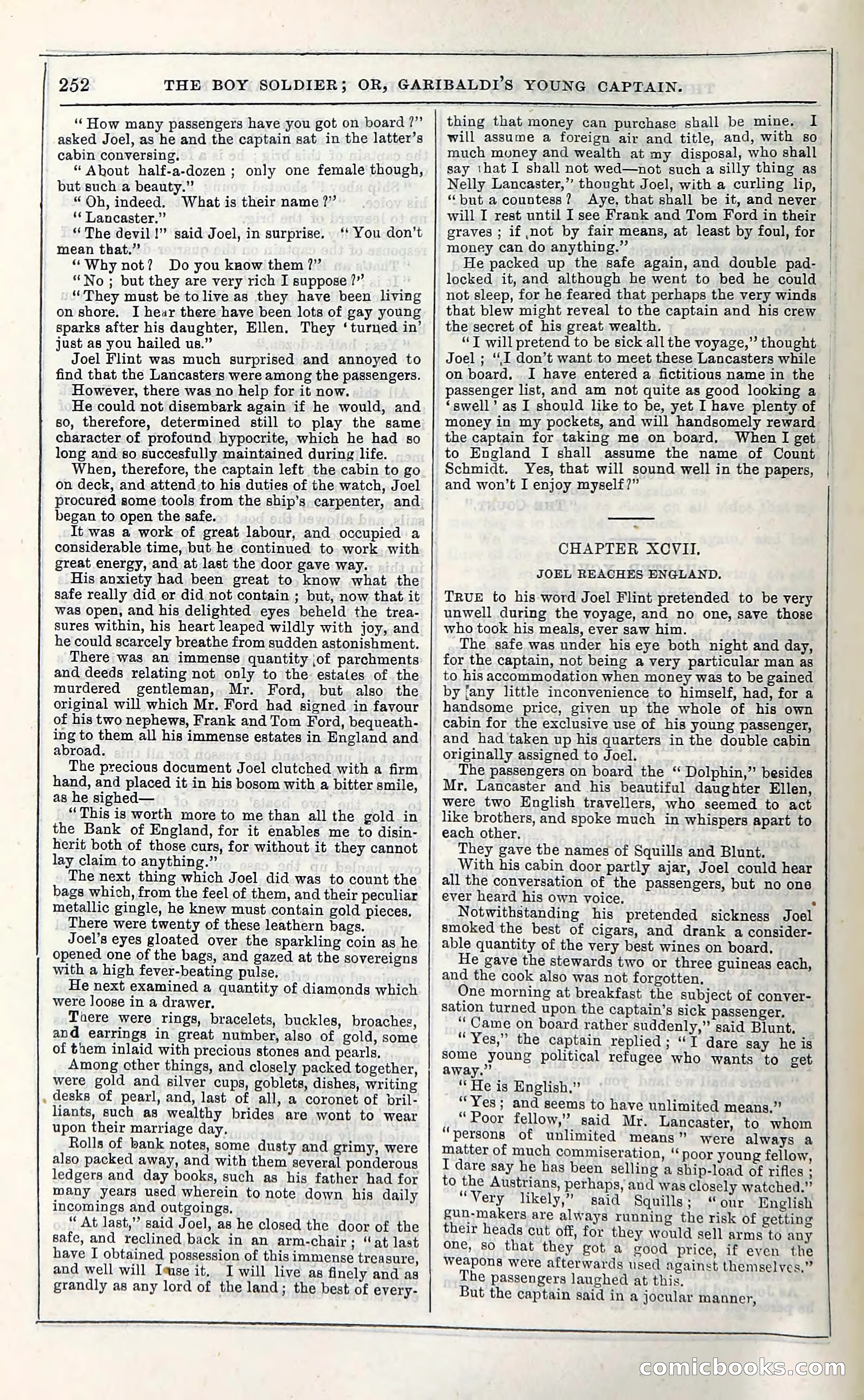
A restored page from Penny Dreadfuls, 1867. Page through the whole issue in the reader above.
📄 Transcribed text from this page (OCR, searchable)
Machine-transcribed from the original scan — historical spelling and the odd misread are preserved.
‘‘How many passengers have you got on board ? asked Joel, as he and the captain sat in the latter’s cabin conversing, “ About half-a-dozen ; only one female though, but such a beauty.”’ “ Oh, indeed. What is their name ?” ‘ Lancaster.” “ The devil!’ said Joel, in surprise, ‘* You don’t mean that.” “Why not? Do you know them ?” “No ; but they are very rich Isuppose?” “They must be tolive as they have been living on shore. I hear there have been lots of gay young sparks after his daughter, Ellen. They ‘turned in’ just as you hailed us.” Joel Flint was much surprised and annoyed to find that the Lancasters were among the passengers. However, there was no help for it now. He could not disembark again if he would, and so, therefore, determined still to play the same character of profound hypocrite, which he had so long and so succesfully maintained during life. When, therefore, the captain left the cabin to go on deck, and attend to his duties of the watch, Joel procured some tools from the ship’s carpenter, and began to open the safe. It was a work of great labour, and occupied a considerable time, but he continued to work with great energy, and at last the door gave way. His anxiety had been great to know what the safe really did or did not contain ; but, now that it was open, and his delighted eyes beheld the trea- sures within, his heart leaped wildly with joy, and he could scarcely breathe from sudden astonishment. There was an immense quantity ;of parchments and deeds relating not only to the estates of the murdered gentleman, Mr. Ford, but also the original will which Mr. Ford had signed in favour of his two nephews, Frank and Tom Ford, bequeath- ing to them all his immense estates in England and abroad. The precious document Joel clutched with a firm hand, and placed it in his bosom with a bitter smile, as he sighed— “This is worth more to me than all the gold in the Bank of England, for it enables me to disin- herit both of those curs, for without it they cannot lay claim to anything.” The next thing which Joel did was to count the bags which, from the feel of them, and their peculiar metallic gingle, he knew must contain gold pieces, There were twenty of these leathern bags. Joel’s eyes gloated over the sparkling coin as he opened one of the bags, and gazed at the sovereigns with a high fever-beating pulse. He next examined a quantity of diamonds which were loose in a drawer, Toaere were rings, bracelets, buckles, broaches, and earrings in great number, also of gold, some of them inlaid with precious stones and pearls, Among cther things, and closely packed together, were gold and silver cups, goblets, dishes, writing desks of pearl, and, last of all, a coronet of bril- liants, such as wealthy brides are wont to wear upon their marriage day. Rolls of bank notes, some dusty and grimy, were also packed away, and with them several ponderous ledgers and day books, such as his father had for many years used wherein to note down his daily incomings and outgoings. At last,” said Joel, as he closed the door of the safe, and reclined back in an arm-chair ; “at last have I obtained possession of this immense treasure, and well will Imse it, I will live as finely and as grandly as any lord of the land; the best of every- THE BOY SOLDIER; OR, GARIBALDI’S YOUNG CAPTAIN. thing that money can purchase shall be mine. I will assume a foreign air and title, and, with so much money and wealth at my disposal, who shall say that I shall not wed—not such a silly thing as Nelly Lancaster,” thought Joel, with a curling lip, “but a countess? Aye, that shall be it, and never will I rest until I see Frank and Tom Ford in their graves ; if not by fair means, at least by foul, for money can do anything.” He packed up the safe again, and double pad- locked it, and although he went to bed he could not sleep, for he feared that perhaps the very winds that blew might reveal to the captain and his crew the secret of his great wealth. “T will pretend to be sick all the voyage,” thought Joel ; “I don’t want to meet these Lancasters while on board, I have entered a fictitious name in the passenger list, and am not quite as good looking a ‘swell’ as I should like to be, yet I have plenty of money in my pockets, and will handsomely reward the captain for taking me on board, When I get to England I shall assume the name of Count Schmidt. Yes, that will sound well in the papers, and won’t I enjoy myself?” - CHAPTER XOVII. JOEL REACHES ENGLAND. TRUE to his word Joel Flint pretended to be very unwell during the voyage, and no one, save those who took his meals, ever saw him. The safe was under his eye both night and day, for the captain, not being a very particular man as to his accommodation when money was to be gained by fany little inconvenience to himself, had, for a handsome price, given up the whole of his own cabin for the exclusive use of his young passenger, and had taken up his quarters in the double cabin originally assigned to Joel. The passengers on board the ‘“ Dolphin,” besides Mr. Lancaster and his beautiful daughter Ellen, were two English travellers, who seemed to act like brothers, and spoke much in whispers apart to each other. They gave the names of Squills and Blunt. With his cabin door partly ajar, Joel could hear all the conversation of the passengers, but no one ever heard his own voice. : Notwithstanding his pretended sickness Joel smoked the best of cigars, and drank a consider- able quantity of the very best wines on board. He gave the stewards two or three guineas each, and the cook also was not forgotten. One morning at breakfast the subject of conver- sation turned upon the captain’s sick passenger, ‘‘ Came on board rather suddenly,” said Blunt, “Yes,” the captain replied; “TI dare say he is some young political refugee who wants to get away.” ‘‘ He is English,” “Yes ; and seems to have unlimited means.” “Poor fellow,” said Mr. Lancaster, to whom ‘persons of unlimited means” were always a matter of much commiseration, ‘ poor young fellow, I dare say he has been selling a ship-load of rifles ; to the Austrians, perhaps, and was closely watched.” “Very likely,” said Squills; “our English gun-makers are always running the risk of getting their heads cut off, for they would sell arms to any one, so that they got a good price, if even the weapons were afterwards used against themselves.” The passengers laughed at this, But the captain said in a jocular manner, aaa } PT GEomicboo C©