
Penny Dreadfuls, 1867 · page 308 of 390
The Boy Soldier; Or, Garibaldi's Young Captain — page 308: what you’re looking at
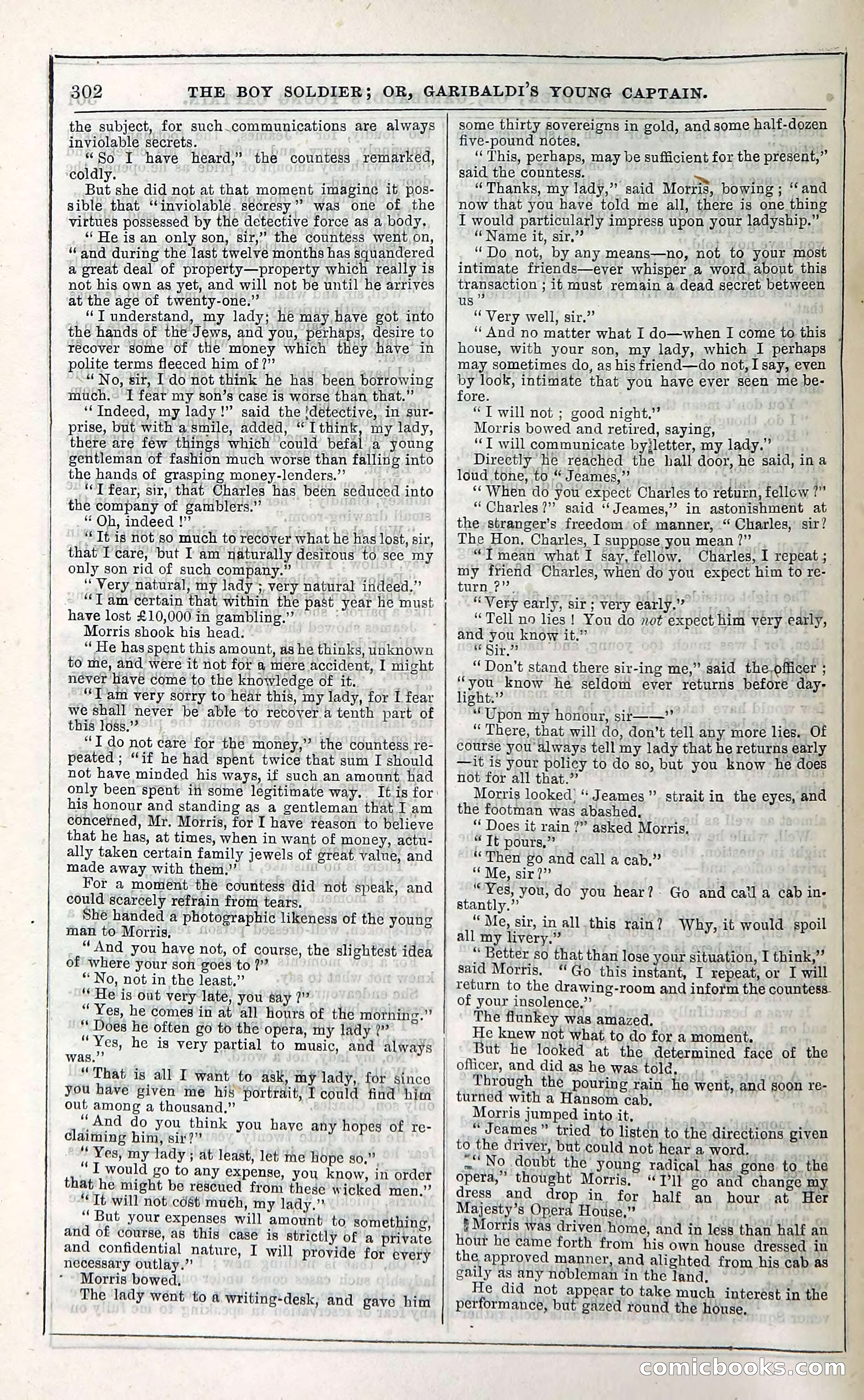
A restored page from Penny Dreadfuls, 1867. Page through the whole issue in the reader above.
📄 Transcribed text from this page (OCR, searchable)
Machine-transcribed from the original scan — historical spelling and the odd misread are preserved.
302 THE BOY SOLDIER; OR, GARIBALDI’S YOUNG CAPTAIN. > the subject, for such_.communications are always inviolable secrets. “So I have heard,” the countess remarked, coldly. But she did not at that moment imagine it pos- sible that ‘inviolable sécresy ” was one of the virtues possessed by the detective force as a body. “He is an only son, sir,” the countess went on, ‘and during the last twelve months has squandered a great deal of property—property which really is not his own as yet, and will not be until he arrives at the age of twenty-one.” ‘T understand, my lady; he may have got into the hands of the J ews, and you, perhaps, desire to recover some of the money which they have in polite terms fleeced him of?” “No, sir, Ido not think he has been borrowing much. I fear my son’s case is worse than that.” ‘Indeed, my lady!” said the ‘detective, in sur- prise, but with a smile, added, “ Ithink, my lady, there are few things which could befal @ young gentleman of fashion much worse than fallin g into the hands of grasping money-lenders.”’ ‘“T fear, sir, that Charles has been seduced into the company of gamblers.” “ Oh, indeed !” ‘Tf is not so much to recover what he has lost, sir, that T'care, but I am naturally desirous to see my only son rid of such company.” ‘‘ Very natural, my lady ; very natural indeed,” ‘““T am certain that within the past year he must have lost £10,000 in gambling.” Morris shook his head. ‘‘ He has spent this amount, as he thinks, unknown to me, and were it not for a mere accident, I might never ‘Have come to the knowledge of it. “Tam very sorry to hear this, my lady, for I fear we shall never be able to recover a tenth part of this loss.” “T do not care for the money,” the countess re- peated ; “if he had spent twice that sum I should not have minded his ways, if such an amount had only been spent in some legitimate way. It is for his honour and standing as a gentleman that I am concerned, Mr. Morris, for I have reason to believe that he has, at times, when in want of money, actu- ally taken certain family jewels of great valne, and made away with them,” For a moment the countess did not speak, and could scarcely refrain from tears. She handed a photographic likeness of the young man to Morris, “And you have not, of course, the slightést idea of where your son goes to ?” “No, not in the least,” “He is out very late, you say ?” “Yes, he comes ‘in at all Hours of the morning. a “ Does he often go to the opera, my lady ?” “Yes, he is very partial to music, and always was,”’ “That is all I want to ask, my lady, for since you have given me his” portrait, I could find him out among a thousand.” “And do you think you haye any hopes of re- claiming him, sir?” ‘Yes, my lady ; at least, let me Hope so,” “TI would go to any expense, you know, in order that he might be rescued from these wicked men.” ‘Tt will not cost much, my lady.” ‘But your expenses will amount to something, and of course, as this case is strictly of a private and confidential nature, I will provide for every necessary outlay.”’ Morris bowed, The lady went ‘to a writing-desk, and gave him some thirty sovereigns in gold, and some half- dozen five-pound notes, ‘“This, perhaps, may be sufficient for the present, g said the ‘countess, “Thanks, my lady,” said Morris, bowing ; “and now that you have told me all, there is one thing I would particularly impress upon your ladyship.” “Name it, sir,” “Do not, by any means—no, not to your most intimate friends—eyer whisper a word. about this transaction ; it must remain a dead secret between us’ ‘Very well, sir.” ‘And no matter what I do—when I come to this house, with your son, my lady, which I perhaps may sometimes do, as his friend—do not, I say, even by look, intimate that you have ever seen me hbe- fore. “T will not ; good night,” Morris bowed and retired, saying, ‘T will communicate byjletter, my lady.” Directly he reached the hall door, he said, ina loud tone, to “ Jeames,” “When do + you expect Charles to return, fellew ?” “Charles?” said ‘‘Jeames,” in astonishment at the stranger’s freedom. of manner, “ Charles,’ sir? The Hon, Charles, I suppose, you mean ?” “T mean what I say, fellow. Charles, I repeat; my friend Charles, when do you expect him to re- turn_?”, rm: “Very early, sir ; very early.” “Tell no lies ! You do not expect him very early, and you know it.” | c Sir. 3 “Don’t stand there sir-ing me,” said the.officer ; ; “you know he seldom ever returns before day- light.” ‘“Upon my honour, sir——”’ ‘‘ There, that will do, don’t tell any more lies. Ot course you always tell my lady that he returns early —it is your policy to do so, but you know he does not for all that.” Morris looked’ “ Jeames”’ strait in the eyes, ‘and the footman was abashed, “‘ Does it rain ?” asked Morris, “Tt pours,” “Then go and call a cab,” “Me, sir?” . Yes, you, do you hear?- Go and caila cabi in stantly.” “ Me, sir, in allthis rain? Why, it would Fil all my livery. ea “ Better so that than lose your situation, I think,” said Morris. “Go this instant, I repeat, or I will return to the drawing-room and inform the countess. of your insolence,” The flunkey was amazed, He knew not what to do for a moment. | But he looked at the determined face of the officer, and did as he was told Through the pouring rain he went, and soon re- turned with a Hansom cab, Morris jumped into it, — “Jeames” tried to listen to the directions given to the driver, but could not hear a word. ““ No doubt the young radical has gone to. the opera,” thought Morris, “Tl go and change my dress and drop in for half an hour at Her Majesty’s Opera House,” § Morris was driven home, and in less than half an hout he came forth from his own house dressed in the approved manner, and alighted from his cab as gaily as any nobleman in the land, He did not appear to take much interest in the performance, but gazed round the house. mm comichoGkercom <SuGOmM