
Penny Dreadfuls, 1867 · page 73 of 390
The Boy Soldier; Or, Garibaldi's Young Captain — page 73: what you’re looking at
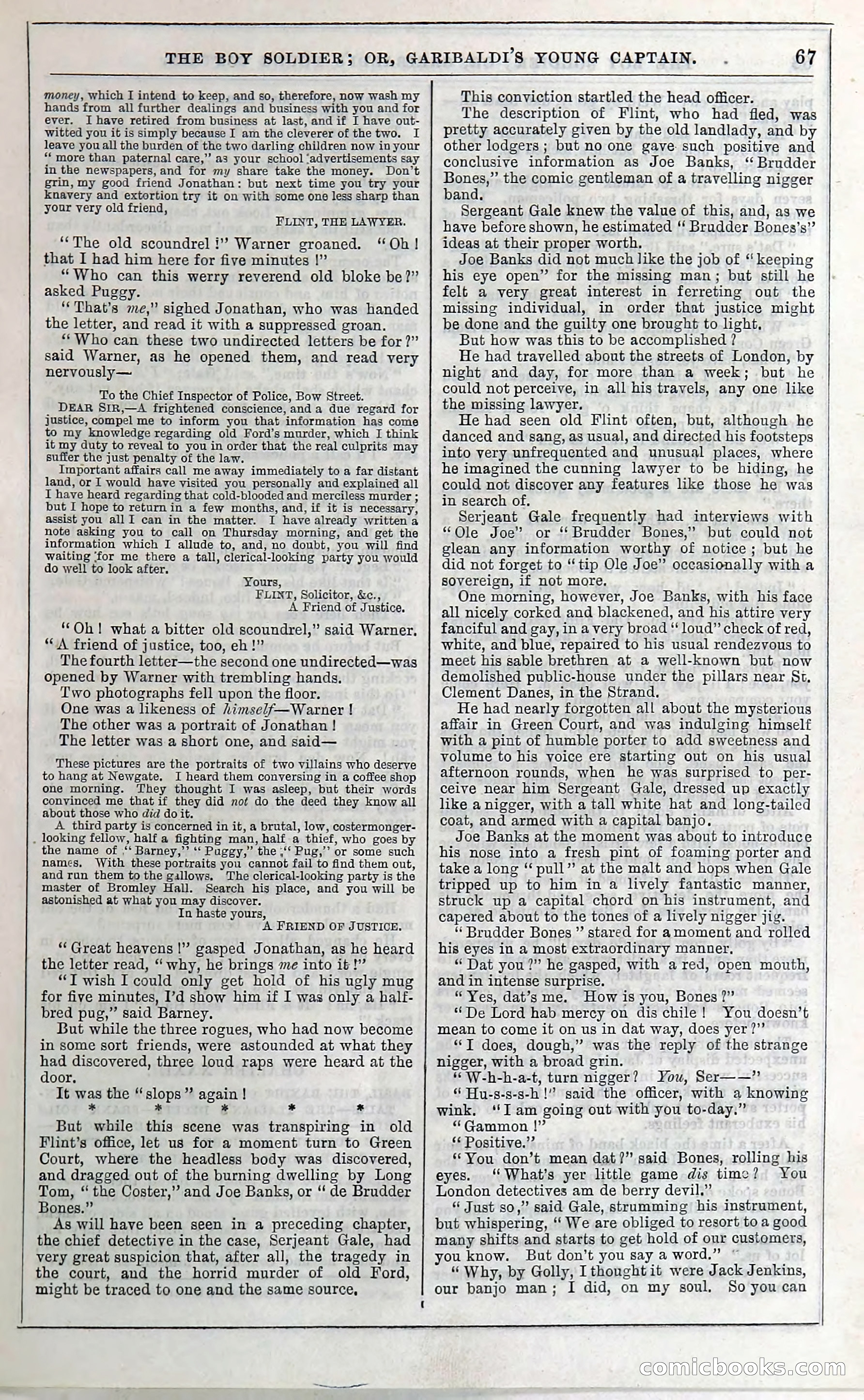
A restored page from Penny Dreadfuls, 1867. Page through the whole issue in the reader above.
📄 Transcribed text from this page (OCR, searchable)
Machine-transcribed from the original scan — historical spelling and the odd misread are preserved.
THE BOY SOLDIER; OR, GARIBALDI'S YOUNG CAPTAIN. 67 money, Which I intend to keep, and so, therefore, now wash my hands from all further dealings and business with you and for ever. Ihave retired from business at last, and if I have out- witted you it is simply because I am the cleverer of the two. I leave you all the burden of the two darling children now in your *‘ more than paternal care,” a3 your school ‘advertisements say in the newspapers, and for my share take the money. Don’t grin, my good friend Jonathan: but next time you try your knavery and extortion try it on with some one less sharp than your very old friend, FLINT, THE LAWYER. ‘‘The old scoundrel !’? Warner groaned. “Oh! that I had him here for five minutes !” ““Who can this werry reverend old bloke be?” asked Puggy. “That's me,” sighed Jonathan, who was handed the letter, and read it with a suppressed groan. “‘Who can these two undirected letters be for?” said Warner, as he opened them, and read very nervously — To the Chief Inspector of Police, Bow Street. _ DEAR SIR,—A frightened conscience, and a due regard for justice, compel me to inform you that information has come to my knowledge regarding old Ford’s murder, which I think it my duty to reveal to you in order that the real culprits may suffer the just penalty of the law. Important affairs call me away immediately to a far distant land, or I would have visited you personally and explained all I have heard regarding that cold-blooded and merciless murder ; but I hope to return in a few months, and, if it is necessary, assist you all I can in the matter. I have already written a note asking you to call on Thursday morning, and get the information which I allude to, and, no doubt, you will find waiting ‘for me there a tall, clerical-looking party you would do well to look after. Yours, FLINT, Solicitor, &c., A Friend of Justice. ‘Oh! what a bitter old scoundrel,” said Warner. “A friend of justice, too, eh !” The fourth letter—the second one undirected—was opened by Warner with trembling hands. Two photographs fell upon the floor. One was a likeness of himself—Warner ! The other was a portrait of Jonathan ! The letter was a short one, and said— These pictures are the portraits of two villains who deserve to hang at Newgate. I heard them conversing in a coffee shop one morning. They thought I was asleep, but their words convinced me that if they did not do the deed they know all about those who did do it. A third party is concerned in it, a brutal, low, costermonger- . looking fellow, half a fighting man, half a thief, who goes by the name of ,“‘ Barney,’’ ‘‘ Puggy,”’ the ,“‘ Pug,’’ or some such names, With these portraits you cannot fail to find them out, and run them to the gallows. The clerical-looking party is the master of Bromley Hall. Search his place, and you will be astonished at what you may discover. In haste yours, A FRIEND OF JUSTICE. *‘ Great heavens |” gasped Jonathan, as he heard the letter read, “ why, he brings me into it!” “T wish I could only get hold of his ugly mug for five minutes, I’d show him if I was only a half- bred pug,” said Barney. But while the three rogues, who had now become in some sort friends, were astounded at what they had discovered, three loud raps were heard at the door. It was the “slops ” again ! * * * * But while this scene was transpiring in old Flint’s office, let us for a moment turn to Green Court, where the headless body was discovered, and dragged out of the burning dwelling by Long Tom, “ the Coster,” and Joe Banks, or ‘‘ de Brudder Bones.” As will have been seen in a preceding chapter, the chief detective in the case, Serjeant Gale, had very great suspicion that, after all, the tragedy in the court, and the horrid murder of old Ford, might be traced to one and the same source, This conviction startled the head officer. The description of Flint, who had fled, was pretty accurately given by the old landlady, and by other lodgers ; but no one gave: such positive and conclusive information as Joe Banks, ‘“ Brudder Bones,” the comic gentleman of a travelling nigger band, Sergeant Gale knew the value of this, and, as we have before shown, he estimated ‘‘ Brudder Bones’s”’ ideas at their proper worth. Joe Banks did not much like the job of ‘“‘ keeping his eye open” for the missing man; but still he felt a very great interest in ferreting out the missing individual, in order that justice might be done and the guilty one brought to light, But how was this to be accomplished ? He had travelled about the streets of London, by night and day, for more than a week; but he could not perceive, in all his travels, any one like the missing lawyer. He had seen old Flint often, but, although he danced and sang, as usual, and directed his footsteps into very unfrequented and unusual places, where he imagined the cunning lawyer to be hiding, he could not discover any features like those he was in search of. Serjeant Gale frequently had interviews with “Ole Joe’ or ‘*Brudder Bones,” but could not glean any information worthy of notice; but he did not forget to “tip Ole Joe” occasionally with a sovereign, if not more. One morning, however, Joe Banks, with his face all nicely corked and blackened, and his attire very fanciful and gay, in a very broad “‘ loud” check of red, white, and blue, repaired to his usual rendezvous to meet his sable brethren at a well-known but now demolished public-house under the pillars near St, Clement Danes, in the Strand. He had nearly forgotten all about the mysterious affair in Green Court, and was indulging himself with a pint of humble porter to add sweetness and volume to his yoice ere starting out on his usual afternoon rounds, when he was surprised to per- ceive near him Sergeant Gale, dressed up exactly like a nigger, with a tall white hat and long-tailed coat, and armed with a capital banjo. Joe Banks at the moment was about to introduce his nose into a fresh pint of foaming porter and take a long “‘ pull” at the malt and hops when Gale tripped up to him in a lively fantastic manner, struck up a capital chord on his instrument, and capered about to the tones of a lively nigger jig. ‘“‘Brudder Bones ” stared for amoment and rolled his eyes in a most extraordinary manner, “Dat you ?” he gasped, with a red, open mouth, and in intense surprise. “Yes, dat’s me. How is you, Bones ?” “De Lord hab mercy on dis chile! You doesn’t mean to come it on us in dat way, does yer?” ““T does, dough,” was the reply of the strange nigger, with a broad grin. ‘“W-h-h-a-t, turn nigger? You, Ser——” “ Hu-s-s-s-h |!” said the officer, with a knowing wink, ‘‘I am going out with you to-day.” “Gammon !” ‘* Positive.”’ “You don’t mean dat?” said Bones, rolling his eyes. ‘“What’s yer little game dis time? You London detectives am de berry devil.” * Just so,” said Gale, strumming his instrument, but whispering, ‘‘ We are obliged to resort to a good many shifts and starts to get hold of our customers, you know. But don’t you say a word.” “ Why, by Golly, I thought it were Jack Jenkins, our banjo man; I did, on my soul. So you can EE MICLOOKS.€O (©