
Penny Dreadfuls, 1868 · page 45 of 98
The Frozen Crew Of The Ice-Bound Ship; Or, Terrors Of The Arctic Region — page 45: what you’re looking at
A restored page from Penny Dreadfuls, 1868. Page through the whole issue in the reader above.
📄 Transcribed text from this page (OCR, searchable)
Machine-transcribed from the original scan — historical spelling and the odd misread are preserved.
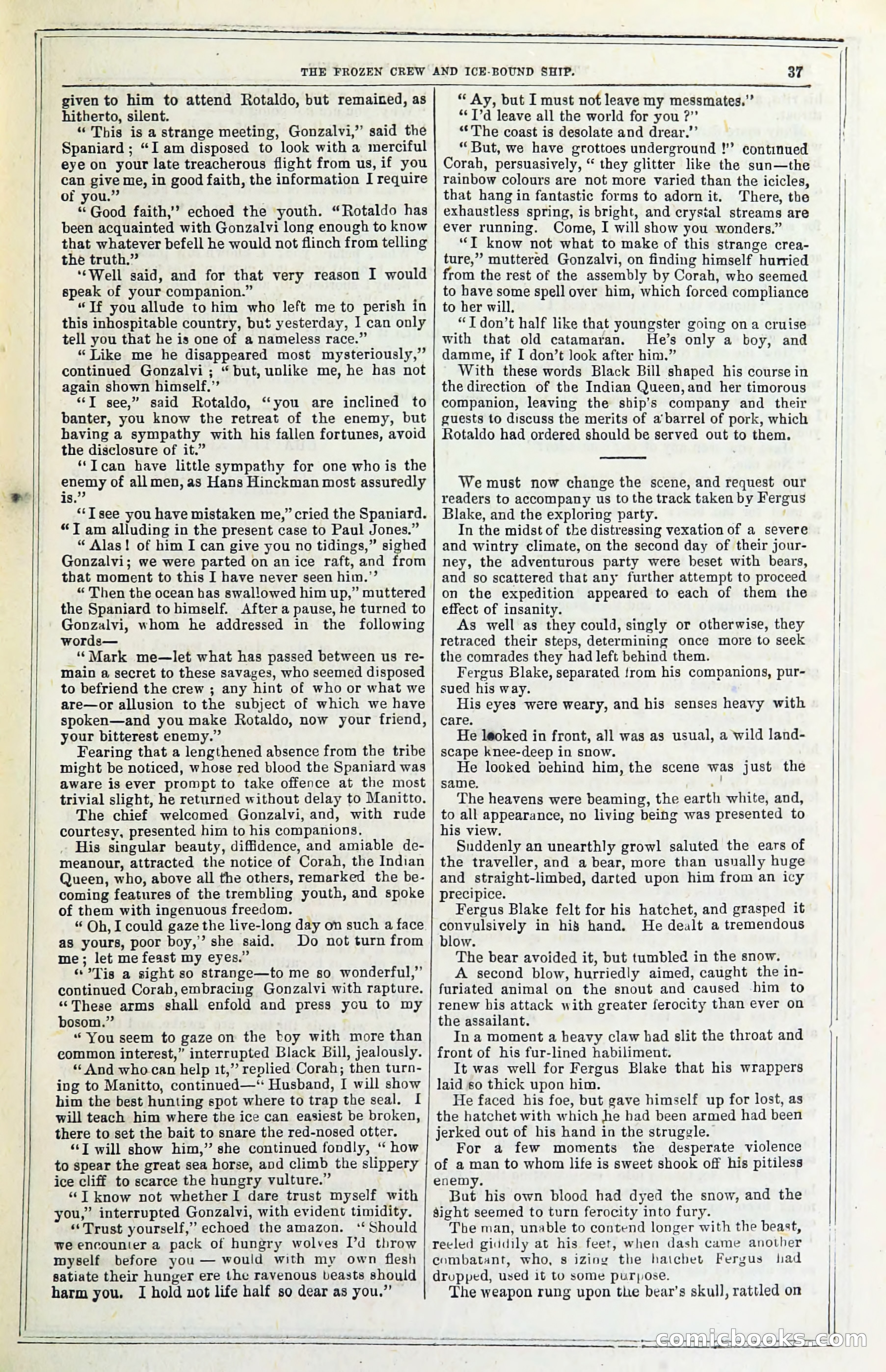
eS es THE FROZEN CREW AND ICE-BOUND SHIP. 37 given to him to attend Rotaldo, but remained, as hitherto, silent. “This is a strange meeting, Gonzalvi,’’ said the Spaniard ; “I am disposed to look with a merciful eye on your late treacherous flight from us, if you can give me, in good faith, the information I require of you.” “Good faith,’ echoed the youth. “Rotaldo has been acquainted with Gonzalvi long enough to know that whatever befell he would not flinch from telling the truth.” ‘‘Well said, and for that very reason I would speak of your companion.” “Tf you allude to him who left me to perish in this inhospitable country, but yesterday, I can only tell you that he is one of a nameless race.” “Like me he disappeared most mysteriously,” continued Gonzalvi ; “but, unlike me, he has not again shown himself.” “T see,” said Rotaldo, “you are inclined to banter, you know the retreat of the enemy, but having a sympathy with his fallen fortunes, avoid the disclosure of it.” *‘Tcan have little sympathy for one who is the enemy of all men, as Hans Hinckman most assuredly is. ‘‘Tsee you have mistaken me,” cried the Spaniard. “JT am alluding in the present case to Paul Jones.” “ Alas! of him I can give you no tidings,” sighed Gonzalvi; we were parted on an ice raft, and from that moment to this I have never seen him.” “ Then the ocean has swallowed him up,” muttered the Spaniard to himself. After a pause, he turned to Gonzalvi, whom he addressed in the following words— _“*Mark me—let what has passed between us re- main a secret to these savages, who seemed disposed to befriend the crew ; any hint of who or what we are—or allusion to the subject of which we have spoken—and you make Rotaldo, now your friend, your bitterest enemy.” Fearing that a lengthened absence from the tribe might be noticed, whose red blood the Spaniard was aware is ever prompt to take offence at the most trivial slight, he returned without delay to Manitto. The chief welcomed Gonzalvi, and, with rude courtesy, presented him to his companions, _ His singular beauty, diffidence, and amiable de- meanour, attracted the notice of Corah, the Indian Queen, who, above all the others, remarked the be- coming features of the trembling youth, and spoke of them with ingenuous freedom. “Oh, I could gaze the live-long day on such a face as yours, poor boy,’ she said. Do not turn from me; let me feast my eyes.” “Tis a sight so strange—to me so wonderful,” continued Corab,embraciug Gonzalvi with rapture. “These arms shall enfold and press you to my bosom.” “You seem to gaze on the toy with more than common interest,” interrupted Black Bill, jealously. “And whocan help it,” replied Corah; then turn- ing to Manitto, continued—‘“: Husband, I will show him the best hunting spot where to trap the seal. I will teach him where the ice can easiest be broken, there to set the bait to snare the red-nosed otter. “‘T will show him,’ she continued fondly, ‘ how to spear the great sea horse, and climb the slippery ice cliff to scarce the hungry vulture.” “J know not whetherI dare trust myself with you,” interrupted Gonzalvi, with evident timidity. “Trust yourself,” echoed the amazon. ‘‘ Should we encounter a pack of hungry wolves I’d throw myself before you — would with my own flesh satiate their hunger ere the ravenous beasts should harm you. I hold not life half so dear as you.’’ “ Ay, but I must not leave my messmates.”’ **T’d leave all the world for you ?”’ “The coast is desolate and drear.’’ “But, we have grottoes underground !” continued Corah, persuasively, “ they glitter like the sun—the rainbow colours are not more varied than the icicles, that hang in fantastic forms to adorn it. There, the exhaustless spring, is bright, and crystal streams are ever running. Come, I will show you wonders.” “I know not what to make of this strange crea- ture,” muttered Gonzalvi, on finding himself hurried from the rest of the assembly by Corah, who seemed to have some spell over him, which forced compliance to her will. “T don’t half like that youngster going ona cruise with that old catamaran. He’s only a boy, and damme, if I don’t look after him.” With these words Black Bill shaped his course in the direction of the Indian Queen, and her timorous companion, leaving the sbhip’s company and their guests to discuss the merits of a’barrel of pork, which Rotaldo had ordered should be served out to them. We must now change the scene, and request our readers to accompany us to the track taken by Fergus Blake, and the exploring party. ; In the midst of the distressing vexation of a severe and wintry climate, on the second day of their jour- ney, the adventurous party were beset with bears, and so scattered that any further attempt to proceed on the expedition appeared to each of them the effect of insanity. As well as they could, singly or otherwise, they retraced their steps, determining once more to seek the comrades they had left behind them. Fergus Blake, separated from his companions, pur- sued his way. His eyes were weary, and his senses heavy with care. He leoked in front, all was as usual, a wild land- scape knee-deep in snow. He looked pehind him, the scene was just the same. at The heavens were beaming, the earth white, and, to all appearance, no living being was presented to his view. Suddenly an unearthly growl saluted the ears of the traveller, and a bear, more than usually huge and straight-limbed, darted upon him from an icy precipice. Fergus Blake felt for his hatchet, and grasped it convulsively in his hand. He dealt a tremendous blow. The bear avoided it, but tumbled in the snow. A second blow, hurriedly aimed, caught the in- furiated animal on the snout and caused -him to renew his attack with greater ferocity than ever on the assailant. In a moment a heavy claw had slit the throat and front of his fur-lined habiliment. It was well for Fergus Blake that his wrappers laid so thick upon him. He faced his foe, but gave himself up for lost, as the hatchet with which he had been armed had been jerked out of his hand in the struggle. For a few moments the desperate violence of a man to whom life is sweet shook off his pitiless enemy. But his own blood had dyed the snow, and the sight seemed to turn ferocity into fury. The man, unable to contend longer with the beast, reeled giddily at his feet, when dash came another combatant, who, s izing the hatchet Fergus had dropped, used it to some purpose. The weapon rung upon the bear’s skull, rattled on