
Penny Dreadfuls, 1867 · page 107 of 196
The Skeleton Crew; Or, Wildfire Ned — page 107: what you’re looking at
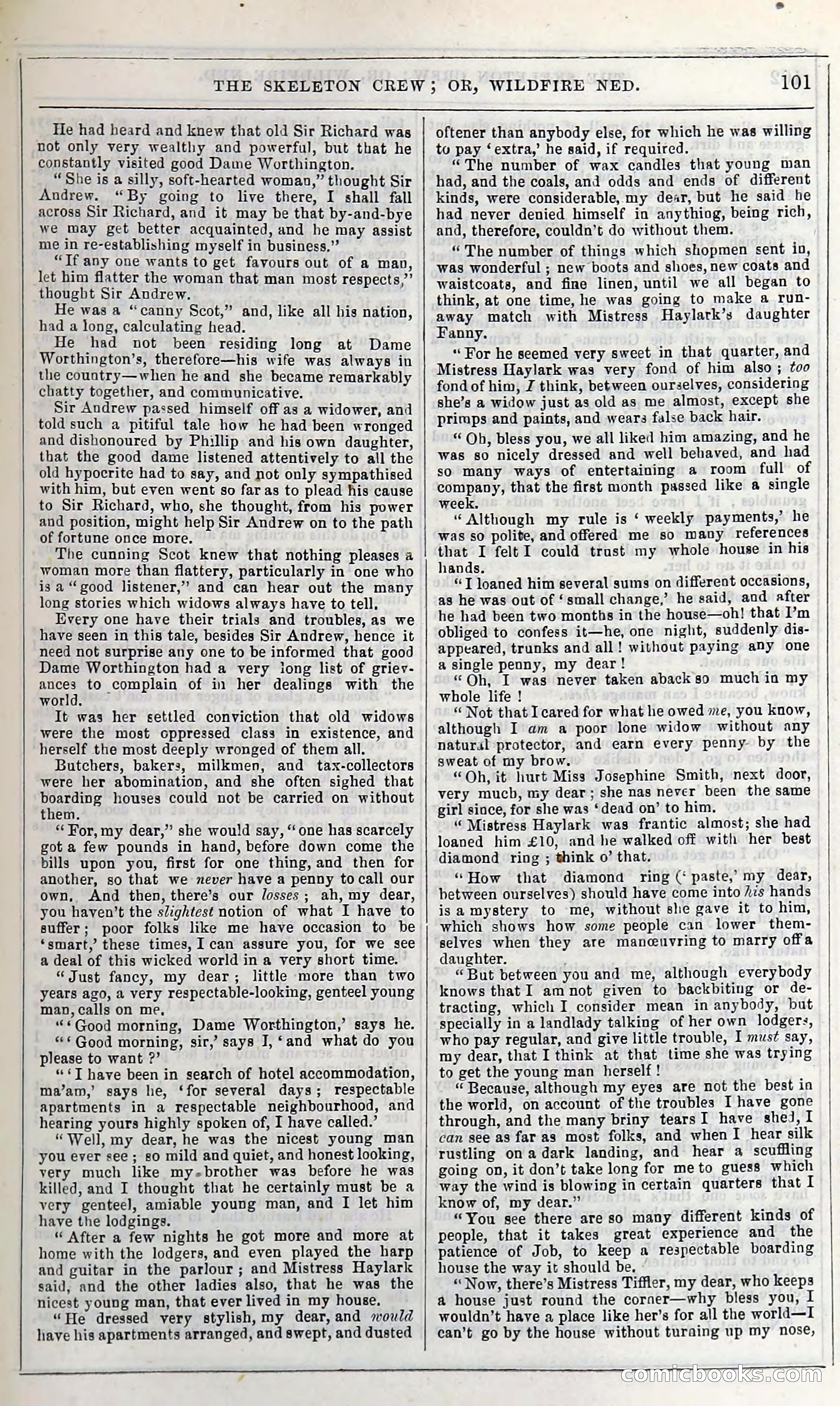
A restored page from Penny Dreadfuls, 1867. Page through the whole issue in the reader above.
📄 Transcribed text from this page (OCR, searchable)
Machine-transcribed from the original scan — historical spelling and the odd misread are preserved.
THE SKELETON CREW; OR, WILDFIRE NED. 101 He had heard and knew that old Sir Richard was not only very wealthy and powerful, but that he constantly visited good Dame Worthington. “She is a silly, soft-hearted woman,” thought Sir Andrew. “By going to live there, I shall fall across Sir Richard, and it may be that by-and-bye we may get better acquainted, and he may assist me in re-establishing myself in business,” “Tf any one wants to get favours out of a man, let him flatter the woman that man most respects,’’ thought Sir Andrew. He was a “canny Scot,” and, like all his nation, had a long, calculating head. He had not been residing long at Dame Worthington’s, therefore—his wife was always in the country—when he and she became remarkably chatty together, and communicative. Sir Andrew passed himself off as a widower, and told such a pitiful tale how he had been wronged and dishonoured by Phillip and his own daughter, that the good dame listened attentively to all the old hypocrite had to say, and not only sympathised with him, but even went so far as to plead his cause to Sir Richard, who, she thought, from his power and position, might help Sir Andrew on to the path of fortune once more. The cunning Scot knew that nothing pleases a woman more than flattery, particularly in one who is a “good listener,” and can hear out the many long stories which widows always have to tell, Every one have their trials and troubles, as we have seen in this tale, besides Sir Andrew, hence it need not surprise any one to be informed that good Dame Worthington had a very iong list of griev- ances to complain of in her dealings with the world. It was her settled conviction that old widows were the most oppressed class in existence, and herself the most deeply wronged of them all. Butchers, bakers, milkmen, and tax-collectors were her abomination, and she often sighed that boarding houses could not be carried on without them. “For, my dear,” she would say, “one has scarcely got a few pounds in hand, before down come the bills upon you, first for one thing, and then for another, so that we never have a penny tocall our own, And then, there’s our losses; ah, my dear, you haven’t the slightest notion of what I have to suffer; poor folks like me have occasion to be ‘smart,’ these times, I can assure you, for we see a deal of this wicked world in a very short time. “Just fancy, my dear; little more than two years ago, a very respectable-looking, genteel young man, calls on me, “¢Good morning, Dame Worthington,’ says he. “Good morning, sir,’ says I, ‘and what do you please to want ?’ “*T have been in search of hotel accommodation, ma’am,’ says he, ‘for several days; respectable apartments in a respectable neighbourhood, and hearing yours highly spoken of, I have called.’ “Well, my dear, he was the nicest young man you ever see; so mild and quiet, and honest looking, very much like my-brother was before he was killed, and I thought that he certainly must be a very genteel, amiable young man, and [I let him have the lodgings. “ After a few nights he got more and more at home with the lodgers, and even played the harp and guitar in the parlour; and Mistress Haylark said, and the other ladies also, that he was the nicest young man, that ever lived in my house. “Fe dressed very stylish,my dear, and mould have his apartments arranged, and swept, and dusted SS oftener than anybody else, for which he was willing to pay ‘extra,’ he said, if required. “The number of wax candles that young man had, and the coals, and odds and ends of different kinds, were considerable, my dear, but he said he had never denied himself in anythiog, being rich, and, therefore, couldn’t do without them. “The number of things which shopmen sent in, was wonderful ; new boots and shoes, new coats and waistcoats, and fine linen, until we all began to think, at one time, he was going to make a run- away match with Mistress Haylark’s daughter Fanny. “For he seemed very sweet in that quarter, and Mistress Haylark was very fond of him also; too fond of him, J think, between ourselves, considering she’s a widow just as old as me almost, except she primps and paints, and wears false back hair. “ Oh, bless you, we all liked him amazing, and he was so nicely dressed and well behaved, and had so many ways of entertaining a room full of company, that the first month passed like a single week. “ Although my rule is ‘ weekly payments,’ he was so polite, and offered me so many references that I felt I could trast my whole house in his hands. ; “JT Joaned him several sums on different occasions, as he was out of ‘small change,’ he said, and after he had been two months in the house—oh! that I’m obliged to confess it—he, one night, suddenly dis- appeared, trunks and all! without paying any one a single penny, my dear! “Oh, I was never taken aback so much in my whole life ! « Not that Icared for what he owed me, you know, although I am a poor lone widow without any natural protector, and earn every penny- by the sweat of my brow. “Oh, it hurt Miss Josephine Smith, next door, very much, my dear; she nas never been the same girl since, for she was ‘dead on’ to him. “ Mistress Haylark was frantic almost; she had loaned him £10, and he walked off with her best diamond ring ; think o’ that. “How that diamond ring (‘ paste,’ my dear, between ourselves) should have come into /zs hands isa mystery to me, without she gave it to him, which shows how some people can lower them- selves when they are manceuvring to marry offa daughter. “But between you and me, although everybody knows that I amnot given to backbiting or de- tracting, which I consider mean in anybody, but specially in a landlady talking of her own lodgers, who pay regular, and give little trouble, I mus? say, my dear, that I think at that time she was trying to get the young man herself! “ Because, although my eyes are not the best in the world, on account of the troubles I have gone through, and the many briny tears I have shed, I can see as far as most folks, and whenI hear silk rustling ona dark landing, and hear a scuffling going on, it don’t take long for meto guess which way the wind is blowing in certain quarters that I know of, my dear.” ; “You see there are so many different kinds of people, that it takes great experience and the patience of Job, to keep a respectable boarding house the way it should be. “Now, there’s Mistress Tiffler, my dear, who keeps a house just round the corner—why bless you, I wouldn’t have a place like her’s for all the world—I can’t go by the house without turaing up my nose, SOMUUGDOOKSEGOM