
Penny Dreadfuls, 1867 · page 114 of 196
The Skeleton Crew; Or, Wildfire Ned — page 114: what you’re looking at
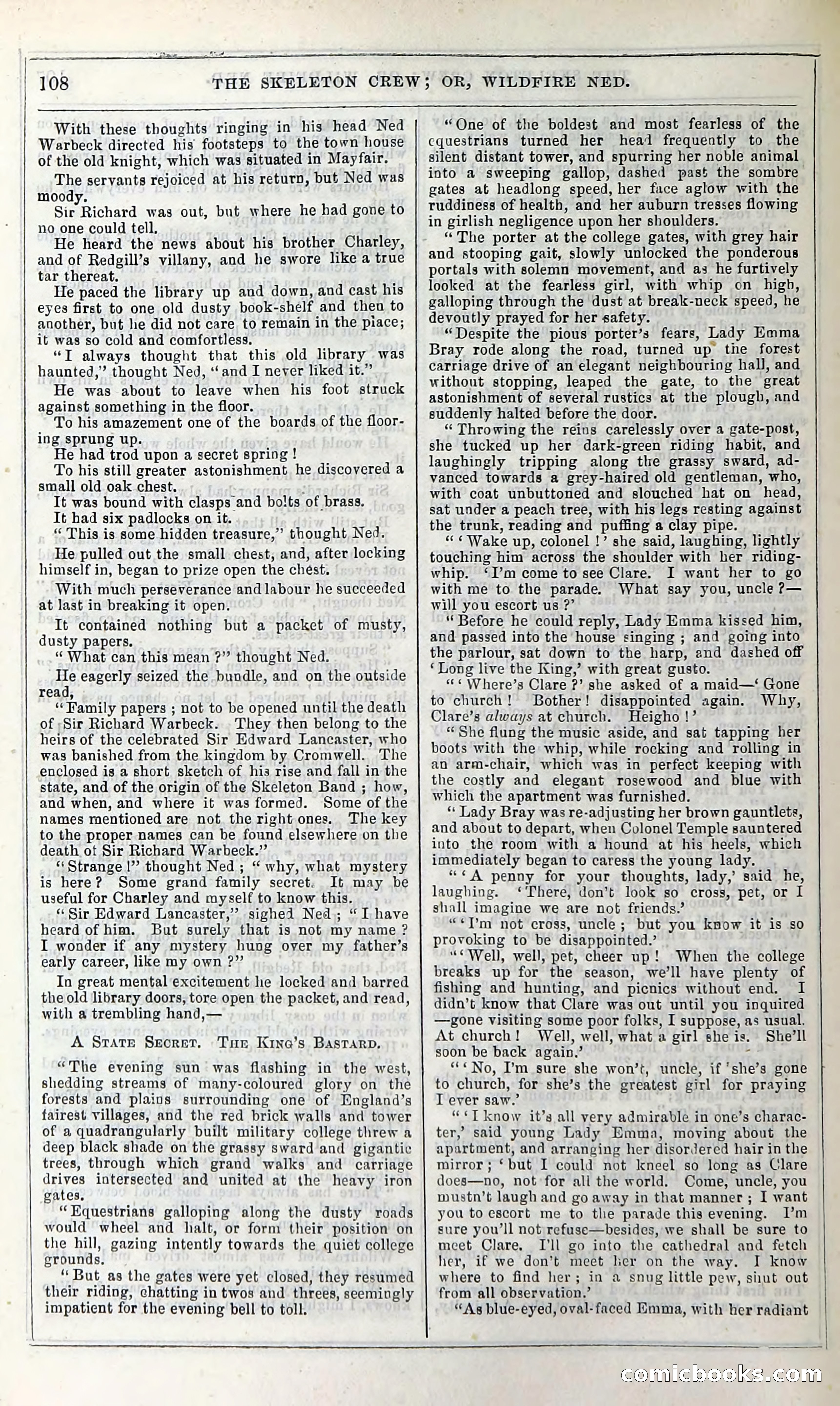
A restored page from Penny Dreadfuls, 1867. Page through the whole issue in the reader above.
📄 Transcribed text from this page (OCR, searchable)
Machine-transcribed from the original scan — historical spelling and the odd misread are preserved.
| 108 THE SKELETON CREW; OR, WILDFIRE NED. $< $$ With these thoughts ringing in his head Ned Warbeck directed his footsteps to the town house of the old knight, which was situated in Mayfair. The servants rejoiced at his return, but Ned was moody. Sir Richard was out, but where he had gone to no one could tell. He heard the news about his brother Charley, and of Redgill’s villany, and he swore like a true tar thereat. He paced the library up and down, and cast his eyes first to one old dusty book-shelf and then to another, but he did not care to remain in the piace; it was so cold and comfortless. “T always thought that this old library was haunted,” thought Ned, ‘‘and I never liked it.” He was about to leave when his foot struck against something in the floor. To his amazement one of the boards of the floor- ing sprung up. He had trod upon a secret spring ! To his still greater astonishment he discovered a small old oak chest. It was bound with clasps and bolts of brass. It had six padlocks on it. “ This is some hidden treasure,” thought Ned. He pulled out the small chest, and, after locking himself in, began to prize open the chest. With much perseverance and labour he succeeded at last in breaking it open. It contained nothing but a packet of musty, dusty papers. “ What can this mean ?” thought Ned. He eagerly seized the bundle, and on the outside read, ‘Family papers ; not to be opened until the death of Sir Richard Warbeck. They then belong to the heirs of the celebrated Sir Edward Lancaster, who was banished from the kingdom by Cromwell. The enclosed is a short sketch of his rise and fall in the state, and of the origin of the Skeleton Band ; how, and when, and where it was formed. Some of the names mentioned are not the right ones. The key to the proper names can be found elsewhere on the death of Sir Richard Warbeck.” “Strange |!” thought Ned; “ why, what mystery is here? Some grand family secret. It may be useful for Charley and myself to know this. ‘Sir Edward Lancaster,” sighed Ned; “Ihave heard of him. But surely that is not my name ? I wonder if any mystery hung over my father’s early career, like my own ?” In great mental excitement he locked and barred the old library doors, tore open the packet, and read, with a trembling hand,— A State Secret. Tur Kine’s Bastarp. “The evening sun was flashing in the west, shedding streams of many-coloured glory on the forests and plains surrounding one of England’s fairest villages, and the red brick walls and tower of a quadrangularly built military college threw a deep black shade on the grassy sward and gigantic trees, through which grand walks and carriage drives intersected and united at the heavy iron gates, “Equestrians galloping along the dusty roads would wheel and halt, or form their position on the hill, gazing intently towards the quiet college grounds. ‘But as the gates were yet closed, they resumed their riding, chatting in twos and threes, seemingly impatient for the evening bell to toll. “One of the boldest and most fearless of the cquestrians turned her head frequently to the silent distant tower, and spurring her noble animal into a sweeping gallop, dashed past the sombre gates at headlong speed, her face aglow with the ruddiness of health, and her auburn tresses flowing in girlish negligence upon her shoulders. “The porter at the college gates, with grey hair and stooping gait, slowly unlocked the ponderous portals with solemn movement, and as he furtively looked at the fearless girl, with whip on higb, galloping through the dust at break-neck speed, he devoutly prayed for her safety. “Despite the pious porter’s fears, Lady Emma Bray rode along the road, turned up the forest carriage drive of an elegant neighbouring hall, and without stopping, leaped the gate, to the great astonishment of several rustics at the plough, and suddenly halted before the door. “ Throwing the reius carelessly over a gate-post, she tucked up her dark-green riding habit, and laughingly tripping along the grassy sward, ad- vanced towards a grey-haired old gentleman, who, with coat unbuttoned and slouched hat on head, sat under a peach tree, with his legs resting against the trunk, reading and puffing a clay pipe. “¢ Wake up, colonel !’ she said, laughing, lightly touching him across the shoulder with her riding- whip. ‘I’m come to see Clare. I want her to go with me to the parade. What say you, uncle ?— will you escort us ?’ . ‘Before he could reply, Lady Emma kissed him, and passed into the house singing ; and going into the parlour, sat down to the harp, and dashed off ‘Long live the King,’ with great gusto. “‘« Where’s Clare ?’ she asked of a maid—‘ Gone to church! Bother! disappointed again. Why, Clare’s always at church. Heigho !’ “She flung the music aside, and sat tapping her boots with the whip, while rocking and rolling in an arm-chair, which was in perfect keeping with the costly and elegant rosewood and blue with which the apartment was furnished. “ Lady Bray was re-adjusting her brown gauntlets, and about to depart, when Colonel Temple sauntered into the room with a hound at his heels, which immediately began to caress the young lady. “¢A penny for your thoughts, lady,’ said he, laughing. ‘There, don’t look so cross, pet, or I shall imagine we are not friends.’ “*T’m not cross, uncle; but you know it is so provoking to be disappointed.’ “Well, well, pet, cheer up! When the college breaks up for the season, we'll have plenty of fishing and hunting, and picnics without end. I didn’t know that Clare was out until you inquired —gone visiting some poor folks, I suppose, as usual. At church! Well, well, what a girl she is. She'll soon be back again.’ 2 *** No, I’m sure she won’t, uncle, if ‘she’s gone to church, for she’s the greatest girl for praying I ever saw.’ “*T know it’s all very admirable in one’s charac- ter,’ said young Lady Emma, moving about the apartment, and arranging her disordered hair in the mirror; ‘but I could not kneel so Jong as Clare does—no, not for all the world. Come, uncle, you mustn’t laugh and go away in that manner; I want you to escort me to the parade this evening. I’m sure you'll not refuse—besides, we shall be sure to meet Clare. I'll go into the cathedral and fetch her, if we don’t meet her on the way. I know where to find her; in a snug little pew, shut out from all observation.’ “Ag blue-eyed, oval-faced Emma, with her radiant -— (E(0) micboo SH (E(0) nn