
Penny Dreadfuls, 1867 · page 13 of 196
The Skeleton Crew; Or, Wildfire Ned — page 13: what you’re looking at
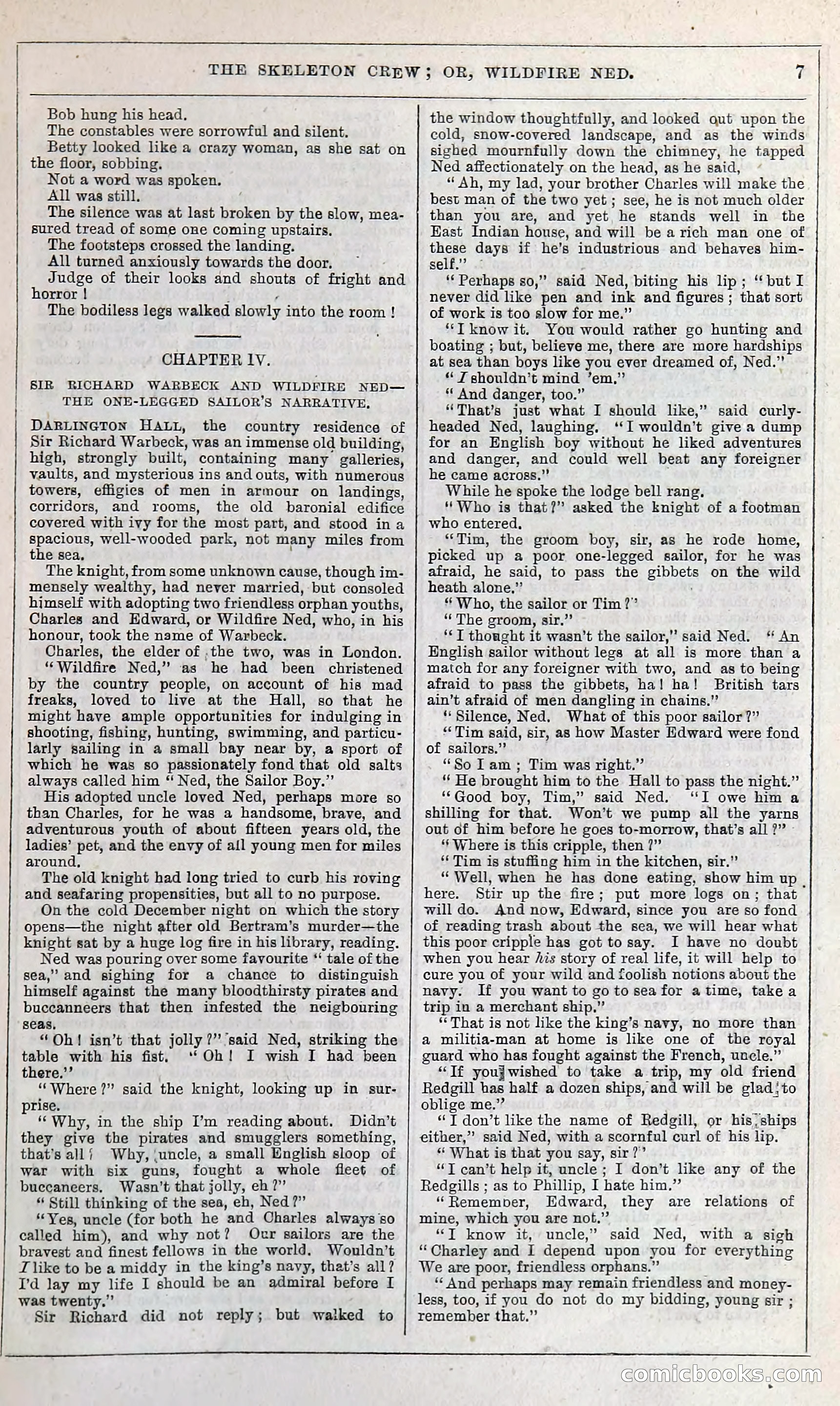
A restored page from Penny Dreadfuls, 1867. Page through the whole issue in the reader above.
📄 Transcribed text from this page (OCR, searchable)
Machine-transcribed from the original scan — historical spelling and the odd misread are preserved.
THE SKELETON CREW; OR, WILDFIRE NED. ~ ( a ee ee ee Bob hung his head. The constables were sorrowful and silent. Betty looked like a crazy woman, as she sat on the floor, sobbing. Not a word was spoken. All was still. é The silence was at last broken by the slow, mea- sured tread of some one coming upstairs. The footsteps crossed the landing. All turned anxiously towards the door. Judge of their looks and shouts of fright and horror | / ; The bodiless legs walked slowly into the room! CHAPTER LV. SIR RICHARD WARBECK AND WILDFIRE NED— THE ONE-LEGGED SAILOR’S NARRATIVE, DARLINGTON HALL, the country residence of Sir Richard Warbeck, was an immense old building, high, strongly built, containing many galleries, vaults, and mysterious ins and outs, with numerous towers, effigies of men in armour on landings, corridors, and rooms, the old baronial edifice covered with ivy for the most part, and stood ina spacious, well-wooded park, not many miles from the sea, The knight, from some unknown cause, though im- mensely wealthy, had never married, but consoled himself with adopting two friendless orphan youths, Charles and Edward, or Wildfire Ned, who, in his honour, took the name of Warbeck. Charles, the elder of .the two, was in London. ““Wildfire Ned,” as he had been christened by the country people, on account of his mad freaks, loved to live at the Hall, so that he might have ample opportunities for indulging in shooting, fishing, hunting, swimming, and particu- larly sailing in a small bay near by, a sport of which he was so passionately fond that old salts always called him “ Ned, the Sailor Boy.’’ His adopted uncle loved Ned, perhaps more so than Charles, for he was a handsome, brave, and adventurous youth of about fifteen years old, the ladies’ pet, and the envy of all young men for miles around, The old knight had long tried to curb his roving and seafaring propensities, but all to no purpose. On the cold December night on which the story opens—the night after old Bertram’s murder—the knicht sat by a huge log fire in his library, reading. Ned was pouring over some fayourite *‘ tale of the sea,’ and sighing for a chance to distinguish himself against the many bloodthirsty pirates and buccanneers that then infested the neigbouring seas, “Oh! isn’t that jolly?” said Ned, striking the table with his fist, ‘‘Oh! I wish I had been there.”’ “Where ?” said the knight, looking up in sur- prise. ‘Why, in the ship I’m reading about. Didn’t they give the pirates and smugglers something, that’s alli Why, .uncle, a small English sloop of war with six guns, fought a whole fleet of buccaneers. Wasn’t that jolly, eh?” “ Still thinking of the sea, eh, Ned ?” “Yes, uncle (for both he and Charles always‘so called him), and why not? Our sailors are the bravest and finest fellows in the world. Wouldn’t T like to be a middy in the king’s navy, that’s all? I’d lay my life I should be an admiral before I was twenty.” Sir Richard did not reply; but waiked to the window thoughtfully, and looked out upon the cold, snow-covered landscape, and as the winds sighed mournfully down the chimney, he tapped Ned affectionately on the head, as he said, “Ah, my lad, your brother Charles will make the best man of the two yet; see, he is not much older than you are, and yet he stands well in the East Indian house, and will be a rich man one of these days if he’s industrious and behaves him- self.” ‘Perhaps so,” said Ned, biting his lip; ‘but I never did like pen and ink and figures ; that sort of work is too slow for me.” ““T know it. You would rather go hunting and boating ; but, believe me, there are more hardships at sea than boys like you ever dreamed of, Ned.”’ *“ T shouldn’t mind ’em,” * And danger, too.” “That’s just what I should like,” said curly- headed Ned, laughing, ‘‘I wouldn’t give a dump for an English boy without he liked adventures and danger, and could well beat any foreigner he came across.”’ While he spoke the lodge bell rang, ‘Who is that?” asked the knight of a footman who entered. “Tim, the groom boy, sir, as he rode home, picked up a poor one-legged sailor, for he was afraid, he said, to pass the gibbets on the wild heath alone,”’ “Who, the sailor or Tim?” “The groom, sir.”’ ‘<1 thought it wasn’t the sailor,” said Ned. ‘ An English sailor without legs at all is more than a match for any foreigner with two, and as to being afraid to pass the gibbets, ha! ha! British tars ain’t afraid of men dangling in chains.” ** Silence, Ned, What of this poor sailor?” “Tim said, sir, as how Master Edward were fond of sailors.” “So Lam; Tim was right.” “He brought him to the Hall to pass the night.” ‘Good boy, Tim,” said Ned. ‘I owe him a shilling for that. Won’t we pump all the yarns out of him before he goes to-morrow, that’s all ?” - ‘‘ Where is this cripple, then ?” ‘Tim is stuffing him in the kitchen, sir.” “Well, when he has done eating, show him up - here. Stir up the fire; put more logs on; that will do. And now, Edward, since you are so fond of reading trash about the sea, we will hear what this poor cripple has got tosay. I have no doubt when you hear his story of real life, it will help to cure you of your wild and foolish notions about the navy. If you want to gotoseafor atime, takea trip in a merchant ship,” ‘That is not like the king’s navy, no more than a militia-man at home is like one of the royal guard who has fought against the French, uncle.” “If youjwished to take a trip, my old friend Redgill bas half a dozen ships, and will be glad/to oblige me.” “TJ don’t like the name of Redgill, or his, ships either,” said Ned, with a scornful curl of his lip. “ What is that you say, sir?” “T can’t help it, uncle ; I don’t like any of the Redgills ; as to Phillip, I hate him.” ‘Remember, Edward, they are relations of mine, which you are not,” “T know it, uncle,” said Ned, with a sigh “Charley and I depend upon you for everything We are poor, friendless orphans.” ‘ ‘“‘ And perhaps may remain friendless and money- less, too, if you do not do my bidding, young sir ; remember that.” GOMIIGIOOKSHEO